
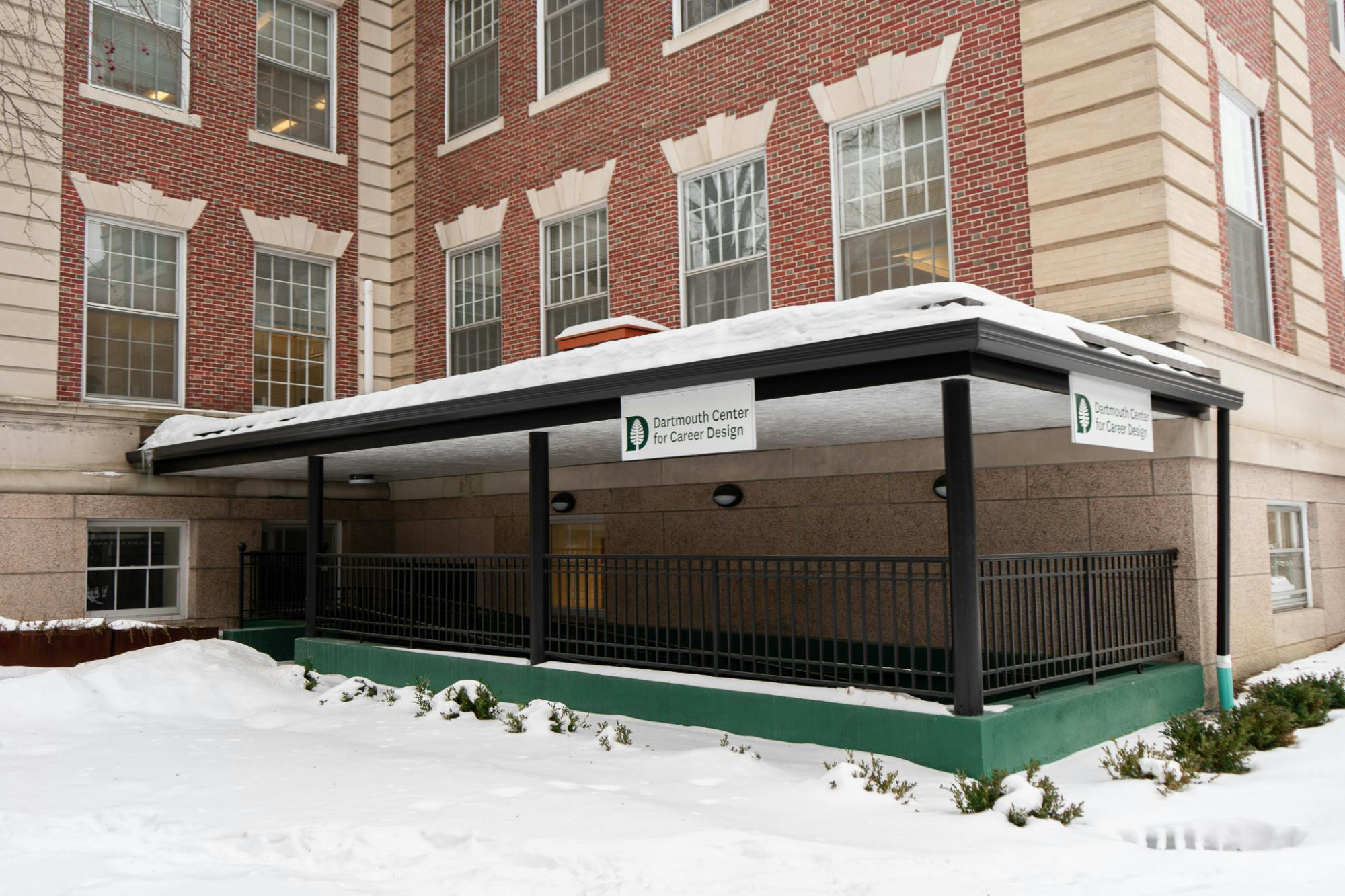
As students progress through their Dartmouth careers, the phrases “coffee chats” and “superday interviews” often grow more and more familiar. As early as sophomore year, many find themselves recruiting for summer internships that will hopefully yield return offers for their post graduate careers.
According to Dartmouth’s Center for Career Design, 26.51% of the Class of 2025 is employed in finance and 13.87% are employed in the business and management consulting fields — a total of more than 40%. While Dartmouth emphasizes its interdisciplinary majors — such as quantitative social science and human centered design — and liberal arts education, students’ post-graduation plans seem to quickly streamline into the same few paths.
CCD executive director Joseph Catrino recognized the value in entering finance and consulting careers after Dartmouth.
“It’s a path that’s really paved,” Catrino said. “There’s a lot of recruitment around it. It’s lucrative.”
Aaron Velez ’29 explained that he attended an “educational session” hosted by the Dartmouth Consulting Group — one of the many available clubs for students interested in finance and consulting — to explore available career paths.
“I went to the first Dartmouth Consulting Group educational session because a lot of people were going, and I was going to apply anyway,” Velez said.
After joining DCG and exploring different departments, Velez hopes to major in economics and pursue consulting.
“I like people and I like thinking — I think both of those are ingrained in consulting,” Velez said.
Student organizations are not the only avenues through which students end up in finance and consulting. Jack Wisdom ’26 arrived at Dartmouth planning to be a biology or engineering major. While working in a biology lab, he realized he wanted to do “a little more problem solving,” and switched to majoring in engineering modified with biology. Wisdom said he is planning to apply these skills while working on the healthcare and biotechnology team at the investment bank Oppenheimer after graduation.
While prominent and lucrative professions, Catrino said finance and consulting are not the right fit for every student, which some may not realize until later on.
“What we’re hearing is people go and do it for three years and then they go, ‘I don’t want to do this anymore,’ and they come back for coaching.” Catrino said. In those instances, “the values aren’t aligning with what they’re doing. And that’s what we’re trying to defuse early on.”
Compounding the challenge is that recruiting for investment banking and consulting begins before many Dartmouth students have even declared their majors — which they are not able to do until their fifth term.
Wisdom described frustration with the early timeline of recruiting, which required him to potentially commit to a job “a year after high school,” before he had even decided what he wanted to do.
While finance and consulting offer clear pathways, prestige and high pay, the CCD actively seeks to give students the space not only to prepare for careers, but to reflect and discover the interests and values they want to pursue at and beyond Dartmouth. During the fall of 2025, the Center for Career Design launched a reimagined approach to helping students explore their futures and create a “transformational” philosophy rather than a “transactional” one, Catrino said. He added that the approach focuses on helping students reflect on what is important to them and design their life framework around their values, strengths and motivations.
“From there, we’re coaching alongside the student and helping them try stuff so they can gather data to make informed decisions about their Dartmouth design, career design and life design,” Catrino said.
Catrino emphasized the importance of students pursuing their academic interests and obtaining a liberal arts education that will equip them with adaptable and vital human skills, especially in the face of earlier recruiting timelines.
“Build a program because you actually enjoy engaging in it,” Catrino said. “I am a firm believer in the value of a liberal arts degree, and I tell students you do not need to bridge your major to your career. It’s really digging into your values and understanding who you are.”
Wisdom’s Dartmouth experience exemplifies this philosophy.
“I still took my classes seriously and tried to really think about what I wanted to learn and then just hope and work to make the career fall in place after,” he said. “It’s getting harder to do that.”
Wisdom will continue to explore these interests after graduation. He said he appreciates that his job provides the opportunity to explore the finance and science fields while keeping doors open and allow him to pivot to other roles if he decides to.
“It serves the purpose of general experience to get you acquainted in the working world,” he said. “I get why a lot of people do [finance].”
Once students reflect on and explore their values and goals, they can explore the center’s six “career communities”: arts and creative; business; good and green, which is for students interested in non-profits, education and sustainability; government; law and policy; STEM+; and exploratory, which is for students still deciding what to do. Career communities can be joined through the CCD website and offer personalized support, workshops, alumni and employer events and more specified resources for students based on their interests.
These communities allow students to explore diverse industries within an “ecosystem of information,” said Catrino.
“Students have figured out who they are,” Catrino said. “Now, they have access to all these communities where they can dabble in different things that are aligned with the different industries.”
“[That philosophy] is a big step in getting better at helping students decide and figure out what their next step is,” Wisdom said. “It’s more of a ‘We can talk and we can build a plan to help you figure out what you want to do.”
Catrino noted that the partnership between Dartmouth alumni and the CCD has been crucial.
The alumni are “engaging with us to help students, they’re helping through mentorship, through sending us jobs and internships, they’re hosting us for career tracks in different cities, they’re financially through philanthropic endeavors donating to our center,” Catrino said.
Still, Wisdom said he believes that there are additional opportunities for Dartmouth to promote student engagement with alumni.
“People talk about the Dartmouth alumni network and how strong it is, and it absolutely is,” Wisdom said. But “if the school formalized even further the Office of Alumni Relations,” strengthening students’ abilities to reach out to alumni, students could have a better understanding of potential after-college outcomes.
According to Catrino, the aim of CCD is to help students choose careers that better align with their strengths and values.
“If we can help a student really dig in and self-actualize, really empathize with themselves and get to know themselves, you’ll be making career decisions based on who you are,” Catrino said.


