
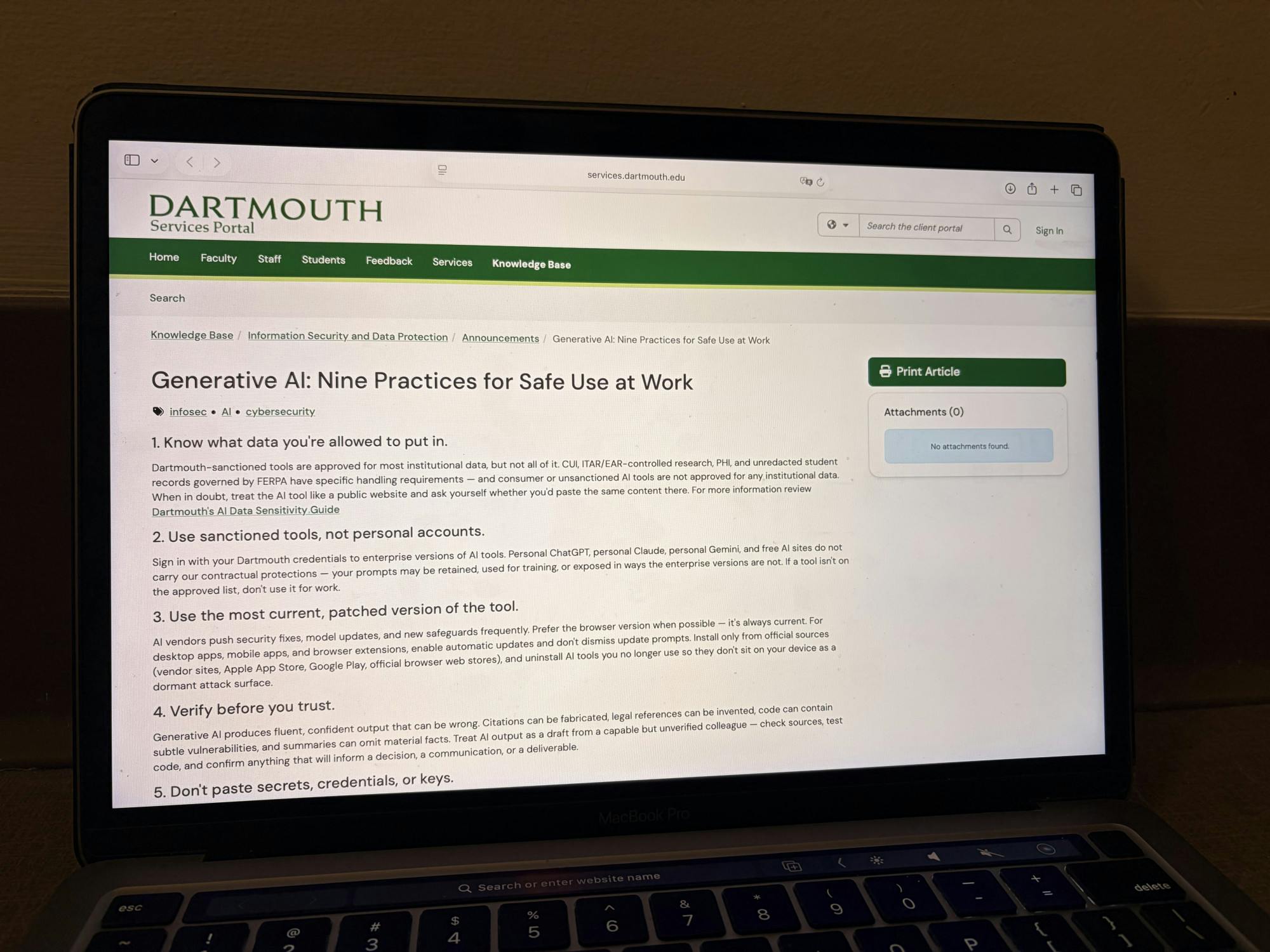
On May 6, the Information, Technology and Consulting office published an updated set of nine guidelines for workplace generative artificial intelligence use on their website. VOX Daily, the College’s official newsletter, circulated the guidelines in an email to campus on May 13, six days after The Dartmouth reported that a chemistry professor unintentionally released student information to campus through the Dartmouth Claude enterprise portal in a “test” of Claude’s grading capabilities.
The guidelines urge campus community members to “know what data you’re allowed to put in” AI chats, “keep humans in the loop for consequential decisions” and “document AI’s role in your work.” They also advise community members not to let AI “make decisions about people,” including decisions about accommodations, admissions, discipline, grading and hiring “without human review.”
“Unredacted student records governed by FERPA [the Family Educational Rights and Privacy Act] have specific handling requirements,” according to the guide. “When in doubt, treat the AI tool like a public website and ask yourself whether you’d paste the same content there.”
“Ask yourself, ‘Would I share this info with the public?’ If no, then don’t use GenAI,” VOX Daily wrote in their May 13 announcement. “Keep your friends close, keep your AI closer.”
The Dartmouth could not verify whether the sharing of identifiable student problem sets to campus through the Dartmouth Claude enterprise portal constituted a FERPA violation. Student submissions on Canvas are generally subject to FERPA regulations, according to Cornell University’s Center for Teaching Innovation.
In a statement to The Dartmouth, ITC wrote that the new guidelines “reflect ITC’s and Dartmouth’s ongoing commitment to responsible AI use.”
“These are general best practices to help Dartmouth community members use AI tools safely and effectively,” ITC wrote.
English professor James Dobson, who previously served as the Special Advisor to the Provost on Artificial Intelligence, wrote in an email statement to The Dartmouth that he thought ITC offered “generally good” advice and that he was “glad” it was being provided to campus.
“More platform-specific guidance and literacy training for faculty and staff is a clear need — evidenced by recent events that have been well covered by [The Dartmouth],” Dobson wrote.
Computer science professor and Digital Applied Learning and Innovation Lab co-founder Tim Tregubov ’11 GR ’15 — who said he built an AI system to help students “understand” AI-generated code — said it is “good” for faculty to be “transparent” about their use of AI.
“If you expect your students not to use AI, don’t then go around and grade their homework with AI,” Tregubov said. “If you uphold the standard of human cognition, apply it equally.”
ITC’s guidelines instruct the Dartmouth community to “note” when “AI materially contributes to research, code, written deliverables or analysis.”
Theo Chan ’29 — who assists students with course coding projects as a learning fellow for CS 50: Software Design and Implementation — said “every professor” he has talked to about AI usage has been “anti-AI for producing code,” while some allow students to use it for learning concepts if they are “very explicit” in how it has been used.
“Professors should hold themselves the same standard that they hold their students to,” Chan said. “If they’re expecting students to share when they use AI, I think they should too.”
A spokesperson for the College declined to comment.
Alex Klee ’29 is a reporter from Woodbridge, Conn. He plans to major in economics and minor in math. He enjoys live music, skating and climbing.


