
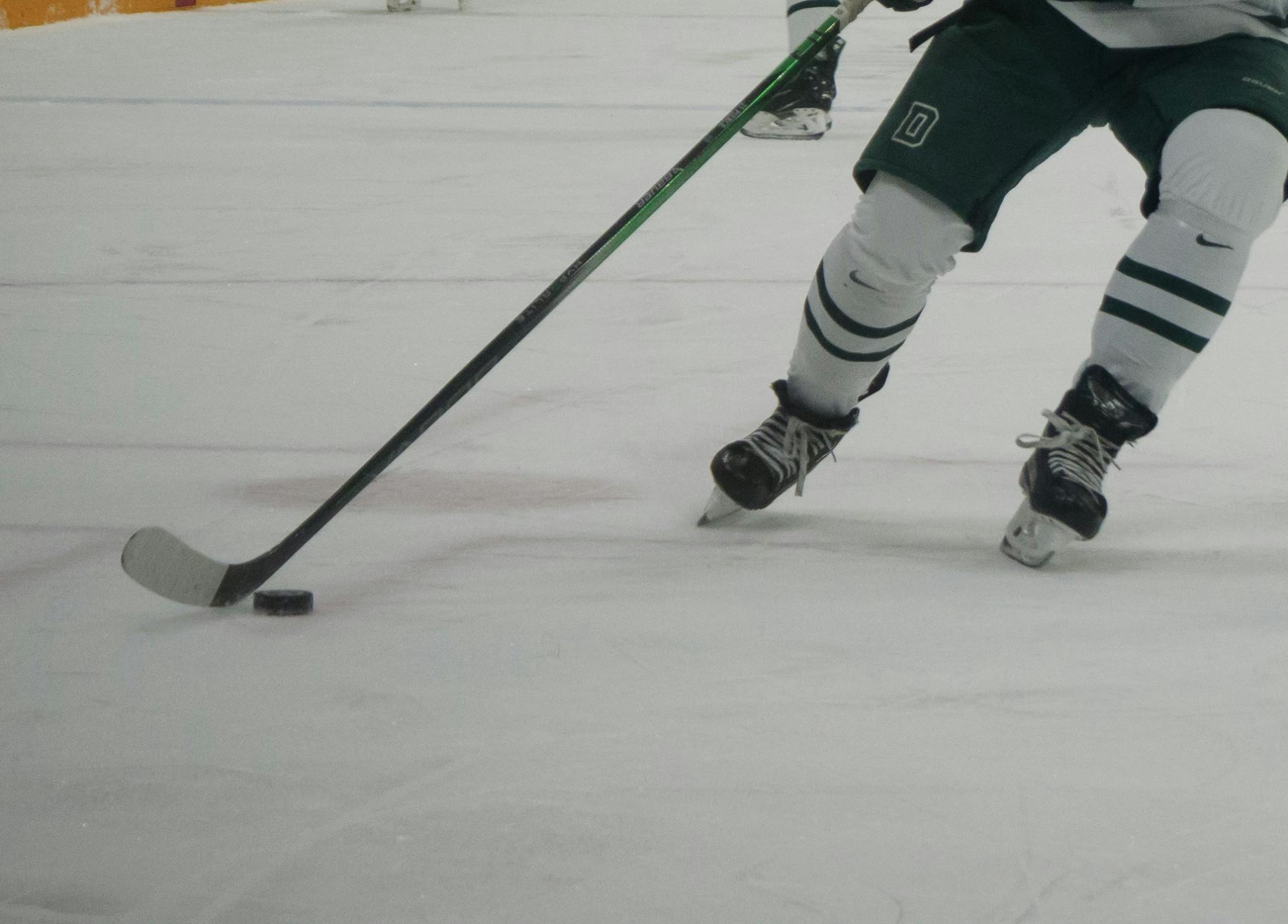
On March 21, Men’s ice hockey won the Eastern College Athletic Conference championship for the first time in program history. The win sent the team to the NCAA Division I Men’s Ice Hockey Tournament for the first time since 1980, where they ultimately lost to the University of Wisconsin-Madison in the first round but left decorated with awards.
Goalie Emmett Croteau ’28 was named the tournament’s most outstanding player. Tim Busconi ’28, who scored the winning goal; CJ Foley ’27, the 2026-27 season captain; and powerhouse forward Hayden Stavroff ’28 all joined Croteau in the All-Tournament Team. Head coach Reid Cashman also earned the Spencer Penrose Award, given to the NCAA’s top hockey coach each season.
The ECAC final against Princeton
When Foley, a defender, stepped off the bus in Lake Placid, N.Y. for the ECAC tournament, he found himself in a familiar place.
“That wasn’t most of our first times going to Lake Placid — that was my third,” Foley said.
The team’s recent experience with the tournament had been one of heartbreak, after they fell in the tournament semifinals for two consecutive seasons. That losing streak ended this year.
In this year’s ECAC final against Princeton, after holding a one goal lead for nearly the entire game, a backdoor pass zipped past Foley to find the Tigers’ Joshua Karnish, who put it away to tie the game midway through third period.
“It’s easy to get riled up when you lose momentum like that, but that’s not at all how we responded,” Foley said. “We were cool, calm and collected, and it was an exciting finish.”
When the buzzer sounded to announce the end of regulation time, the score was tied at 1-1. The final was going to overtime. Would heartbreak strike again?
Dartmouth lost closely to Princeton twice in the 2025-26 regular season and had not won a game against the Tigers since November 2024. This was a motivating factor for the team.
“I treated [the game] like every other game, but I kind of had a little bit of snarl there and did what I do best to help the team win,” Croteau said.
So when a wrist shot by Busconi sailed into the top right corner to win the ECAC in sudden death, 11 minutes and 48 seconds into overtime, the team was thrilled.
“There’s no one more deserving than Timmy [Busconi] for that,” Foley said. “He’s worked so hard in the past two years, just doing the right things when no one’s looking.”
“It was a great feeling watching that puck go in,” Stavroff, who scored the first goal in the game, said.
The journey to Lake Placid
The team’s historic ECAC tournament win put the cherry on top of the Big Green’s winningest season in program history.
“It was fun to watch [the team] win and celebrate how much work they have put in,” Cashman said.
Foley said the team’s historic season was a product of consistent effort that began before the season even started.
“From the moment practices started in the fall and in the weight room, we were looking to grow and push each other,” he explained.
Foley, who was invited to the Boston Bruins training camp summer 2025, said he brought the details and techniques he learned by playing with professionals back to D1 hockey.
“I learned little things of how to take care of your body and do a little bit of extra work that allows the body to stay healthy throughout a long season, especially towards the end when we went far in the playoffs,” Foley said. “It’s great, because I can go to these camps and come back and show some of my teammates the sorts of things that I learned.”
Foley introduced the team to various new stretches, for example, which they have incorporated into their warmup routine.
Similarly, the coaching staff had to prepare their roster. Three key upperclassmen left in the offseason, including Cooper Flinton ’26 and Luke Haymes ’26, who departed for American Hockey League. Faced with this roster turnover, Cashman had to adapt and rethink lineups.
The adjustment process “was a constant evaluation, but also a constant reminder that there’s a ton of opportunity,” Cashman said. “Our guys really embraced that and had a great fall.”
The first half of the season
Cashman and company found the right recipe for success. The team started off red-hot, winning its first 11 games, including those against top teams such as Colgate University and No. 17 Cornell.
While facing top teams is a significant moment, Croteau emphasized the importance of sticking to routine and approaching all games with the same mindset.
“Sometimes if you’re playing a big opponent and the lights seem a little brighter than usual, it can take you off your edge and change your focus a little bit,” Croteau said. “The way we approach it is we play our game and do what we do, regardless of who we’re playing.”
Foley credited the team’s winning performance to a strong work ethic and consistent habits. These are also the secret to keeping the team energized throughout the season and avoiding fatigue.
“My brain’s almost turned off during the game — I’m just relying on my habits,” Foley said. “I’ve seen these plays hundreds of times from practice.”
Foley added that the coaching staff played an important role in keeping the team motivated.
“Cash does an unbelievable job motivating us,” Foley said. “We practice so hard and the coaches are just so supportive.”
The Big Green looked to stay perfect going into the winter break with a game against the University of New Hampshire. Down 2-1 late, Dartmouth successfully tied the game with just two minutes left in regulation. But their momentum came to a halt when UNH quickly took control of overtime, rattling off five unanswered shots. The last shot, from UNH’s Brendan Fitzgerald, found the back of the net to clinch the game for the Wildcats.
“We really had the goal of being 12-0 going into the break, but we were down, I guess we had to lose at some point and it sucks that it happened,” Foley said. “I’m really happy with the way we finished the year.”
Recovering from the first significant loss
The loss against UNH was still a big blow. Even after the team returned to campus, Dartmouth couldn’t shake the loss off, dropping three out of its next four games.
“The season goes on,” Croteau said. “It was an eye-opening experience for us as a group.”
Cashman had a similar perspective on those three losses, emphasizing that many of the games were still close and that the team had to focus on the bigger picture.
“We lost to Arizona State [one day], then we beat Arizona State [the next day], which was an awesome win for us,” Cashman said. “We’re in some close games and a couple could have gone the other way, let’s go back to what’s our ultimate goal.”
The ultimate goal, Cashman said, was ensuring that the playoff games went well, which required adjustments by the team.
“There’s a lot of stuff we work on — nerdy hockey terminologies,” Croteau said. “As a group, we looked at what we needed to do on the ice and off the ice to make sure we’re putting ourselves in the best position.”
The ECAC playoffs
These adjustments made during the regular season proved useful in the playoff rounds in March when the team faced Clarkson University, Colgate and Princeton. Colgate in particular, was a memorable opponent — Cashman considered this season’s games against them as two of the team’s best because the Big Green countered Colgate’s strengths, which included disturbing opponents’ transitions and having a dynamic defense.
These moments led up to the team’s big win against Princeton, putting Dartmouth on everyone’s radar.
“I saw through the alumni networks and the love from around town and around campus — it was something special that took a long time coming,” Croteau said.
Stavroff agreed, adding that the win was important for the Dartmouth hockey community and its longtime supporters.
“[Dartmouth men’s hockey operations director] Brian Corcoran said a few words after Lake Placid and just seeing his emotion and how much he loves this program was really touching,” Stavroff said.
The win automatically sent the Big Green to the NCAA tournament, where they faced the University of Wisconsin-Madison in the first round. The Wisconsin Badgers were the 2006 national champions and have consistently remained one of the country’s top teams since.
Coming into the third period, the Big Green and the Badgers were tied 1-1. Two goals scored by the Badgers halfway through the third period forced Dartmouth to pull Croteau from the net — a move which ultimately backfired as the Badgers scored two empty-net goals at the end of the third period, resulting in a Dartmouth loss.
“When a good team plays a good team, there are opportunities for both sides, and they [Wisconsin] took advantage of those,” Croteau said.
Looking forward
With higher expectations and increased visibility, the team has a lot to look forward to next season. Cashman is particularly excited about continuing to work with the players.
“We have guys that could have left — pro contracts, NHL deals, the transfer portal — as this is pretty common in our sport right now,” Cashman said. “The fact that everybody decided to come back, I think that we just have great guys.”
Some of these returning players include Hank Cleaves ’28 and Stavroff, who were nominees for the Hobey Baker Award alongside Foley. The Hobey Baker Award is given to the top NCAA men’s ice hockey player at the end of each season. Cleaves and Stavroff also lead the team in points. Cashman credits the pair’s success to their drive to get better and their contributions to the team.
“Obviously, those two guys got great results, but they’re also extremely selfless and do a lot of things that make our team better, not just score points,” Cashman said.
Cashman added that he is confident that the team will work on getting better, and that the players and the coaches know what they need to improve. With the biggest jump usually occurring between a player’s first and second season, Cashman is excited to see how current freshmen will elevate themselves and the team.
The players themselves are committed to bringing a higher standard next season. In their off-season, they are already hitting the weight room, where they “push each other really hard,” Foley said.
This accountability was critical during the past season, and Foley said heexpects the same from the team next year,adding that Colin Grable ’28 is one to watch.
Grable “has a great story because he was in and out of the lineup his first year, and then he was in every game playing 20 plus minutes a night this year,” Foley said. “He just continues to grow as a person on and off the ice.”
That motivation across the team excites Cashman, who said the coaching staff also has homework to do before next season.
“That hunger, that desire, that cohesiveness of wanting to be a part of Dartmouth hockey is what I’m most excited about,” Cashman said.


