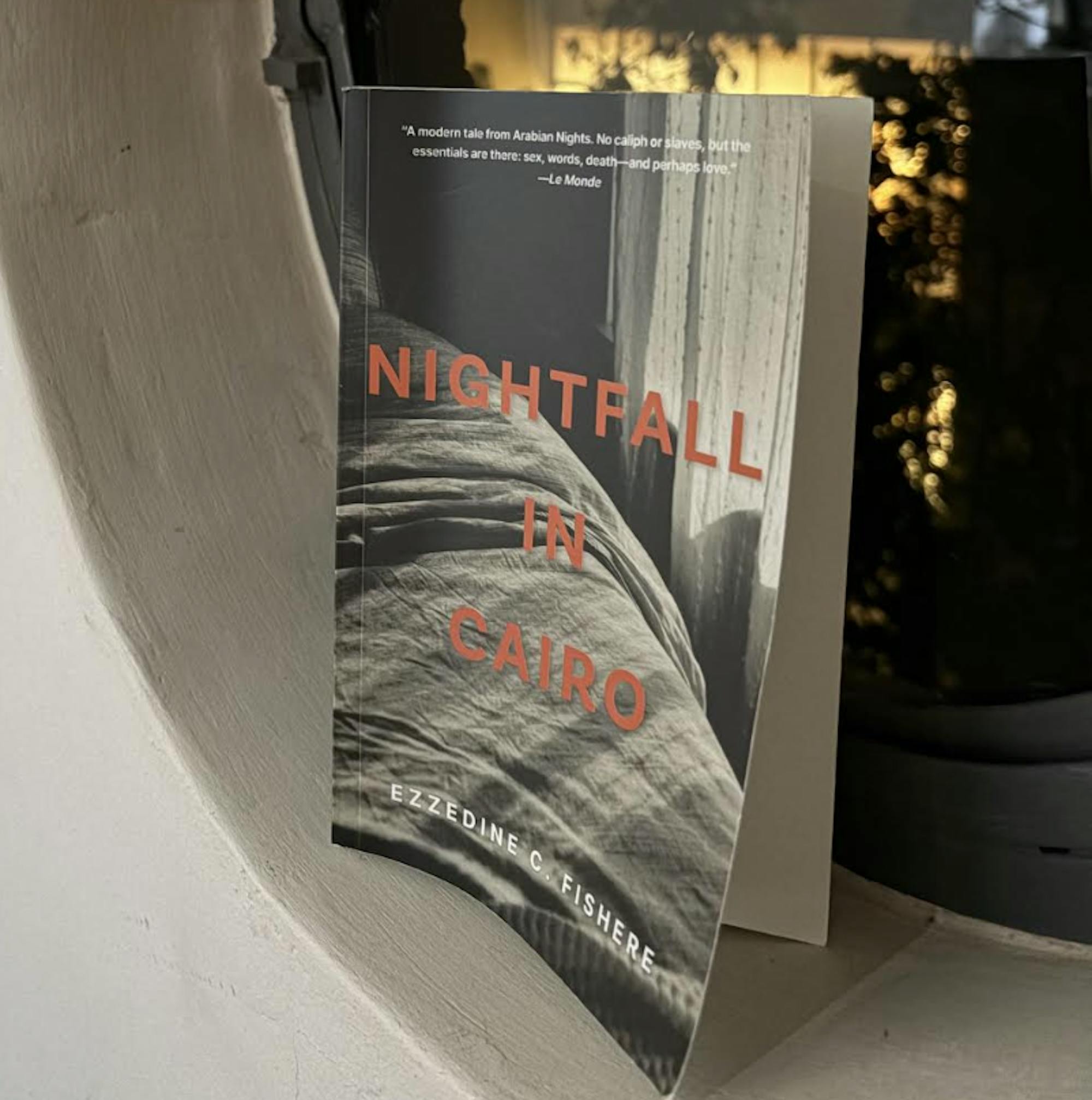
In March, distinguished fellow Ezzedine Fishere published the English translation of his 2017 Arabic-language novel “Nightfall in Cairo.” Fishere worked with editor Sharidan Russell ’18 on the release, which was published by Commonsense House.
One of Fishere’s five novels to date, “Nightfall in Cairo” draws on his personal involvement in the 2011 Tahrir uprising as an Egyptian diplomat and “deliberate” research about the events recounted in the novel, Fishere said in an interview with The Dartmouth.
His work and experience in Egyptian politics have undoubtedly informed his writing as a novelist. Nonetheless, Fishere said he opposes any simplistic conflation of his work, which he associates more with his “identity,” with his work in diplomacy and academia. In contrast to the “constraints” he faces in those other areas, Fishere explained that “for a long time, [novel writing] has been the main outlet for freedom and creativity in my life.”
“Nightfall in Cairo” unfolds over 36 hours in a Cairo apartment at the time of the novel’s original publication date in 2017. Resembling the frame story of “One Thousand and One Nights,” the novel mainly consists of a monologue by Omar, a young Egyptian taxi driver and Islamic fundamentalist-turned-disillusioned atheist. He tells these stories to Amal, an Egyptian-American lawyer awaiting forced departure to the United States, as the two spend a farewell night together in her apartment.
Imprisoned for her activist work following the revolution, Amal awaits her so-called extradition to the United States as a condition of her release and renunciation of Egyptian citizenship, so that American authorities can then release her. When Amal asks Omar to stay with her after a farewell party held in her honor, he agrees, recounting stories about his and his friends’ lives during the uprising.
However, Amal is an “active listener,” interrupting Omar’s stories to point out the biases in his narration and at times tell her own hypothetical version of events or outcomes, Fishere noted. Their “political and existential disagreements,” he explained, are colored by their different dispositions — to “simplify it,” Amal’s “determination” versus Omar’s “resignation.”
Fishere emphasized that his knowledge of these differences in perspective on historical events did not come from “some academic training,” but rather rooted in his lived experience during the Tahrir uprising. He further linked this awareness to his general “hatred” of the “omniscient voice,” explaining that “it’s simply because I hate authority.”
“I think it’s too pretentious for a writer to be like, ‘I’m gonna tell you what really happened’ — because all we have are perspectives,” Fishere said.
Fishere said his decision to translate the novel into English was “purely selfish” rather than motivated by any external factor. He said he had “read the translated versions of [his] other novels” and sometimes thought, “‘This is not how I want to say it.’”
Consequently, when he had a “window of time,” Fishere decided to take on the project, recruiting an editor because he is not a native English speaker. He found one in Russell, who took Fishere’s Arabic fiction course at Dartmouth and is currently pursuing her Ph.D. in Modern Arabic Literature at the University of Chicago.
Russell explained that, according to her discussion with Fishere, her role was to make the translation “as natural as possible in English.” As a result, Russell had to strike a balance between experimenting with some “freedom” to “play with the wording of different things” and still “preserv[ing] the characters and their voices,” she said.
For his part, Fishere described the “pleasure” of being able to “see the flows of the language that you used” and practice a “different” kind of editing in the translation process, calling it a “second chance at writing.”
Middle Eastern studies senior lecturer Jamila Chahboun noted that novels translated from Arabic to English are a “well-established genre” and emphasized the power of translation to English to gain a “bigger,” more “international” audience.
Chahboun underscored that, compared to news coverage of events as “harrowing” and “contested” as those from the Egyptian revolution — in the words of Russell and Fishere, respectively — the detail provided by literary accounts can actually make them feel “more plausible and more credible.”
As a result, she said a novel like “Nightfall in Cairo,” which “provides a really good window to understand[ing] the recent history and the uprising in Egypt,” has value “for any human being.”
Fishere said the idea of an audience for his novels has been a “crisis” for him. He explained that although he believes he once “had in mind a hypothetical average Arab reader who’s like a mini me,” he “[doesn't] know who this hypothetical reader is anymore” after living in the U.S. for almost 10 ten years.
As suspected reasons for this shift, he cited his “being in exile” after leaving Egypt for the U.S. and the current “polarization” of Middle Eastern societies. While writing in Arabic now, he added, “it feels like by the end of the draft or of the book, everybody would be gone who started reading it.”
Fishere said this sentiment has led him to consider that “maybe it’s time that I transition to a hypothetical global reader that’s not tied to a place or a language.” He added that “the translation is part of that story.”
From a literary criticism perspective, Chahboun emphasized how everyone will read a novel from their own “lenses.” For instance, she said her identity as a Moroccan caused her to see the stories in “Nightfall in Cairo” in relation to the Egyptian Arab Spring’s real effects on and resonance with Moroccan society today.
She sees Omar not just as a novel character, but as a representative for countless contemporary young Arabs whose “despair” comes in part from painful and disillusioning experiences from the Arab Spring and its legacy.
Still, Chahboun underscored that while literature can “encompass” a “sea” of human experience and emotion and is “much needed” because of that, it is always inherently subject to “different perspectives” and “interpretations.” In that way, translation happens not just between languages, but also between novels and their readers.
Fishere said he has “always been much more modest” about any takeaways he would hope for from his novels.
“I never know what people keep or not keep, or how they read ... but then, it’s not my place to tell people how to read,” Fishere said.
Avery Lin ’27 is an arts editor and writer from New York City. She studies Comparative Literature, including French and Classical Greek, at Dartmouth and also writes for Spare Rib Magazine.