
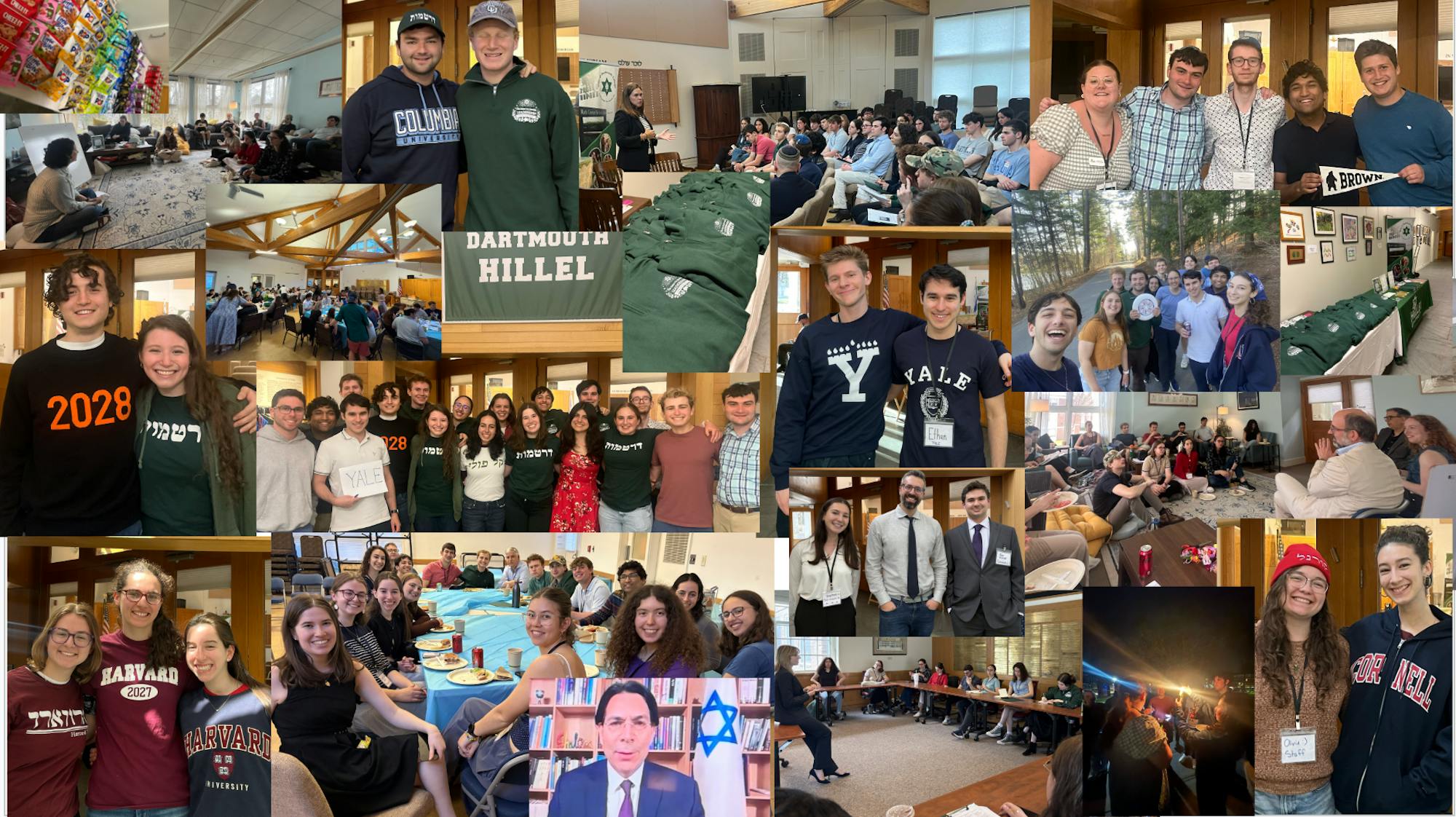
From April 16 to April 19, Hillel at Dartmouth hosted the inaugural Ivy Jewish Leadership Conference at the College, according to conference board executive director Darci Rochkind ’28. Approximately 85 Jewish students — including 25 non-Dartmouth students, representing six of the seven other Ivy League institutions — attended the conference, which focused on “conversation” and community between Jewish students from different institutions, experiences and perspectives, Rochkind said.
Invited guests and event speakers included College President Sian Leah Beilock, Dartmouth Dialogues executive director Kristi Clemens, Israeli ambassador to the United Nations Danny Danon, Dartmouth distinguished fellow Ezzedine Fishere, Chabad Rabbi Moshe Leib Gray, Hillel International Campus Climate Initiative education director Mara Lee Grayson, journalist Ezra Klein, Hollywood director and World Zionist Organization youth department head Rob Kurtz, Hillel at Dartmouth executive director Rabbi Seth Linfield, White House special assistant to the President on Jewish engagement Martin Marks, Rochkind, Middle Eastern Studies professor Jonathan Smolin and Jerusalem Center for Security and Foreign Affairs research and diplomacy fellow Sabrina Soffer, according to a conference schedule that was shared with The Dartmouth
“I am proud of the work our students did to bring this first-ever conference to Dartmouth,” Beilock wrote in an email statement to The Dartmouth.
Linfield said in an interview with The Dartmouth that Dartmouth students “drove every aspect” of the conference’s planning and organization.
“This conference reflected a model of education where students are active architects of community,” Linfield said. “This is just another example that when we trust students with real responsibility, they cultivate ownership and purpose.”
Rochkind added that the conference took “over a year” to plan, starting last spring with the goal of “bringing everyone to Dartmouth” from across the Ivy League.
“As we were working on the conference and I got more students involved, it morphed over time into conversations about anti-Semitism and the urgency of Jewish life on campus,” Rochkind explained. “It took a whole city.”
Conference board executive director of student life Shira Perler ’29 said she matched students from other schools with Dartmouth hosts and organized events for students to “decompress” during the conference. Rochkind said she wanted the conference to “feel super personable” and for visiting students to “feel a part of our community.” In addition to events and religious services, attendees from other colleges “adjusted to Dartmouth culture” by engaging with campus activities such as playing frisbee on the Green, playing board games and hiking at sunrise to Gile Mountain Fire Tower on Sunday morning.
“It’s also important for everyone to decompress a little bit and get to know each other — you’re trying to bond as a cohort,” Perler said. “Honestly, one of the most meaningful things from the conference was the interactions with people from other schools.”
Soffer, who was invited to speak at the event titled “Two Jews, Three Opinions: Leadership After Oct. 7” on April 18, said the event was “about having unity, not uniformity.”
“Even though we may have theological and political differences, we can agree that there’s something that must be done,” Soffer said. “From that starting point of having a unified goal in mind, we can start moving forward toward pioneer solutions together and using our different opinions and different perspectives to enrich that goal.”
Clemens, who spoke at the “Welcome Chat and Breakfast” on April 17 and facilitated student conversations following “Hillel and Chabad in Conversation” on April 18, said she saw “how the group had come together” between the first and second days of the conference.
It was “really amazing to see the camaraderie, to see the jokes, to see in that facilitated conversation on Saturday afternoon, to see them challenging each other, disagreeing respectfully, but still walking out of that room really feeling like that they had formed a cohort and formed some great relationships that will last beyond just the weekend,” she added.
Gray, who was invited to speak with Linfield at “Hillel and Chabad in Conversation” on April 18, said the event sought to address potential “preconceived notions” about the organizations being mutually exclusive.
“Hillel and Chabad are different organizations … but we help each other,” Gray said. “Being able to convey that to students gives them permission to think broader and to collaborate on their own campuses and beyond.”
Gray added that it has been “certainly challenging” for Jewish students in the Ivy League in the last two-and-a-half years, and that the conference helped students “come together” and “share experiences.
Yale University junior Aiden Hall said in an interview after the conference that the many “discussions” he took part in over the course of the weekend “struck” him.
“It wasn’t an echo chamber,” Hall said. “There was real disagreement, there was real engagement and it was the kind of space that’s frankly rarer than it should be.”
Columbia University junior Noah Lederman said the conference helped overcome the “disconnect” he previously felt with other Ivy League institutions.
“It’s nice to now know that I have two or three new friends and the other Ivy League universities,” he said.
Samuel Korff ’27, who attended the conference, said he looked forward to attending next year and for returning attendees to build “lifelong friendships.”
“I hope that [attendees] are able to attend year after year and build longstanding relationships … with these Jews from these other schools,” Korff said. “Those connections help us advocate for each other and help us be better leaders.”
“As the younger generation, we were all just so nuanced,” Rochkind said. “We have this very diverse understanding of Judaism and the different cultures. Because of that, we were able to have amazing conversations, and I think we just had a much more pluralistic view of what Judaism is.”
Sahil Gandhi ’29 is a reporter from Staten Island, N.Y., and is majoring in environmental studies and government modified with philosophy and economics. He loves word searches and falling down internet and Wikipedia rabbit holes.


