
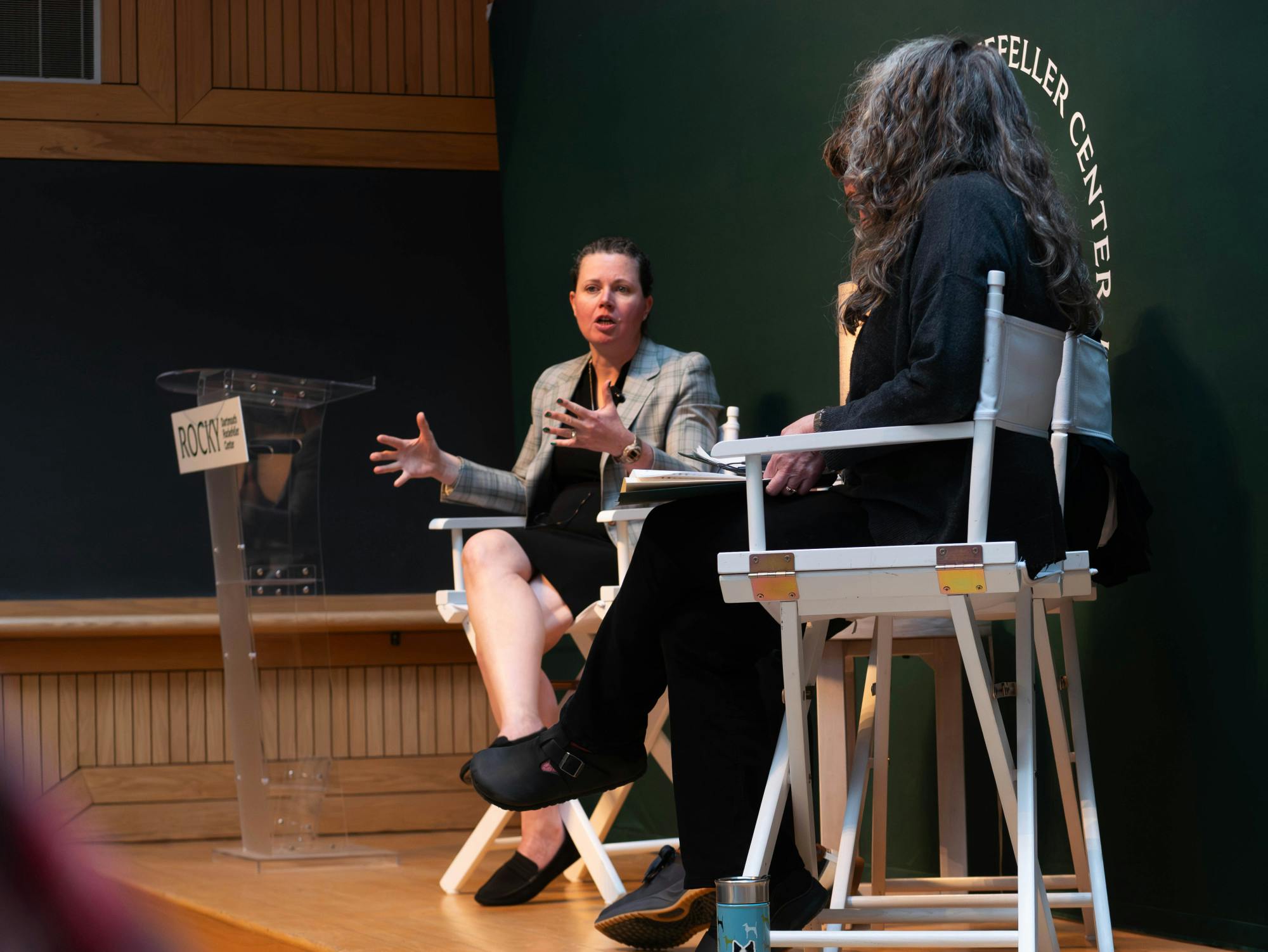
Magistrate Judge Beth Jantz ’99, who sits for the Northern District of Illinois, called for a move away from an “incarceration model” in criminal justice and towards a “treatment and rehabilitation model” instead during an event hosted by the Rockefeller Center for Public Policy on April 2.
As a judge, Jantz is a member of the Sentencing Options that Achieve Results Program, a pre-trial diversion program for criminal defendants charged with felonies in Chicago. The program provides an alternative to incarceration “through a creative blend of treatment, sanctions and incentives to effectively address adverse behavior,” according to the U.S. Pretrial Services for the Northern District of Illinois website.
Participants attend programming and treatment for 18 to 24 months, and at the end have either “the dismissal of all charges, the reduction of charges to a misdemeanor or a felony adjudication that does not [incarceration],” according to Pretrial Services.
Approximately 90 people attended the Rockefeller Center event in Hinman Forum and 100 people watched virtually, according to Rockefeller Center associate director for public programs and special events Dvora Greenberg Koelling. (Will integrate photos in later)

During the event, which was moderated by public policy professor Julie Kalish and Jantz’s former court intern JJ Dega ’26, Jantz said she believes that rehabilitation programs should be used instead of incarceration more often because incarceration is “not good for the people” and costly. However, the shift would require a concerted effort.
“We would have to decide on a larger scale that we’re going to take money out of the incarceration system and put it in the [substance abuse and mental health] treatment system and have more folks participate in those kinds of programs,” Jantz explained.
She added that because it is “very costly” to incarcerate people, there is a “dollars-and-cents case” for programs like SOAR. In the federal system, a year of incarceration for one person in a Bureau of Prisons or non-Bureau facility costs about $44,090, according to a report published by the Bureau in 2024.

While there are people who are dangerous and should be incarcerated for public safety reasons, “most people don’t need that,” Jantz said.
Instead, Jantz described how a model of restorative justice, in which victims and perpetrators “sit down together,” can “open up the eyes of the perpetrator” and be “healing” for the victims.
She added that restorative justice is “particularly good for young people” because it can get them “back on the right path before they have too much of a record.”
However, the pivot to restorative justice would be an uphill battle.
“It’s a really beautiful model, but it’s very resource-intensive, and so people really have to make a decision that we’re really going to change what we’ve been doing for hundreds of years to very different models,” Jantz said.

Attendee Ikenna Nwafor ’27 asked Jantz about her experience with “opposition from colleagues” and how to work with others who “have the same end goal, but a different idea of how to get there.”
Jantz said that she “is not adverse to the other viewpoint” and “understands” those opposed to programs like SOAR, but that “the results speak for themselves.”

Attendee Jazmyne Ybarra ’29 said she found Jantz’s experience moving from the private sector — where she began her career as a private attorney for Sidley Austin LLP — to public defense was “really interesting” because it shows that people can “do both.”
“It seems like you can only be a public defender, or you can only go into big law,” Ybarra said. “But it opens a lot of doors if you go to the private big law firms first, and then you can go into more emotionally fulfilling work.”
Eliza Dorton '29 is a reporter from Washington, D.C. and is studying English and public policy. Outside the classroom, she enjoys reading and going on walks.


