
On April 8, 14 community members attended the Hood Museum of Art’s Hood Highlights Tour inspired by Hank Willis Thomas’s neon sign in the Kaish Gallery. The sign reads, “Remember Me” — two words taken from a note written about a century ago on the back of a postcard with a portrait of an African American man. The postcard was found in an archive, and depicts the man wearing clothes that are a testimony to his wartime experience. Thomas was moved by the found text.
The Hood Highlights Tour is a series of distinct events each focused on a different theme and led by different docents, staff members and Dartmouth student interns. The goal is to give visitors “a breadth of perspective about what’s available at the Hood, so getting people to a bunch of different exhibits, looking at different kinds of art, seeing different time periods,” explained Margaret Caldwell, a docent at the museum. “It’s in the hands of the docent to design what they would like to talk about on that day.”
These tours offer an opportunity for people to explore and get people across the “threshold” of visiting the museum and feeling comfortable engaging with art, Caldwell added. The tours also offer community members a chance to explore the museum’s curations, which are free to the public, she said.
Guides use the “learning to look” method developed at the museum in collaboration with local teachers, Hood assistant curator of education Brooke Friday said in an interview with The Dartmouth. In it, the docent asks visitors a probing question about what ideas the artwork evokes before sharing any information with them.
The approach helps visitors consider what they are looking at before the docent adds context that helps form “new connections and ideas” among group members before they end with “kind of personal experiences,” Friday explained. It is “really grounded in… really providing people with the skills to really look closely and feel comfortable… engaging with art on their own, regardless of their background.”
Caldwell added that the process “invites people to have their own original interpretation or their own original idea.”
Friday said she wants highlights tours to “foster critical conversations,” especially during what she called a “divisive time in American history.” The Hood currently displays many exhibits considering the United States’ 250th anniversary, including Nurturing Nationhood: Artistic Constructions of America and Revolution Reconsidered History, Myth, and Propaganda. Friday said she hopes the highlights tours can “invite folks regardless of their viewpoints to have a conversation together about those topics through the art on the wall.”
Robin Ahrens ’82, who led Wednesday’s tour, said the “Remember Me” sign and story inspired the tour.
Ahrens said that the story “resonates so strongly” because it is not about “who I am or what I was or where I lived, but just, ‘Please: Remember me.’”
“That sparked the theme [of the tours], and then I just wanted people to experience different galleries, different artworks, all the different exhibits we have on,” she explained.
The first stop on Wednesday’s tour was a bronze sculpture inspired by artist Michael Naranjo’s memory of combat in the Vietnam War. The sculpture, titled “He’s My Brother,” reflects the artist’s memory of combat in the Vietnam War. After losing his sight and right hand while serving in the Vietnam War, Naranjo began working with clay, shaping figures and sculptures from what Ahrens described as “tactile memory.” She added that the Hood purchased the work in 2022 in memory of former Dartmouth president James Wright, a Marine Corps veteran who collaborated with senators to develop the Yellow Ribbon Program to help veterans pay for education. In that sense, “He’s My Brother” is both an artwork shaped by memory and a memorial to a leader in the Dartmouth community, Ahrens explained.
Rhonda Willies, a visitor on the tour, described this piece as “emotional” Her husband Doug Willies said it demonstrated to him the “futility of war.” He commented, “Sending people off to be maimed and die, for what?”
The tour continued to the Lathrop Gallery, where a large painting by Nebraska artist Edward Joseph Ruscha, “Standard Station, Amarillo, Texas,” greeted visitors. The painting’s heavy use of primary color and advertisement-like feel responded to the abstract expressionism movement, evoking for a handful of visitors the nostalgia of pop art, the ’60s and commercial culture.
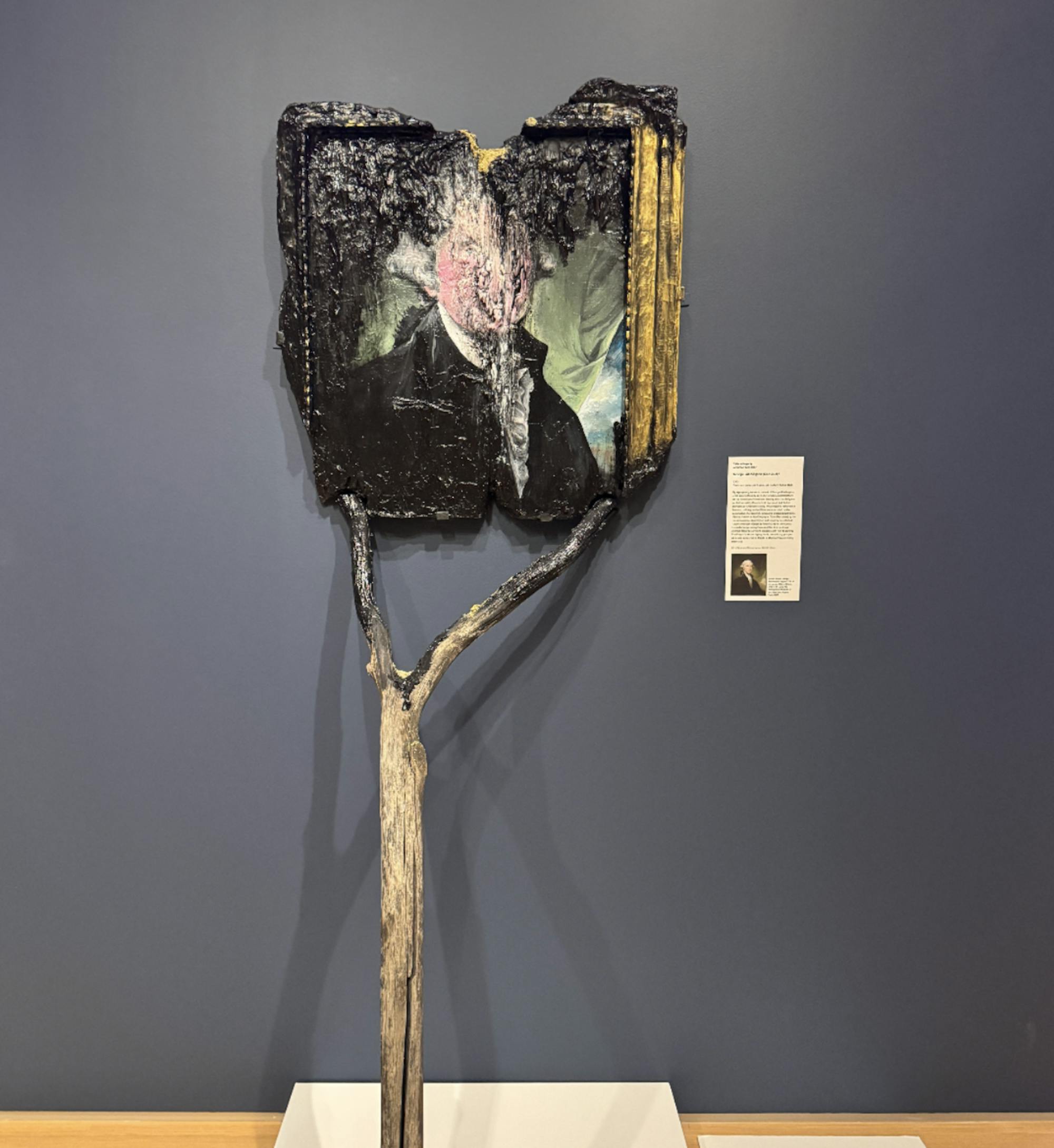
In the Cheatham Gallery, visitors were asked to consider “George Washington on a Stick” by New York City-based artist Valerie Hegarty. The work combines foamcore, paper, paint, glue, gel medium and a forked stick, with foamcore used for the top portion and an actual stick forming the bottom. Hegarty transforms the quintessential portrait of George Washington into a dissolving, melted frame that collapses in on itself. The disfigured portrait serves as a commentary on the incomplete and often sanitized story told about Washington’s past.
Ahrens said the piece “challenges something that’s so embedded into our memory” because “we all have such powerful visual memories of Washington.” When prompted to describe what the image evoked — part of the “learning to look” method — visitors contemplated Washington’s past, especially his ownership of over 500 enslaved individuals throughout his lifetime.
When approaching potentially controversial issues, Ahrens said she anchors herself in asking the audience questions to create “a well-rounded discussion on the artworks.”
“We want all voices to be heard,” Ahrens emphasized.
Caldwell described this sort of discussion as a “careful process.” The piece forces the viewer to “ask some questions about your own assumptions about Washington,” and disrupts the viewer’s automatic understanding of him as a familiar historical figure.
In the Rush Gallery, the visitors considered the idea of “nationhood” and how people, places and ideas are divided. “New Hampshire (White Mountain Landscape)” by French artist Régis François Gignoux is an illustration of an imaginary landscape of the state’s mountain ranges. The romantic painting, made in about 1864, evoked strong feelings of awe, wonder and expansiveness.
Tim Rieser ’76, a visitor on the tour, observed that “although it doesn’t depict an actual scene,” the painting is “a beautiful portrayal of the wilderness and the mountains and what life was like 150 years ago.”
Next on Ahrens’s tour were plaster casts of Abraham Lincoln’s hands. Before he became president, Lincoln was asked by American sculptor Leonard Volk to preserve his hands. Volk created the casts because, according to Ahrens, he believed hands had the power to capture history. The Hood’s curators placed them at the height they would rest if Lincoln were standing.
Just as many many influences shape a shared identity, they likewise shape how the museum engages with its visitors.
“We want visitors to realize that the Hood is for everyone,” Ahrens said. “There’s so many voices within the building itself… [each piece of art] relates to a community, a culture, a color, a shape. I think that, to me, what I really want to convey is: Listen, and look, and share.”
Correction (April 19, 2026, 1:00 p.m.): This article has been updated to include information provided by the Communications Coordinator at the Hood Museum. The article now reflects that Hood Highlights Tours may be led by docents, staff members and Dartmouth student interns; that Ed Ruscha’s “Standard Station, Amarillo, Texas” evokes the 1960s rather than the 1970s; and that Valerie Hegarty’s “George Washington on a Stick” is made with foamcore only in its top portion, while the bottom portion is an actual forked stick.

