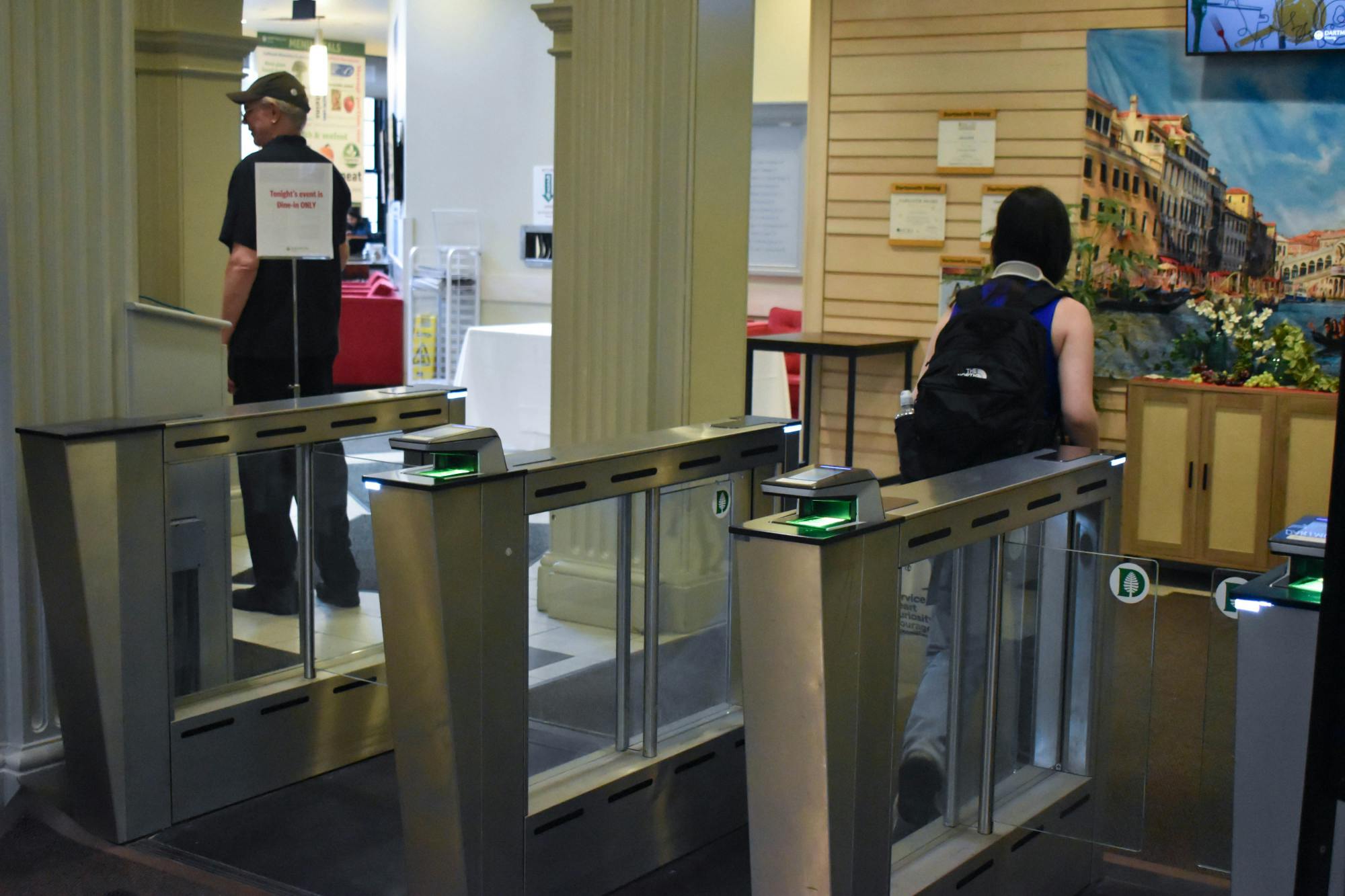
In April 2024, Dartmouth Dining implemented biometric hand scanners at the Class of 1953 Commons and self-order kiosks at Courtyard Cafe. One year later, the technology has become part of daily life at Dartmouth. Lines still form at ’53 Commons, where some students swipe in manually as others skip the line using the biometric hand scanners. At Courtyard Cafe, students line up behind kiosks to place orders, occasionally pausing when screens freeze or break down. However, student concerns about data privacy persist, even a year later.
Dartmouth Dining introduced the technologies as part of an effort to streamline service and improve efficiency. Dartmouth Dining director Jon Plodzik wrote in an email statement that long lines to enter ’53 Commons have “almost fully [been] eliminated” by the hand scanners, with roughly 75% of diners are enrolled in the system.
Courtyard Cafe now averages over 200 transactions per hour, with multiple ordering points allowing students to bypass traditional lines, according to Plodzik.
Students expressed a range of perspectives on the new systems.
Noah Sams ’29 said the hand scanners at the ’53 Commons are “convenient,” and Eidur Baldvinsson ’28 said the scanners have removed the long lines he remembered from his first year.
Others, however, expressed privacy concerns. Thuan Tran ’24 said he chose not to enroll in the system and prefers to swipe his card instead.
“Something about them scanning my body parts just doesn’t sit right,” Tran explained. “I know they talk a lot about how they don’t store your biometric information and all that, but I don’t know, I don’t believe it.”
Maggie Cabot ’29 said she had heard concerns about “the company running the hand scanners … stealing all our information.”
Plodzik wrote that “no data that is traceable to an individual” is being “retained” by the College or “any data base.”
“A numeric random number is created based on the enrollment scan and no scan is retained,” he explained. “Thus, it is not reversible to a person’s hand.”

Tran said that he likes Courtyard Cafe kiosks, though.
“I think the touch screens are efficient and the system is very streamlined,” he said.
Plodzik acknowledged that while some community members miss the interpersonal aspects of pre-kiosk dining at Courtyard Cafe, staff have been reallocated to focus on food preparation and service.
“Staff are still with us; they are just now focused on delivering you what you want efficiently,” he wrote.
In September, human staff returned to cashiers at the Courtyard Cafe to supplement kiosks following renovations to the Hopkins Center for the Arts.
Looking ahead, Dartmouth Dining plans to expand its use of technology across campus. Plodzik said the department is exploring improvements to mobile ordering and concessions systems, as well as applications of artificial intelligence technology.
“We have opportunities to improve,” Plodzik said. “We also have a great deal of interest in continuing to expand our use of AI technologies and equipment to put more food items and information closer to where people are.”