
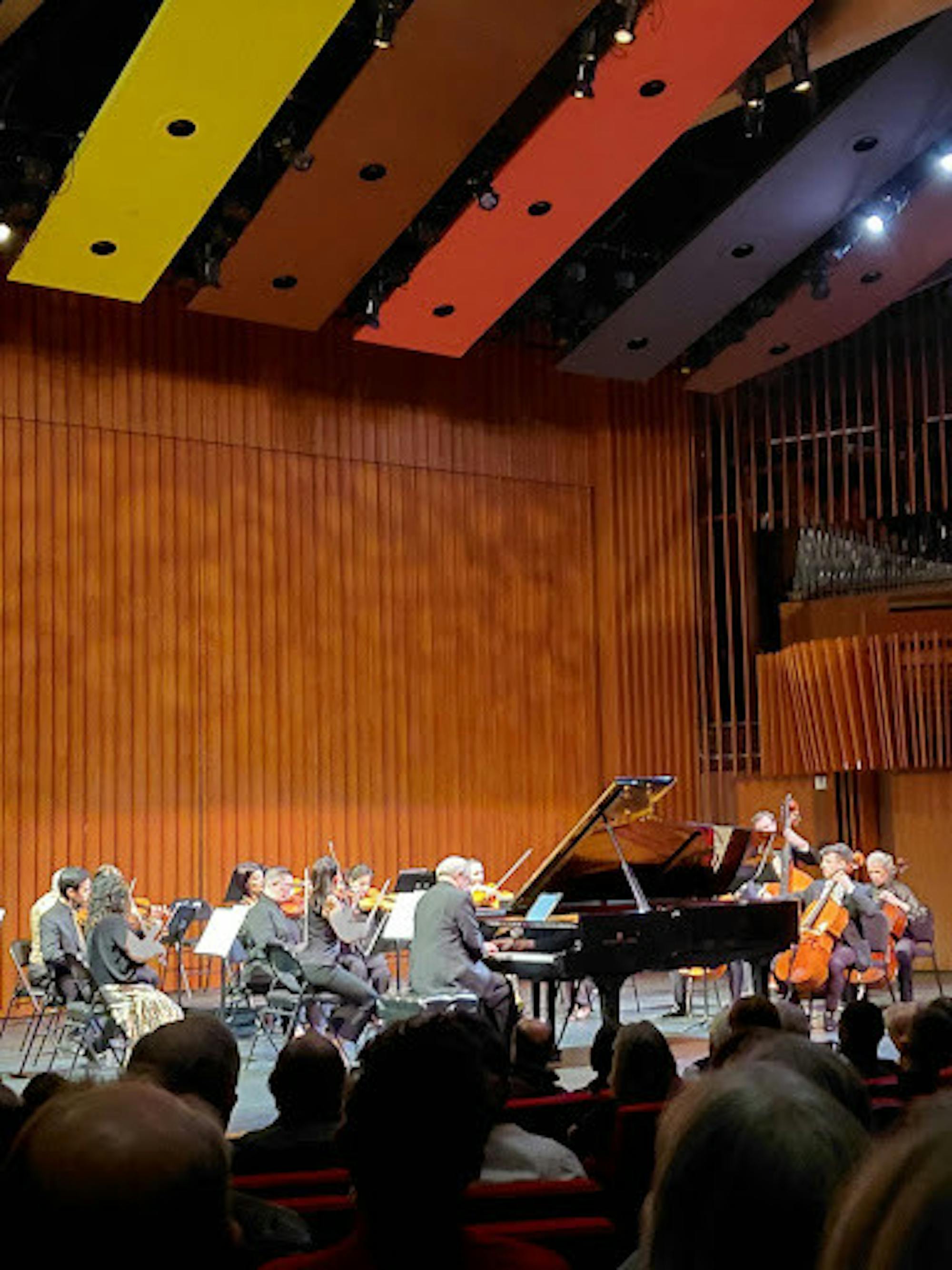
The Hopkins Center for the Arts hosted the Grammy Award-winning Orpheus Chamber Orchestra and the globally acclaimed pianist Marc-André Hamelin on Feb. 4 for a performance of a physically challenging, emotionally-charged lineup featuring recently commissioned and contemporary orchestrations of classic scores from Beethoven, Liszt and Schubert.
Specifically, the orchestra and Hamelin delivered performances of orchestrations, recently commissioned by Orpheus Chamber Orchestra, of Beethoven’s “Allegretto from Piano Sonata No. 17” and “The Tempest” as well as Liszt’s “Wanderer Fantasy, Op. 15” by Zachary Wadsworth and Sahun Sam Hong respectively. There were also performances of Hamelin’s piece “Passacaglia” for piano and strings and Heribert Breuer’s 2006 orchestration of Schubert’s “Chamber Symphony in B-flat Major.”
Since its 1972 inception as a “radical experiment in musical democracy,” according to its website, the Orpheus Chamber Orchestra has performed music without a conductor. Instead, operating with a communal and collaborative ethos in contrast to symphony orchestras’ traditional “corporate” nature, the group plans and performs concerts with rotating leadership roles while relying on mutual trust between the musicians and partnerships with guest artists such as Hamelin, according to its website.
Karen Henderson, the Hop’s program manager, said it was exciting for the Hop to have such a “big name” as Hamelin in concert alongside the orchestra.
Henderson described the concert as particularly “engaging” for audience members due to its small size of around 30 members — significantly fewer than a typical symphony orchestra.
“You see each member; you are not [just] looking at this huge symphony,” Henderson said. As a result, Henderson called it “the kind of experience where you are more immersed as an audience member.”
Pianist Scipio Han ’29 called the concert “captivating.” Speaking to the unique experience of live versus recorded music, he described how the Hop’s programs such as this one have powerfully given him his first opportunity to “see professional musicians perform in real time.”
“Seeing a performance online is one thing, but seeing musicians perform live and witnessing the passion and energy they have is truly an interaction that cannot be recreated,” Han said.
Cellist and Dartmouth Chamber Orchestra member Siena Bush ’29 noted her appreciation for the diversity of musical “backgrounds” and “genres” presented in the concert.
“This performance brings together [musicians] from different musical backgrounds, and I really liked how the orchestra brought together different genres,” Bush said.
Bush also noted her appreciation for the stylistic diversity among the pieces.
“Beethoven’s ‘The Allegreto’ is a constrained piece and ‘The Tempest’ is a tumultuous piece; they did a very good job combining those together,” Bush said.
Pianist and Dartmouth Chamber Orchestra member Jake Keil ’29 said the first Beethoven number, the “Allegretto,” “really stood out” to him.
“This will be a long-time memory,” Keil said. “It made me inspired to continue pursuing music.”
Meanwhile, Han said Hamelin’s piano performance and the orchestra members’ “communication” was “inspiring.”
“Seeing the way [Hamelin] runs chords and jumps across the keys gives me visions [that] I can remember the next time I am practicing piano, and feeling so close yet so far to getting something down,” Han reflected.
“The strong communication between members of the orchestra — not to mention without a conductor — was another inspiring sight,” he added.
Henderson reflected on how the Orpheus Chamber Orchestra represents a powerful model for an orchestral group which, in part due to its collaborative spirit, delivers particularly “engaging and heartfelt” performances.
“All of the musicians are really incredible. They are drawn from all the top tier orchestras to play in this ensemble,” Henderson said.
Henderson also described her admiration for the group’s work ethic.
“Their time together is limited — so they work really hard in a short amount of time to produce these programs together and create that sound,” Henderson said.


