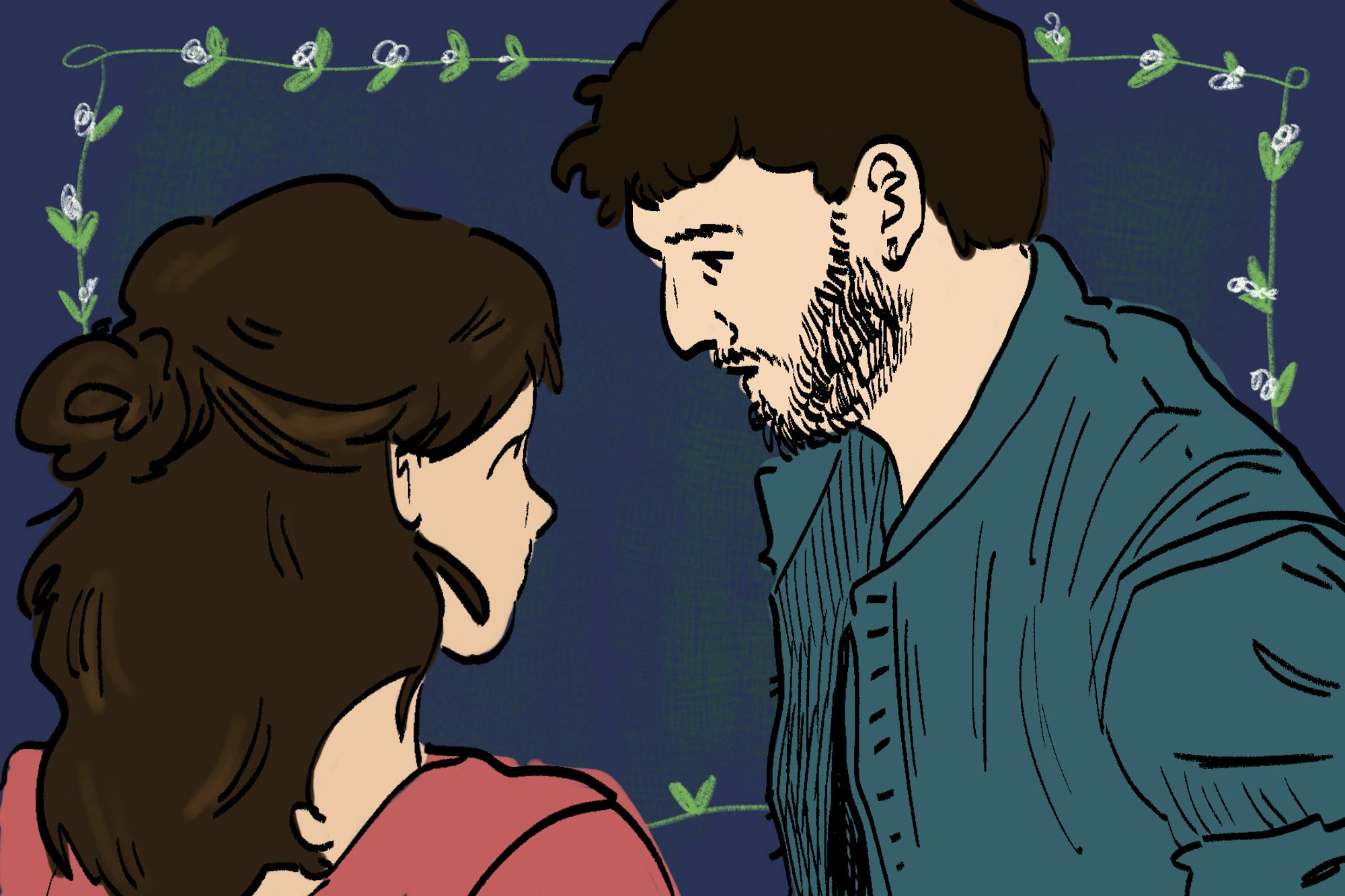
“Hamnet” is a film designed to make you cry. In Chloé Zhao’s film, raw performances and breathtaking cinematography coalesce into a stunning meditation on grief and its endurance. An adaptation of Maggie O’Farrell’s 2020 novel, “Hamnet” follows William Shakespeare’s nuclear family before and after the death of his son Hamnet. Both the novel and the screenplay, which was co-written by O’Farrell and Zhao, assume that Shakespeare’s famous tragedy “Hamlet” was inspired by the death of his son. Although scholars debate the veracity of this premise, its historicity is ultimately irrelevant — the film never claims to be accurate, and its power derives from its efficacy as a deeply human tale.
Most of the film takes place in Stratford-upon-Avon, outside of London. Soon after the mystical Agnes (Jessie Buckley) meets an unassuming Latin tutor William Shakespeare (Paul Mescal), the two are engaged and expecting a child. Since her mother’s death, Agnes has felt misunderstood by everyone except for her brother Bartholomew (Joe Alwyn) — and now Will — and her connection to nature is frowned upon in her devout Christian village. Yet Agnes tells William that “The women in my family see things.” By pressing her thumb below someone’s index finger, she can sense their true character and future, although the premonitions are sometimes frustratingly vague. When Will moves to London and begins to find success, Agnes stays in Stratford to raise their three children — yet when the pestilence ravaging London reaches their village, she and Will’s mother (Emily Watson) watch helplessly as Hamnet dies a gruesome death.
Buckley is a fierce physical actor who especially shines in the three scenes involving birth and death. It is thanks to Buckley that the film is immersive — her wails are guttural, her physical acting kinetic and emotionally charged. Yet when need be, she can also make her face completely blank. Mescal, best known for his portrayals of quietly suffering men in “Aftersun” and “Normal People,” accesses unprecedented depth for this role. To play William Shakespeare is a monstrous undertaking, yet his craft in “Hamnet” is confident and finely honed. This achievement is especially evident when he delivers the famous soliloquy that asks “To be or not to be?” The speech has endured because it addresses some of life’s fundamental questions: What happens when we die? When facing despair, do we get up or give up? Often, adaptations of the speech take it at face value — life or death — and ignore the play’s broader themes of action versus inaction and fear of the unknown. Mescal’s wrenching delivery, which leans on true understanding of Shakespearean language and speech patterns, makes his grieving character’s plight believable.
In addition to incorporating feminine perspectives into traditionally male narratives, Zhao has long been concerned with the transcendent properties of nature. Her 2021 Best Picture winner “Nomadland,” for instance, follows a woman who decides to lead a nomadic life after the 2008 recession and features sweeping shots of the American West. In “Hamnet,” the forest is a distinctive force, almost a character of its own. The film’s first shot is of the sky looking through trees, and the second is of Agnes curled up in the fetal position at the base of a tree. While beautifully framed close-ups comprise much of the film, occasional wide and detached shots turn audiences into voyeurs as they watch the Shakespeare family’s most intimate moments. Death is another character, and a combination of detached angles and swooping shots offer its perspective as it stalks the family from afar.
Some moments in the film are not particularly faithful to the source text — perhaps to its detriment. For instance, Zhao explicitly names William Shakespeare, which O’Farrell never does in the novel as a way of centering Agnes and her grief.
At other times, “Hamnet” tries too transparently to elicit an emotional response. In one early scene Will woos Agnes with his recitation of the tale of Orpheus and Euridyce, drawing tragic though explicit parallels that are a tad overused in modern media. In other moments, the script is decidedly unsubtle. “He died,” Agnes lashes out at her husband in one scene, “He died in agony and you weren’t there.” Zhao also scores the final scene with Max Richter’s “On the Nature of Daylight,” a mournful song that has been used ad nauseam to score moments of loss in film and television — so its usage here feels a little cheap.
Were any of the central actors less talented, the film might feel excessive in its appeal to sadness. But Buckley is commanding, and Zhao makes up for most contrived moments with the film’s subtler moments and the fantastic familial chemistry between the entire cast. “Hamnet” is painful to watch because it is a believable rendering of grief.
The film ends with a staging of “Hamlet,” a fantastic concluding sequence with remarkable overhead shots. At the Globe Theatre in London, Agnes witnesses her son’s impact firsthand. In the crowd, she sees the oceans and undiscovered countries that had been her premonition from holding Will’s hand all those years ago. Onstage, she sees the version of her son she thought would live. One gets the sense that Agnes understands the phenomenon “Hamlet” will become.
“Hamnet” soars. The direction and cinematography is standout, and Buckley’s performance is one that settles into your bones.