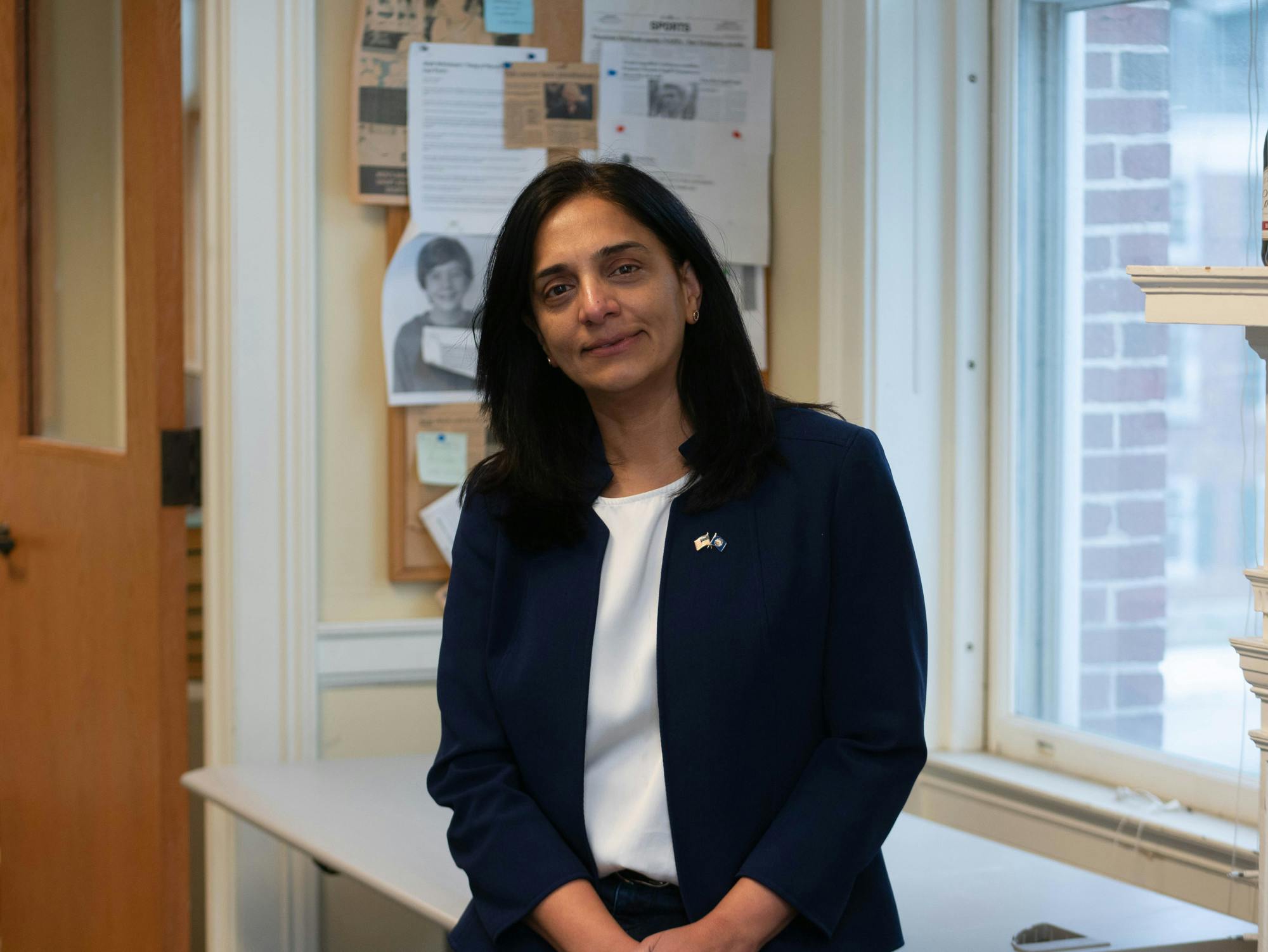
As part of The Dartmouth’s coverage of the upcoming 2026 midterm and gubernatorial elections, the paper is publishing an interview series, “A Sit-Down with The Dartmouth,” featuring in-depth conversations with major national and statewide candidates in New Hampshire.
In this installment of the series, The Dartmouth interviewed Karishma Manzur, a Democratic candidate for the U.S. Senate in the race to succeed retiring Sen. Jeanne Shaheen, D-N.H. Manzur, a scientist with a Ph.D. in biochemistry and molecular biology, has framed her campaign around affordability, universal health care and reducing the influence of money in politics.
During the interview conducted at the offices of The Dartmouth, Manzur, who lives in Exeter, N.H., discussed why she is running for Senate, her policy priorities and how she distinguishes her candidacy in a competitive Democratic primary that includes Rep. Chris Pappas, D-N.H., who is leaving his U.S. House of Representatives seat to seek the open Senate position.
Why are you running for U.S. Senate?
KM: We are the richest country in the world and people can’t afford food, housing or health care. That’s unacceptable, and it’s not because we lack resources. It’s because of political decisions made in Congress. I’m a scientist, and through my work on campaign finance reform, I started to see how deeply money influences policy. I realized it’s not enough to vote for Democrats. We need to vote for the right Democrats who are willing to stand up to corporate interests.
Your campaign launched in August 2025. How has the race evolved since then?
KM: This is a true grassroots campaign. Rep. Pappas has name recognition and access to millions of dollars from national donors. We don’t. What we do have is people. Young voters, in particular, are energized when you give them hope and real choices. Early polling mostly reflects name recognition. About 80% of voters say they don’t know enough about me yet — that’s the gap we’re working to close.

Karishma Manzur is running her campaign on campaign finance reform, housing, cost of living and affordable health care among others.
You’ve indicated sharp policy contrasts with Pappas. What are the clearest differences between the two of you?
KM: There are very clear differences: Rep. Pappas wants to reform the Immigration and Customs Enforcement, I want to abolish ICE; he has never co-sponsored Medicare for All, I will; he has voted to approve billions of dollars in weapons transfers to Israel, I would never do that; he has taken significant funding from pro-Israel lobbying groups, including American Israel Public Affairs Committee, I won’t. These are fundamental differences in values and priorities.
What do you see as the most pressing issues facing New Hampshire voters?
KM: Affordability across the board: food, housing and health care. Some children are getting their first meal of the day at school. Housing insecurity includes visible homelessness but also people couch surfing or living in overcrowded apartments. On health care, [approximately] three out of four New Hampshire residents are delaying care because they can’t afford it. That’s a crisis.
If you had to prioritize among those issues, where would you start?
KM: Medicare for All. At the same time, these issues are interconnected, and we need to address them together.

Many candidates cite housing affordability. What distinguishes your approach?
KM: Programs like the Low-Income Housing Tax Credit allow politicians to say they’re addressing the housing crisis without actually solving it. But developers need upfront investment, not tax credits that end up sold to Wall Street. We need direct federal investment through the Department of Housing and Urban Development, expanded Section 8 housing and limits on private equity firms buying up homes. New Hampshire is already tens of thousands of units short and that number is growing.
Health care costs and access remain persistent issues in New Hampshire. What reforms would you prioritize?
KM: We spend about $5 trillion in the United States a year across public and private systems, yet millions remain uninsured. Medicare for All would cost less — about $4.3 trillion — while covering everyone. It doesn’t pass because powerful industries don’t want it to. Meanwhile, people are dying because they can’t afford care. That’s unacceptable.
How would you approach political polarization while representing a divided state?
KM: When someone can’t afford rent or cancer treatment, it doesn’t matter who they voted for. I talk to people as people. I’ve spoken with MAGA Republicans and found common ground on health care and opposing endless war. Polarization benefits politicians, not the public.

So, how would you then measure success if elected?
KM: Passing Medicare for All, raising the minimum wage to a livable wage and changing the national conversation so people are demanding these things from Congress. I also want young people to feel hopeful again. They’re asking what kind of world they’re inheriting and that matters.
What should voters know about you personally that may not be evident from campaign materials or media exposure?
KM: I’ve lived these issues. My family experienced homelessness. We survived on minimum wage. I know the anxiety and stress that come with poverty and a lack of health care. The data shows poor Americans live 10 to 15 years less than wealthy Americans. I’ve seen that reality up close and it’s why I’m running.
What do you hope voters take away from your campaign?
KM: Congress should work for the public again. These are public service jobs, yet too many members become multimillionaires while answering to donors. I want people to think big again and demand a government that serves them.
This interview has been edited for clarity and length.
Isabel Menna ‘29 is a reporter from Leavenworth, Wash., is majoring in economics and is a member of the Dartmouth Ski Patrol.