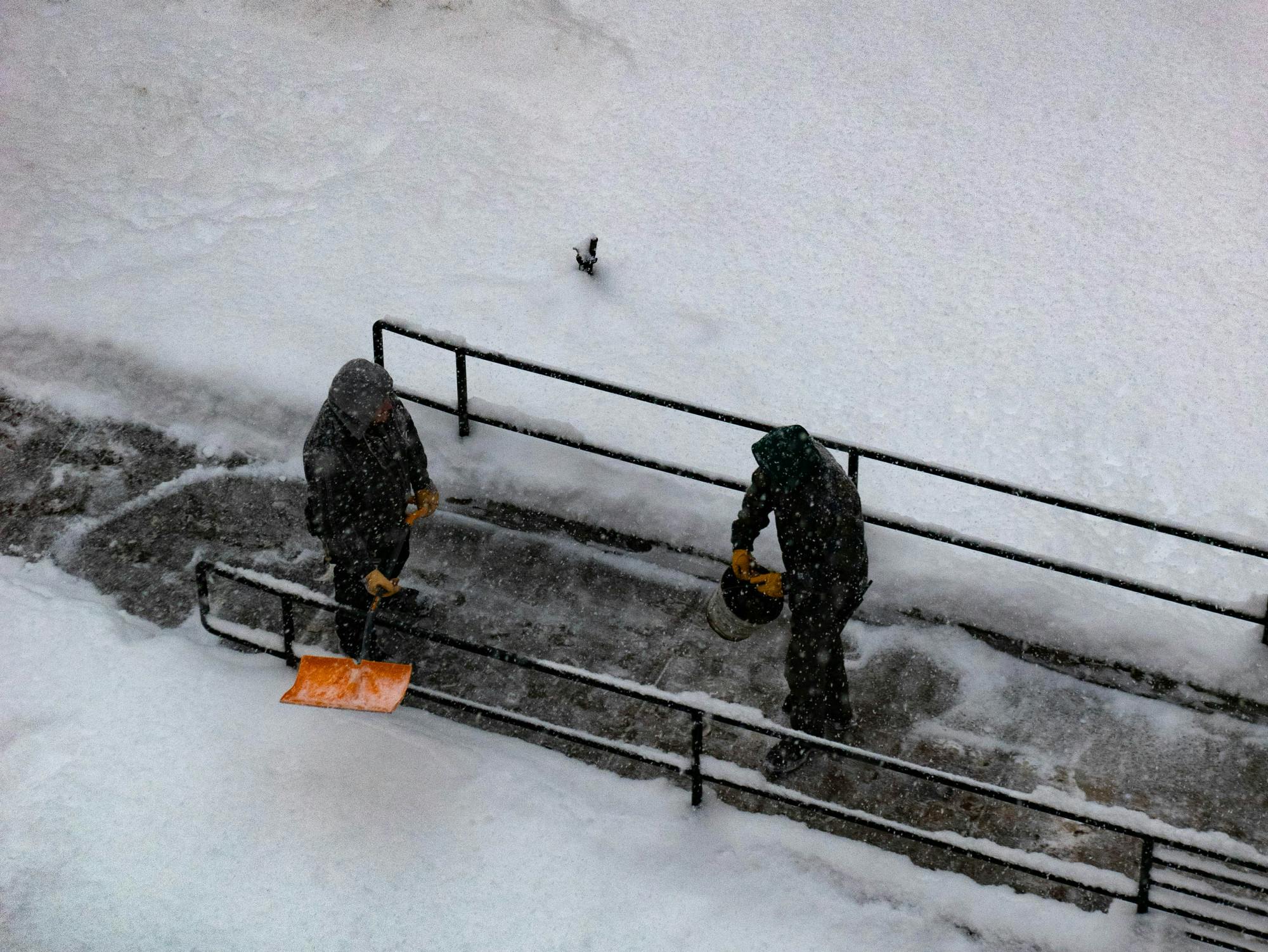
This year, various Upper Valley localities have reported road salt shortages, according to Hanover director of public works Peter Kulbacki. Hanover, however, was adequately equipped to deal with this year’s winter due to a pre-treatment brine solution and a stockpile of salt from previous years, according to Kulbacki.
“We never ran out [of salt] like some of the other communities did,” Kulbacki said. “The shortages didn’t affect us.”
Kulbacki said that because Hanover pre-treats road salt with a calcium chloride brine solution, the town uses 82% less salt than other communities.
“You might have seen stripes on the sidewalk,” Kulbacki said. “That’s a brine solution that’s allowed to dry, and it allows us to use a lot less salt.”
Kulbacki noted that the brine solution allows salt to be effective at lower temperatures than salt without the pre-treatment.
“Typically, salt starts losing effectiveness around 17 degrees Fahrenheit, but by applying a brine solution with calcium chloride, you can get down to somewhere in the minus 15 or so below zero Fahrenheit,” Kulbacki said. “It gives a larger range.”

In an interview with The Dartmouth, College senior director of grounds Douglas Cosentino said that he hadn’t seen a road salt shortage in New England as severe as this year for at least a decade. However, he added that salt supplies have been “getting tight” in recent years.
Cosentino added that the College has signed a contract with its salt suppliers for 1,000 tons of road salt.
“We stockpiled a bunch of salt at the beginning of the season,” Cosentino said. “We’ve got enough to get us through the rest of the year sitting up there.”
Postdoctoral researcher in geography Alexander Gottlieb said that one of the reasons behind the road salt shortage was “a string of four or five really, really mild winters in a row.” Hanover is experiencing an unusually cold winter this year compared to previous winters.
“They just didn’t need quite as much salt because that cold season … was just relatively condensed,” Gottlieb said. “A lot of town crews [let] their supplies dwindle a little bit, and then you get a year like this year.”
Gottlieb added that there is a “tension” between long-term climate trends and short-term variability.
“Even as our warmers overall get warmer and less snowy, we might still get winters like this one that come out that are really quite cold and snowy,” Gottlieb said. “You plan for the long term expectation of where things are going, but how do we still make sure that we’re robust and ready for those corner cases that bucks that trend?”
Cosentino said that the road salt shortage in other towns shows that “it’s actually not a bad thing to have a little extra [salt] on hand.”
“If you end up with some at the end of the year, you can use it the following year,” Cosentino said.
Kulbacki said that road crews in Hanover have done an “awesome job.”
“If you spend any time outside of Hanover, and then come back, you can see what a great job they’ve been doing in town,” Kulbacki said.
Sahil Gandhi ’29 is a reporter from Staten Island, N.Y., and is majoring in environmental studies and government modified with philosophy and economics. He loves word searches and falling down internet and Wikipedia rabbit holes.
Jeremiah Rayban is a reporter and editor for The Dartmouth from Wilmington, Del., majoring in economics. Outside of The D, he enjoys reading, art and trivia.