
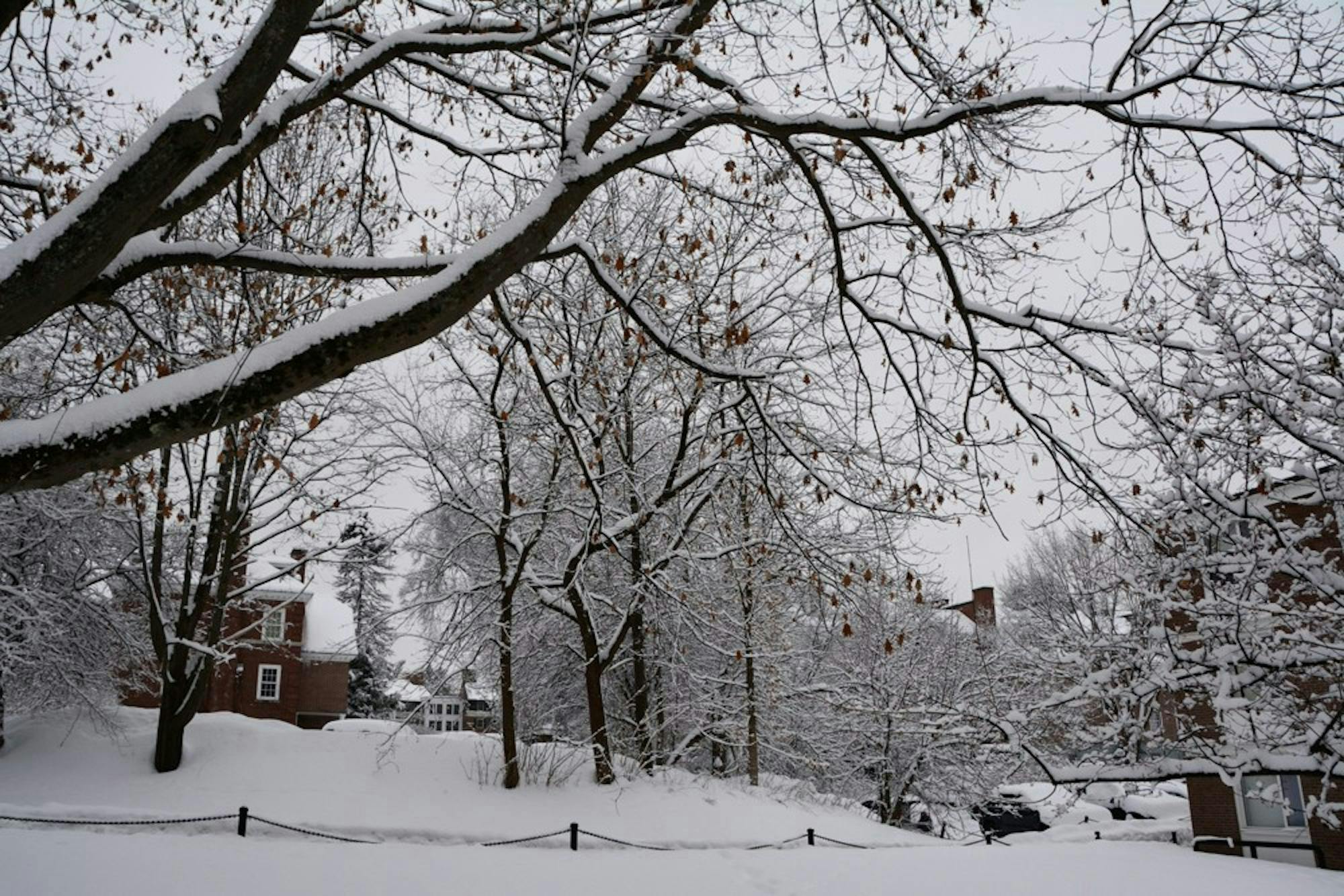
Hanover’s average temperature so far this winter has been five degrees colder than the 30 year average, according to geography professor Alexander Reid Gottlieb. Compared to winters over the past 30 years, Hanover has experienced a “really unusually cold” season this year, he said.
Gottlieb added that the cold weather could negatively impact the Upper Valley’s recovery from last summer’s drought.
“It’s [gotten] so cold so early, and that ground really froze up,” Gottlieb said. “It’s actually potentially going to prolong the recovery from that drought because you aren’t going to get that same kind of recharge of water making its way down to those lower layers of the soil.”
In an email statement to The Dartmouth, earth sciences professor Erich Osterberg wrote that this winter in the Upper Valley has been “much colder” than recent Decembers, including the “extremely warm” last three winters that upperclassmen have experienced.
“For seniors who are comparing this winter to their past winters, it’s much colder this year,” Osterberg wrote.
Gottlieb said the cold conditions could be attributed to jet stream movements, which are “bands of strong wind” in the atmosphere that separate cold air from hot air.
“Particularly earlier in December, we had a couple really, really unusually cold days that were due to that configuration of the jet stream,” he said.
Gottlieb emphasized, however, that this winter’s cold temperatures are an “anomaly” and that, in the past few decades, winters have been trending warmer and warmer.
“It’s not to say that we can’t get these really cold, snowy winters, like we're in the middle of now,” Gottlieb said. “But [climate change] just makes those outcomes increasingly unlikely.”
New Hampshire winters have become about seven degrees Fahrenheit warmer than in 1970 because of climate change, according to Osterberg.
Gottlieb said the trend towards warmer winters may impact the Upper Valley’s economy by attracting fewer tourists to participate in winter sports. Additionally, he said that the local forestry industry is reliant on cold weather.
“You really need good, consistent cold temperatures and a good, thick snowpack to be able to get in the woods and work on those kinds of [forestry] operations,” Gottlieb said.
According to Osterberg, the trend towards warmer winters will mean that what used to count as a normal cold day in Hanover will become rarer.
“The warm winters we had for the past three years are more like what we can expect in the future,” he wrote.
In the meantime, students are adjusting to, and reveling in, the wintry chill.
Avery Larusso ’29, a student from Texas, said it was a bit of a “shock” to experience a Hanover winter for the first time.
“When I got on the plane, it was like 78 degrees, and when I landed, it was something like 12 degrees,” she said.
Larusso added that the winter term has been “really fun” for her because she has been able to try winter activities for the first time, including skiing, ice hockey and snowball fighting.
Adriana Martin ’29, a student from Louisiana, said it was “definitely an adjustment” to start wearing multiple layers of clothing. She added, however, that the snow was “really, really, pretty.”
“It’s really cool to be in this new environment,” Martin said.
Madeline Kahn Ehrlich '29 is a reporter from upstate New York. She is considering studying English and Public Policy. She enjoys creative writing, art and reading historical fiction.


