
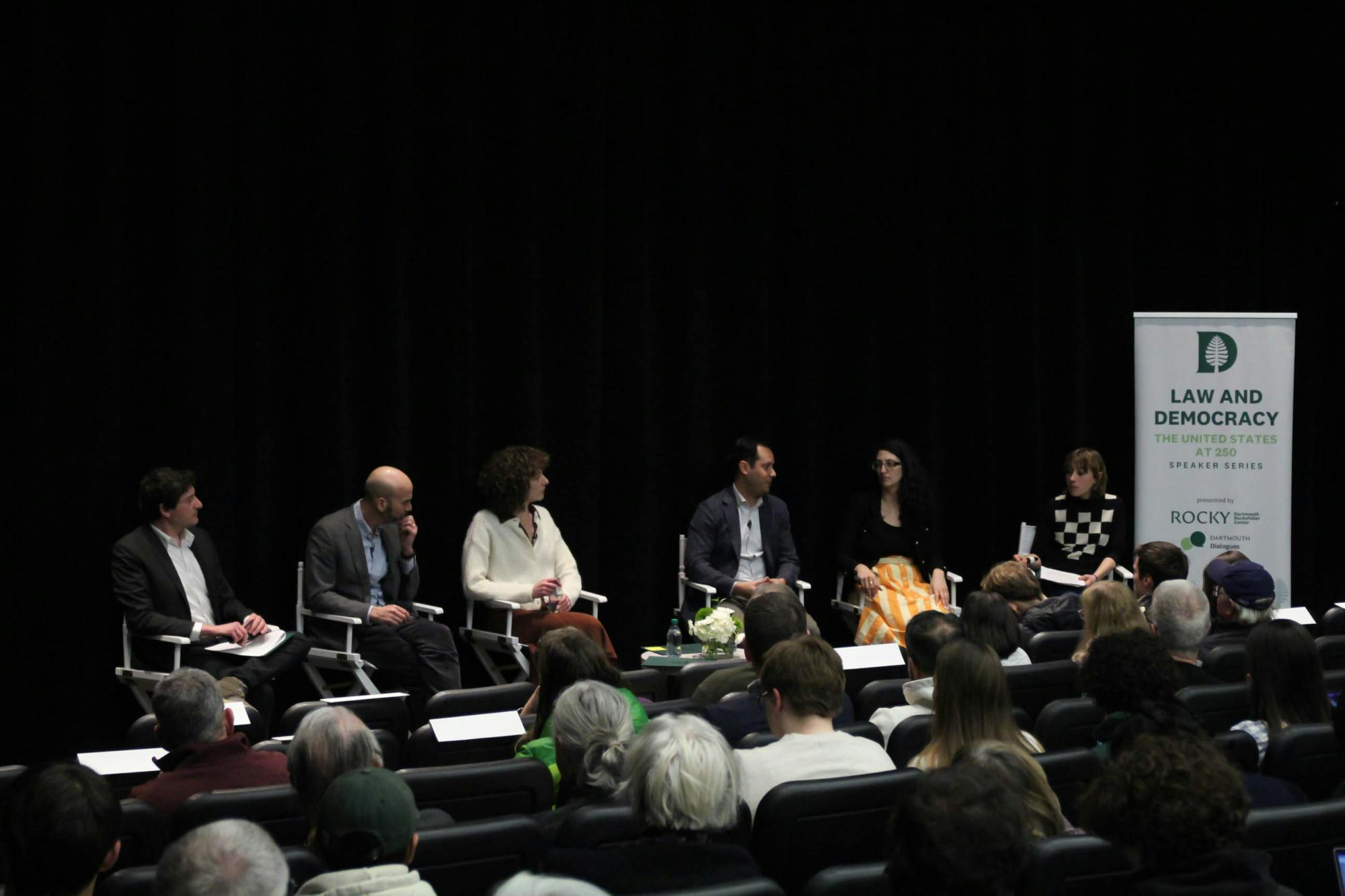
On Feb. 12, four journalists from four very different publications discussed their roles, the media’s shortcomings and the importance of journalism for democracy during a panel hosted by the Rockefeller Center.
The panel featured James Bennet, weekly Lexington columnist at The Economist and former editorial page editor of The New York Times, Jillian Weinberger, senior producer at New York Times Opinion, Emily Greenhouse, editor of the New York Review of Books and Sam Stein ’04, managing editor for The Bulwark.
The discussion was moderated by government professor Herschel Nachlis and The Dartmouth editor-in-chief Charlotte Hampton ’26. Approximately 180 people attended the event in Loew auditorium, according to Rockefeller Center associate director of public programs and special events Dvora Greenberg Koelling.
Hampton began the event with a question to the panelists about a “standard day in the life” in each of their roles in journalism. Greenhouse said that her position required “a lot of correspondence.”
“Being an editor is a very relational job,” Greenhouse said. “The nature of my job is very cacophonous — I’m working with a lot of people who disagree with each other.”
Stein said his days are “very different” from those of Greenhouse.
“We talk about what kind of videos we’re going to do that day,” Stein said. “Could be reactions to the news of the day, programmatic material [or] interviews with lawmakers.”
Nachlis asked panelists about whether there were “some truths” to the Trump administration’s criticisms of academia and the media as “excessively liberal” and “close-minded.” Bennett said that President Donald Trump had his “finger on a real problem.”
“Some [media organizations] have allowed themselves to be captured by the partisanship and polarization of our society,” Bennett said.
Greenhouse added that she felt that there was “a problem of elitism” in media and academia in the United States.
“I’ve never spent a day working with my hands,” Greenhouse said. “I understand why there is resentment towards someone like me.”
The moderated discussion was followed by a brief Q&A between panelists and audience members.
In a response to a question from an audience member about why young men are drawn to right-wing social media influencers, including online streamer Clavicular and influencer in the so-called “manosphere” Andrew Tate, Stein said that people have a “natural tendency to gravitate towards spectacle.”
“For people who don’t know Clavicular, this is a person who livestreams [for] about 10 hours of his day,” Stein said. “Some of it is absurd and crazy, but it’s a freak show, and people can’t turn away … it’s like watching a car crash.”
In response to a question from an audience member about how journalists think about “idiosyncratic opinions,” Greenhouse said some journalists “try too hard to say something new.”
“I think in a lot of pitches that I get there’s too much of an emphasis on something weird and idiosyncratic,” Greenhouse said. “You don’t have to be reinventing something … we all bring something new to this world.”
Hampton concluded the conversation by asking the panelists to give advice to young people aiming to become professional journalists. Weinberger said that journalism was about being “persistent” rather than having “innate talent.”
“Anyone can make a thousand phone calls,” Weinberger said. “You can just keep calling someone until they pick up the phone…you just have to do it and want to do it.”
In an interview with The Dartmouth after the event, Sarah Hedgecock ’29 said the discussion was “really cool.”
“It was really interesting to hear about journalism and democracy and how they work hand in hand,” Hedgecock said. “Journalists really are the embodiment of democracy.”
Attendee Ian Beierle ’29 said the event was a “great experience to hear from journalists across fields.”
“It was great that Dartmouth was able to attract such experienced people who are able to share their wisdom about the journalistic field,” Beierle said.
Charlotte Hampton ’26 is the editor-in-chief of The Dartmouth. She was not involved in the writing or editing of this article.


