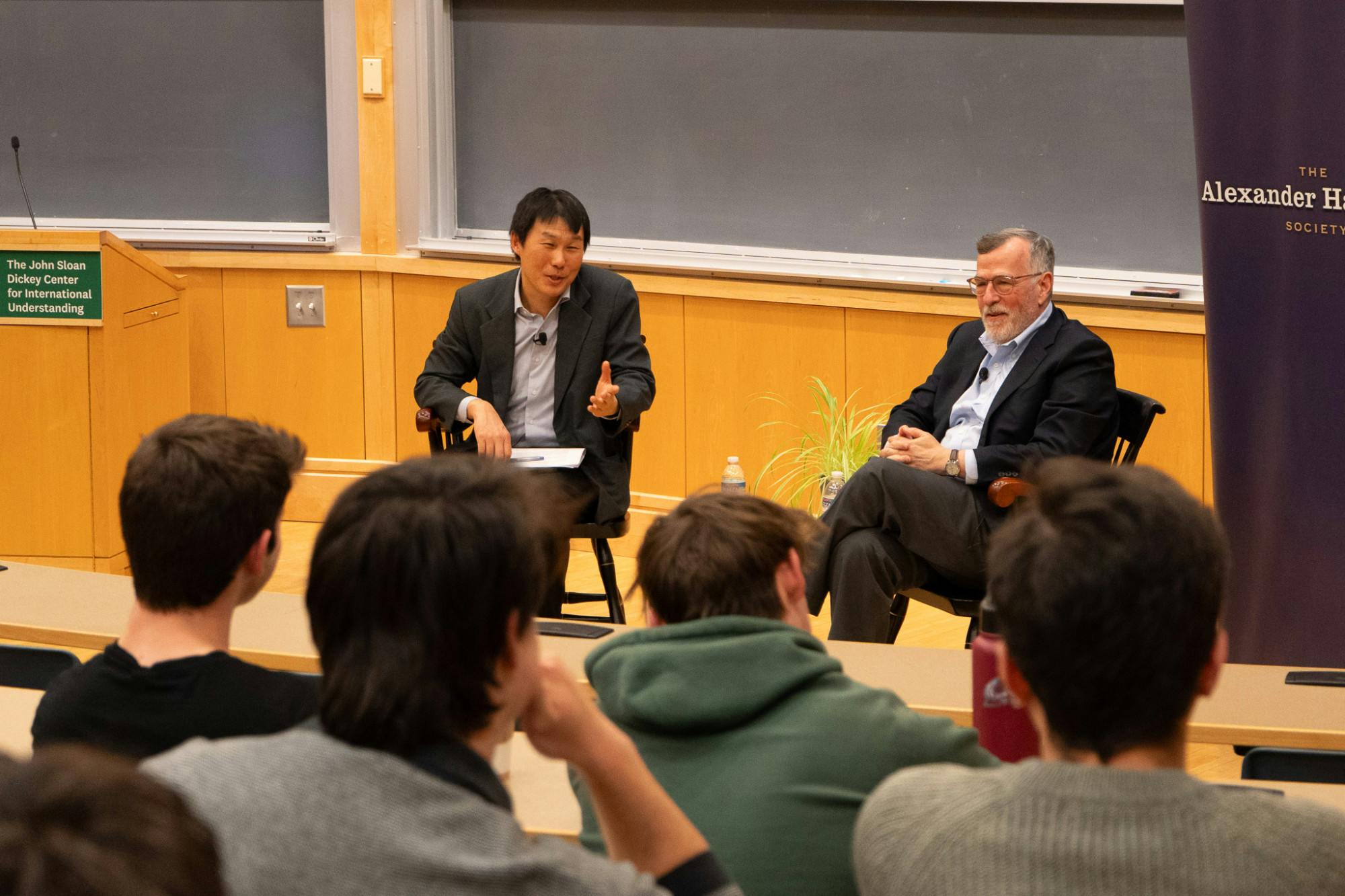
Former U.S. Department of Commerce undersecretary for international trade Frank Lavin said President Donald Trump has “shattered” the consensus among economists over the benefits of trade liberalization by being “aggressive in putting forward tariffs” and turning the focus to American manufacturing at a campus event on Feb. 10.
Lavin — who served as undersecretary under the George W. Bush administration — said Trump has “shifted” trade to a domestic political environment that will be “difficult for any future president.” Up until a year ago, the “consensus” about trade policy in the United States was that trade liberalization is good for the economy, Lavin said.
He summarized this consensus among economists as “countries that don’t move ahead on trade and don’t liberalize and don’t allow their companies to adjust to global competition are only hurting themselves.”
Speaking with The Dartmouth after the event, moderator and Tuck School of Business professor Davin Chor said trade was seen “as a good thing” before Trump but that the “political narrative” has “shifted dramatically.”
Lavin said that Trump has shifted trade policy on a “blanket basis” by placing tariffs on countries “globally.”
“The president came in, [and] for the first time in the modern era … said trade itself is deleterious,” he said.
Lavin added that Trump’s actions on trade policy were a result of “economic grievances.”
“It’s easy to say trade caused economic problems, and there’s always a constituency that goes into that,” he said.
Lavin shifted gears to the economic benefits of tariffs, stating that the United States may see an “uptick” in economic activity but called it “select” and “slight.” He added that this could come from “unused capacity,” such as taking advantage of old factories.
“If you look at examples, such as automobiles or cars, nobody’s going to put together a $300 million factory that has a 30 year life on the basis of one guy’s tariff population, because who knows what’s going to happen two years from now or four years from now,” he said.

Lavin added that while he “suspect[s] that you’re not going to see a rush toward trade agreements or trade initiatives under future presidents,” he does not think Trump’s policies are permanent.
“I think you can unwind a lot or most of what he’s put into place,” he said.
The event, which was attended by approximately 50 people, according to organizer Benjamin Joel ’27, and was hosted by the Alexander Hamilton Society, the Dickey Center for International Understanding and the Davidson Institute for Global Security.
Audience member Arian Chimenson ’28 said he found Lavin’s talk “insightful.”
“His recent thoughts [on] Trump and recent trade policy [were] really interesting and very insightful,” he said.
Chor said in the interview that it was “refreshing” to moderate an event with someone who has worked in a previous administration and who has a positive view on trade.
“A lot of the trade policies that are being undertaken now … are turning our backs to the fact that, fundamentally, trade is something that enhances economic opportunities and enhances access to goods and services around the world,” he said.
Eliza Dorton '29 is a reporter from Washington, D.C. and is studying English and public policy. Outside the classroom, she enjoys reading and going on walks.