From Dec. 4 to Jan. 1, Northern Stage in White River Junction, Vt. will present the play “Peter & Wendy,” a modern reimagination of J.M. Barrie’s novel “Peter Pan” set in 1999 in New York City. Staying true to the novel’s structure while giving it a contemporary refresh, the show will feature 15 young actors and three Dartmouth students alongside professional actors.
The director and adapter Eric Love, who was previously the director of education at Northern Stage, said he and Northern Stage’s producing artistic director Carol Dunne decided to adapt Peter Pan for Northern Stage’s holiday show for its “family friendly theme” and “heightened theatrical” elements.
Love said they intended from the start to utilize a mixed-age cast and for Peter to be “an actual high school student.” He said Northern Stage hosted a “big audition process” for young local actors to cast the “lost kids” who currently range from ages eight to 18.
Besides six professional actors, three Dartmouth students — Julia Zichy ’27, Lilla Bozek ’27 and Kai Carenz ’25 — will act in the show as one component of their “Dartmouth Experiential Term,” or “E-Term,” an internship at Northern Stage offered in collaboration with Dartmouth since 2016. Zichy will play Wendy, Bozek will play Mrs. Willard/Jukes/Nana/Green Mermaid and Carenz will play Ms. Martin/Starkey/Orange Mermaid.
Love said he first encountered the novel’s “beautiful, rich prose that we don’t normally get to hear as much in the bigger musicals,” while playing the role of Peter Pan in an adaptation about ten years ago. He said it made him want to take “another crack at this.”
While adapting the novel over the course of fifteen months, Love said he initially submitted a script that was “extremely faithful” to the book, which yielded a “very traditional” production. In response, he and Dunne asked how they could “make it more relatable” to their audiences and possibly “more modern.”
To do so, he developed a “new framing device” for the play, including a shift from “a classically British story” to “an American story” set in New York City in 1999.
Love said he was inspired to choose 1999 because he was 12 at the time, the same age he imagines Peter Pan, and he wanted to channel the historical moment of the “Y2K fiasco” and “all the uncertainty” around it.
Love said despite the new framing, the production is “still very faithful to the structure of the novel,” following “the same adventure” and “story beats.”
However, Love said that compared to the original, his production “reexamine[s] the female characters” including Wendy, Tinker Bell and Lily (originally Tiger Lily). For instance, he said that while in the novel, Wendy “happily” becomes Peter’s mother and takes a “real backseat in the story,” he wanted to “push back on Peter” to “be the hero” while also “push[ing] back on motherhood.”
“Does [Wendy] have to be a mother to be fulfilled in her life?” Love wondered. “What does it mean to leave Neverland for her?”
The show’s lighting designer Daniel Kotlowitz echoed this sentiment, emphasizing that this adaptation centers Wendy far more than the original.
Meanwhile, Love explained that he gave a “voice” to Tinker Bell who “doesn’t get a chance to speak” in the novel and reworked Lily’s plot to “express more themes around motherhood.”
Carenz and Kotlowitz recalled the “Peter Pan” story being a source of both fascination and fear for them as children — both the existential fear of growing up and the more visceral fear provoked by sinister elements of the traditional visual adaptations.
Carenz said she finds this new adaptation “a little bit lighter” and “more playful” in comparison, in part due to the time and setting change. She said she believes the production will also be “more accessible for American audiences,” particularly through the Americanized “language.”
Comparing it to “sculpting a block of marble,” Love described the early rehearsal process as one of “discovering” what worked while enacting the script and continuing to refine it.
Carenz said the result has been a uniquely “collaborative” process in which the actors have had active roles in shaping their characters.
Carenz said another “challenge” for the cast has been to “find the middle line” between incorporating themselves and the modern zeitgeist into their roles, while continuing to bring out “all the right aspects” of the original Peter Pan world.
Kotlowitz said that while rehearsals started on Friday, the creative team including Love, himself and the other designers, the choreographer and musical director had been in meetings “for months” to prepare “all the design elements.”
Both he and Love described the unique nature of “theater magic” in this show, especially regarding flight, which Love said is an integral aspect of any Peter Pan production.
Love said that while historical productions have portrayed flight using wires, this one will use movement and lifts and shadows — reflecting his intention to do flight in a way that is “actor-driven and uses your imagination.”
“Maybe the whole thing is about play,” Love said. “So if you say something is so, then it is so, and it’s a big game of ‘Yes and-ing’ each other on stage.”
Explaining that actors will manipulate light onstage to make shadows “sway and move,” Kotlowitz suggested that the visibility of the hands behind the magic might increase a sense of audience engagement with the show.
He added that unlike in typical shows, where he is responsible for both the projection and lighting designs, this show has a designated projection designer who created beautiful projection designs resembling watercolor for the portal between Neverland and the real world.
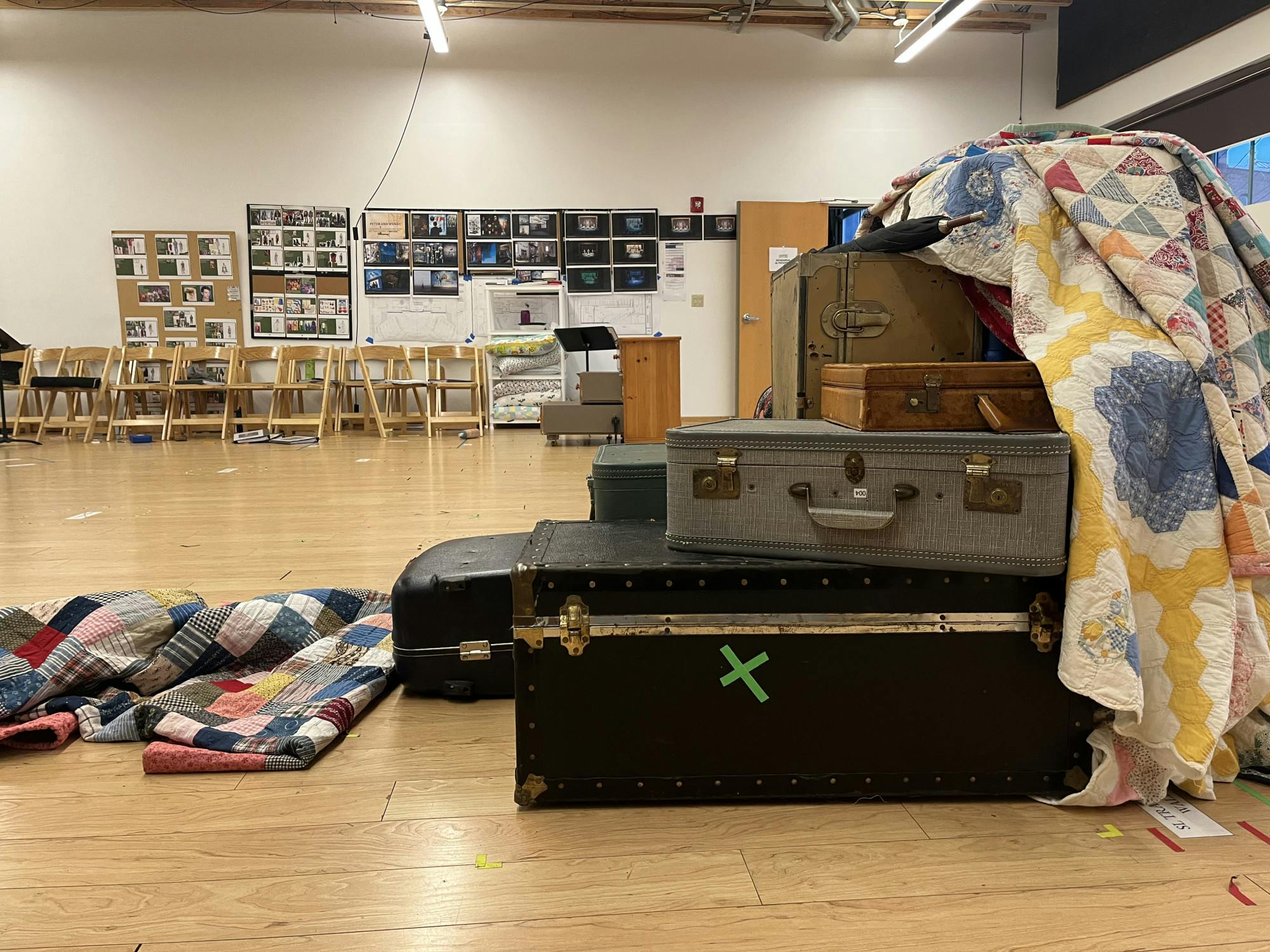
Love said he loves “simple gestures” created by design elements “that can be completely enchanting.” For instance, he cited one moment when the custom quilts that his mom made for Wendy, Don and Michael’s beds flip over to reveal a “completely matching watercolor cosmic backing.”
Carenz said it has been “really fun to play with a younger cast” and to “see how we all work together and how we all pull ideas from each other.”
She said she is excited for young audiences to see people their age on the stage and possibly be motivated to find their own place in theater.
That said, Carenz said the reaction she would most love to see in the audience is “just a spark of imagination,” which may sometimes dim as we age.
“I think that’s where a lot of joy in life comes from: playfulness and playing and imagining things and not being afraid to live abstractly,” she said.
Love seconded this message, saying there is a simple message they hope audience members take away.
“Even after you grow up, you can still have a life full of joy and play and imagination.”
Avery Lin ’27 is an arts editor and writer from New York City. She studies Comparative Literature, including French and Classical Greek, at Dartmouth and also writes for Spare Rib Magazine.