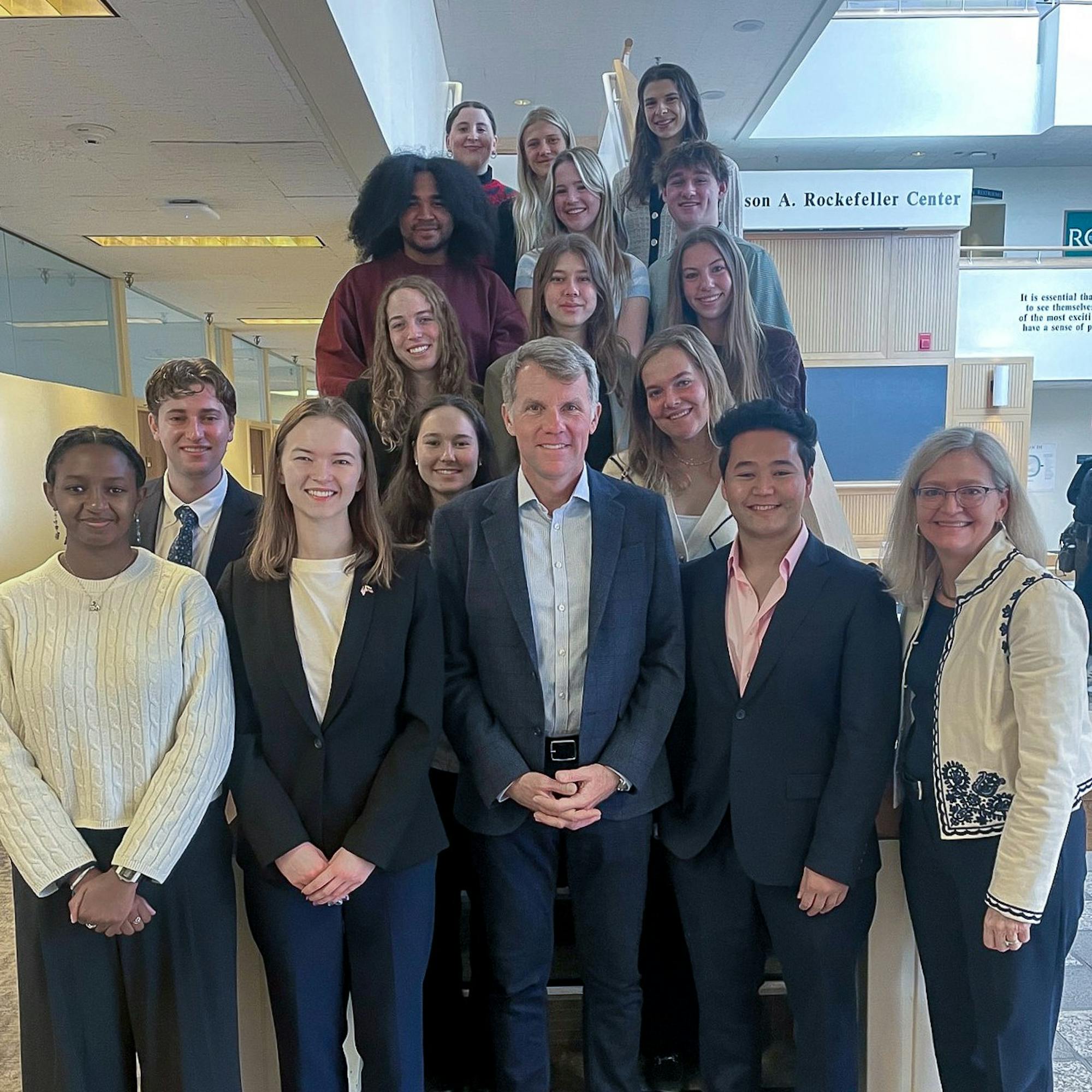
Former U.S. ambassador-at-large for the Bureau of Cyberspace and Digital Policy Nathaniel Fick ’99 told students to spend time in public service and spoke about the role of innovation in foreign policy at a Nov. 12 talk.
The Rockefeller Center, the Davidson Institute for Global Security, the Sloan Dickey Center for International Understanding and Dartmouth Dialogues co-hosted the conversation with Fick, who worked in the Department of State under former President Joe Biden’s administration from 2022 to 2025. This event was part of the Rockefeller Center’s “Law and Democracy: The United States at 250” speaker series.
The conversation was moderated by Dickey Center Diplomat in Residence Erica Barks-Ruggles and Assistant Dean of Undergraduate Students Morgan Ogreen. Approximately 90 community members attended the event in Filene Auditorium, according to Rockefeller Center associate director for public programs and special events Dvora Greenberg Koelling.
Fick began the event by discussing his decision to join the Marine Corps, which he attributed to attending Rockefeller Center talk with military journalist Tom Ricks. Fick said the event with Ricks came during a time when he “felt a little bit of drift.”
“I felt like kids came in with a thousand different interests, and then got funneled into a few paths, and I wasn’t especially interested in some of those paths,” Fick said. “And so I joined the Marines.”
Fick said that students should spend some of their careers in public service.
“It could be state level, local level [or] national level,” Fick said. “There’s lots of ways to do it, but now more than ever, we need common threads and shared experiences.”
In response to a question from Ogreen about how technology is changing the military, Fick said that military service is becoming “increasingly intertwined” with technology. He added that American service members and diplomats “have to get comfortable” with new technologies.
“Nobody would walk into a meeting at the State Department and say ‘I don’t know anything about this China stuff’ or ‘I don’t know anything about this human rights stuff,’” Fick said. “But people still feel like it’s okay to walk in and say ‘I don’t know anything about this tech stuff.’”
Fick said that the Russia-Ukraine war was an example of a conflict in which technology has been “really decisive.” He added that Ukraine is a “proving ground” and “foundry” for military technologies that may be utilized in future conflicts.
Fick said that innovation should remain America’s “north star,” and added that the country’s immigration and tax policies should contribute to a “successful innovation economy.”
“We have to make sure that the United States remains the place in the world, where if you’re a smart kid, this is where you want to be,” Fick said.
In response to an audience member’s question about American immigration policy, Fick said he believes the United States is a “nation of immigrants” and said the country should build “the biggest, best team we can get.”
“I would go as far as to say we cannot win a global technology competition over time without a steady stream of immigrants,” Fick said.
In response to a question from an audience member about AI alignment issues, Fick said he was a “little queasy” about the power of technology companies.
“We have checks and balances and accountability in our [political] system,” Fick said. “Those same accountability measures just don’t exist in the private economy.”
Kavneer Majhail ’29 asked a question during the event about the connection between immigration policy and cyber security. Majhail said he “really enjoyed” the talk.
“The ambassador provided great insights,” Majhail said.
Student Jin Kai Ow ’29 said he thinks Fick’s “perspectives blend a robust national security viewpoint together with a market-driven economist approach to AI.”
“He gave a very holistic representation of what are the challenges that America has to navigate throughout towards the future,” Ow said.
Madeline Kahn Ehrlich '29 is a reporter from upstate New York. She is considering studying English and Public Policy. She enjoys creative writing, art and reading historical fiction.