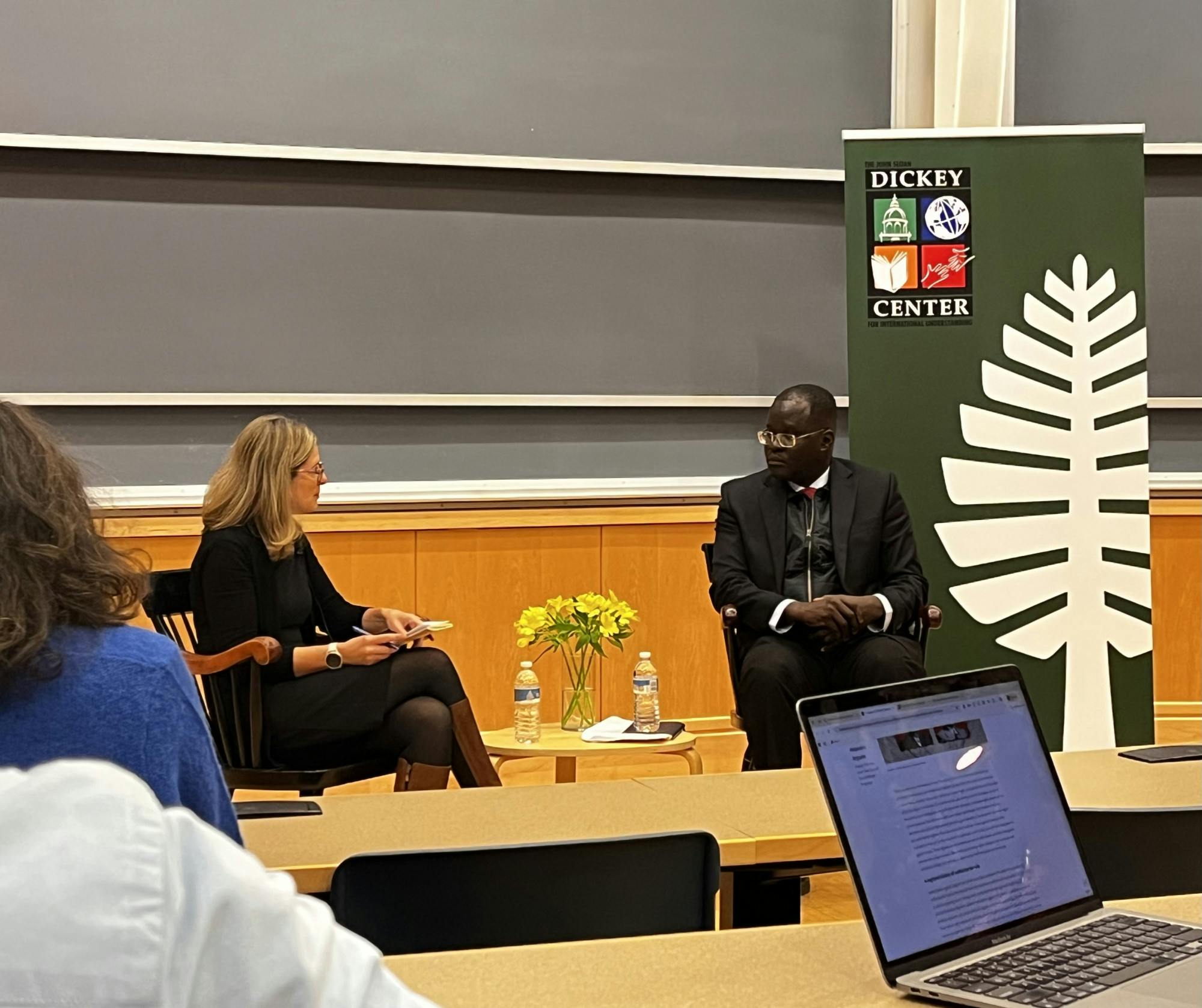
On Oct. 29, human rights lawyer Nicholas Opiyo described a “steep decline in democratic practices” in Uganda in a Dickey Center for International Understanding event. Approximately 65 people attended the talk, which was titled “Lessons from a Democracy Defender,” according to Dickey Center events program manager Judith van Rhijn Jackson.
Opiyo spoke about his experience providing legal services to LGBTQ+ individuals in Uganda, where lawmakers passed an “anti-homosexuality act” last year. The act prescribes the death penalty for “aggravated homosexuality,” according to the Associated Press.
In an interview with The Dartmouth before the event, Opiyo condemned anti-LGBTQ+ sentiment in Uganda and said that Christians who “attack” LGBTQ+ individuals are “perverting the gospel.” Eighty-two percent of Ugandans are Christians, according to the State Department.
“I believe that the core of the Christian faith is about love,” Opiyo said. “What would Jesus do? Would he stone a gay person, or would he love them?”
Opiyo began the event by describing the political situation of Uganda, which he called an “authoritarian” state.
“The way [Museveni] has retained power is with pure corruption,” Opiyo said. “And if corruption fails, the outright use of violence against opponents.”
Opiyo criticized how, under Museveni, “religious faith” has had a “hostile” influence on schools in Uganda.
“Fifty-four percent of all schools are Christian-run education institutions,” Opiyo said. “Religion is deeply part of the curriculum so much that teaching of sexual education in schools can be stopped.”
In addition, Opiyo highlighted how Christian teachings were used to spread misinformation about HIV and AIDS.
“Uganda was known for its progressive HIV policy until religious schools began to have influence on the state,” Opiyo said. “They completely reversed our HIV approach to emphasize abstinence, to not have sex before marriage, which scientifically is not prevention.”
Opiyo said he experienced “social exclusion” from his “own community” for defending the rights of LGBTQ+ people.
“I have received multiple threats to my life because of the work that I do,” Opiyo said.
Opiyo also discussed his 2020 arrest for his work with opposition candidate Bobi Wine, who was then running against Museveni. Opiyo was denied bail and access to legal counsel while he was detained for eight days. The Ugandan government later dropped the charges.
“I was taken to the maximum security prison,” Opiyo said. “When the charges dropped, I couldn’t stay in the country for fear of my life. I fled the country.”
Opiyo arrived at Dartmouth as part of the “Dissident in Residence” program, which is a collaboration between the Dickey Center and the African Middle Eastern Leadership Project.
Despite the current climate, Opiyo said he remains “hopeful” about the future of LGBTQ+ rights in Uganda.
“There are people now who can address the public and say, ‘I’m a gay man.’” Opiyo said. “It is no longer spoken about in silence.”
Opiyo said his work was a “personal calling” shaped by his childhood experiences growing up during a civil war in Uganda.
“As a child, I was caught up in the middle of this two-decade brutal conflict, witnessing atrocities, murders and abductions of children by the rebel groups,” Opiyo said. “Many of my friends and siblings were abducted and killed, and growing up, I wanted to do something about it.”
He said he turned his “early childhood pains” into “a springboard” for the work he does.
“You have to stand up for the very weakest in our society,” he said.
In an interview with The Dartmouth after the event, Maya Spektorov ’28 said the talk was “amazing” and that Opiyo was “very eloquent.”
“He was just so good, talking to an audience that didn’t know that much about Ugandan politics, but still educating us so much,” Spektorov said.
Benjamin Simon ’28 said Opiyo was “incredibly fascinating.”
Opiyo “was very well spoken and inspiring as a figure,” Simon said. “He was a mix of passion and intellect I have not seen before.”
Madeline Kahn Ehrlich '29 is a reporter from upstate New York. She is considering studying English and Public Policy. She enjoys creative writing, art and reading historical fiction.