
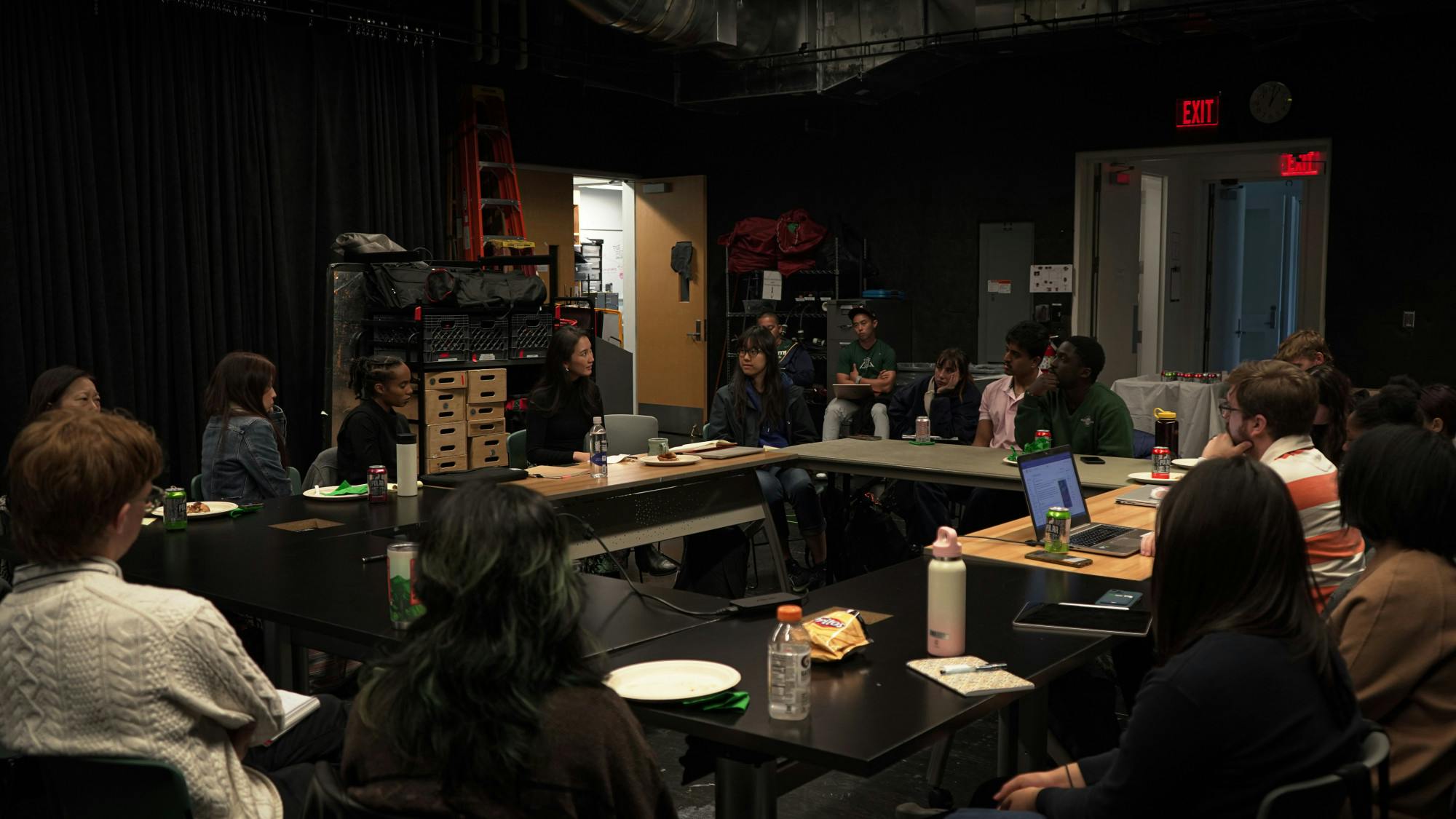
Documentary film director, journalist and gender rights activist Shiori Itō visited Dartmouth from Oct. 6 to Oct. 10 for a week of exhibitions in Baker-Berry Library and Loew Auditorium and public talks. Itō, whose work deals with domestic and sexual violence, also hosted a screening of her 2024 documentary “Black Box Diaries” — which was nominated for Best Documentary at the 2025 Academy Awards.
The film is an adaptation of her 2017 memoir “Black Box,” in which Itō investigates her own sexual assault case by a prominent Japanese media figure. Through a combination of personal testimony and reporting, she recounts her experience and exposes the systemic barriers against sexual violence survivors’ pursuit for justice in Japan.
Itō’s visit was planned in collaboration with a number of academic departments across disciplines, including the department of Asian societies, culture & languages, the department of film and media studies and the program in women’s, gender, and sexuality studies. It was organized by associate professor of Asian societies, cultures & languages Miya Xie.
Xie said she was inspired to invite Itō because of her previous experience organizing a series of events engaging with sexual violence in East Asian literature with the translator Jenna Tang, which drew strong student engagement.
As a literary scholar, Xie described the utility of literature like Itō’s memoir as a medium for expressing experiences of sexual violence when feminist “theory” and “language” can fall short.
“A lot of feminist theories [and] basically common language on the issue cannot really bring out the full complexity of an East Asian experience of sexual violence … [so] they use literature because literature is not about theory — it’s more subtle and sophisticated than that,” she said. “When they use literature, they suddenly feel like they can talk about the subtleties involved in those experiences.”
Xie added that writing about trauma often requires a “new way of speaking.” She explained how this matter was reflected in Itō’s own uncertainty over how to classify her book — as memoir, reportage or something in between.
“When I was reading this book, I think my scholarly language just fell short [...] ‘What should I call this book?’” Xie said.
She added that this uncertainty also reflects the book’s dual purpose to both document Itō’s experience and to advance her suspended legal case.
Filmmaker and department of film and media studies professor Anaiis Cisco moderated the Q&A for the Oct. 6 screening of “Black Box Diaries” at Loew Auditorium. She said it was a rare opportunity to engage “with a filmmaker who completed a feature length film about such a powerful and personal story.”
Cisco called it a “courageous film.”
“I thought the subject matter and her ability to turn the camera on herself [were] really powerful,” she said.
The events brought a sense of collective engagement. Xie explained that the public talks were intentionally designed to center the audience and provide Q&A opportunities.
Philosophy professor Susan Brison, who wrote the book “Aftermath: Violence and the Remaking of a Self” documenting her own experience of sexual violence and hosted an Oct. 8 talk with Itō on her memoir experience with the matter. Brison praised Itō’s “openness and warmth.”
Translator Allison Markin Powell ’95, who translated “Black Box” into English recalled how, during book signings and other events, audiences brought “a lot of emotion and experience” and “their own reaction to Shiori’s story.”
Brison described her optimism about this engagement, underscoring the power of human connection in the recovery process.
“The responses of other people can build you up again,” she said.
Brison emphasized the power of such personal storytelling as a form of societal activism.
“I want people to view sexual violence in a much broader social context,” she said. “It’s something that we’re all responsible for doing something about — not just a women’s issue or a survivor’s issue.”
At the same time, Cisco said that she wanted to go beyond only “focusing on the trauma” of Itō’s work.
“Itō worked really hard to establish herself as a filmmaker, as a journalist, as an author, and I want to celebrate that,” she said.
Cisco praised the merits of programming that fosters “learning outside of the classroom.”
“I think whether it’s a masterclass or a screening event or having folks like Shiori Itō come to our campus, that does so much for our students.”
From the film perspective, Cisco said she also hopes Itō’s visit will encourage more “intimate conversations around [the] practice” of filmmaking. She said she hopes for more spaces where female filmmakers can “gain confidence to use their voices.”
Cisco said Itō emphasized the importance of continuing to create in spite of obstacles.
“[It] was something that [Itō] offered everybody there — Just make the film. Just make it.”


