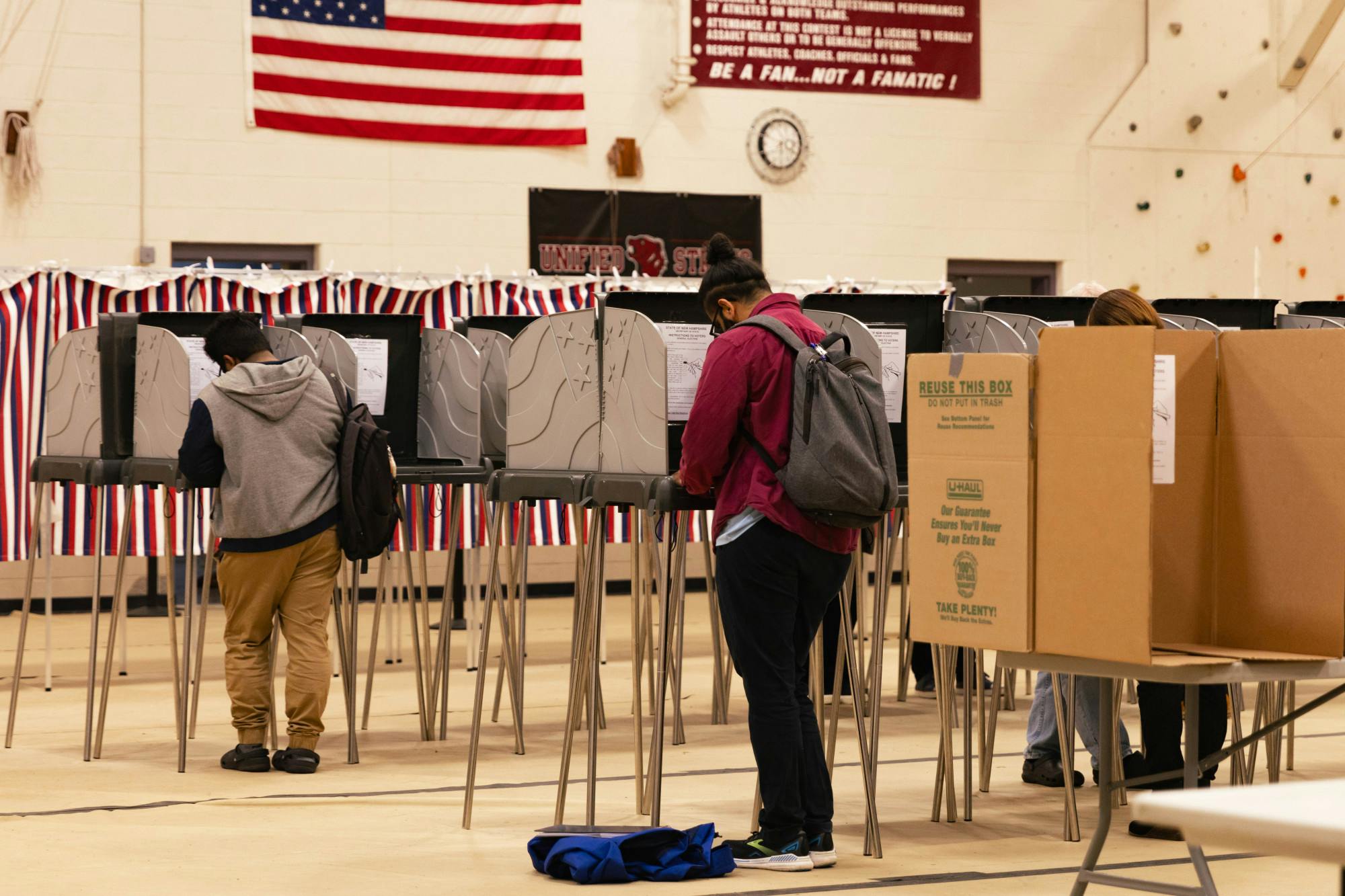
Last month, two state voting laws went into effect that will require absentee voters to submit photo IDs along with documentation of citizenship, age, domicile and identity.
The new laws, S.B. 218 and S.B. 287, come as President Donald Trump has appointed several proponents of his election fraud claims into high-level administration jobs.
Supporters of the bill said they were passed in an effort to make elections more secure. State Sen. Howard Pearl, R-Loudon, who sponsored S.B. 287, argued that the law prevents ballots from being “mailed to anyone’s address.”
“What we were trying to make sure is that [for] whoever’s requesting a ballot, that it is them that is requesting it,” Pearl said.
N.H. State Rep. Ross Berry, R-Hillsborough, who also voted for the bills, said that this could engender trust in the election system. He added that New Hampshire needed a system “where people don’t challenge the outcome.”
“The old system, where you could show up with no ID, did not instill any faith in the outcome of the election,” Berry said.
Critics say the new laws may make absentee voting more difficult. Government professor and N.H. State Rep. Russell Muirhead, D-Hanover, who voted against both bills, said they “burden the right to vote in an effort to solve a problem that doesn’t exist.”
“There’s no actual fraud that is occurring,” he said.
State Sen. Rebecca Perkins Kwoka, D-Portsmouth, who also voted against the bills, noted that S.B. 218 requires newly married individuals who have changed their names since the last election to present their marriage certificates to vote absentee.
“Election Day is busy,” Kwoka said. “For women who are married or might have children, they have to get to school or daycare [or] get to work, [and] now into that day they need to [be] finding their marriage certificate.”
She also argued the bills could have a “disproportionate effect on our military voters.”
“They almost always vote by absentee ballot, especially if they’re overseas,” Kwoka said.
Lecturer in the writing program and N.H. State Rep. Ellen Rockmore, D-Grafton, who voted against the bills, said the bills will “disenfranchise people who should be permitted to vote.” Rockmore pointed out that “not everybody has access to a birth certificate.”
“People move around a lot, sometimes documents get lost,” Rockmore said.
Kaylie Efstratiou — who serves as a development and communications associate for voting rights organization Open Democracy — said that in 2022, a bipartisan committee found “no evidence of widespread fraud” in New Hampshire.
“There’s a lot of pride in our elections and how they’re very efficient, and we don’t have really many problems with them,” Efstratiou said.
She added that “access” to voting was the biggest problem in the state’s elections, noting that New Hampshire was now the only state in the Northeast with a proof-of-citizenship rule.
“In 2022, we were ranked as last in the country in the cost of voting index, which is a study that refers to how easy or hard it is for voters to cast ballots in each state,” Efstratiou said.
Muirhead said that “the main problem” in U.S. elections was “relatively low turnout rates.”
Approximately “forty percent of the people don’t even show up to vote in most elections,” Muirhead said.
Dartmouth Civics research director Cooper Ballard ’28 said the bills are “hurting people's abilities to get registered to vote.” Dartmouth Civics is an organization that provides students with nonpartisan information about voting.
Kwoka said that she expected the new laws to cause people to be “turned away at the polls,” and added that the restrictions “undermine our democracy.”
“We’re definitely making it harder for people to vote,” Kwoka said.
Madeline Kahn Ehrlich '29 is a reporter from upstate New York. She is considering studying English and Public Policy. She enjoys creative writing, art and reading historical fiction.