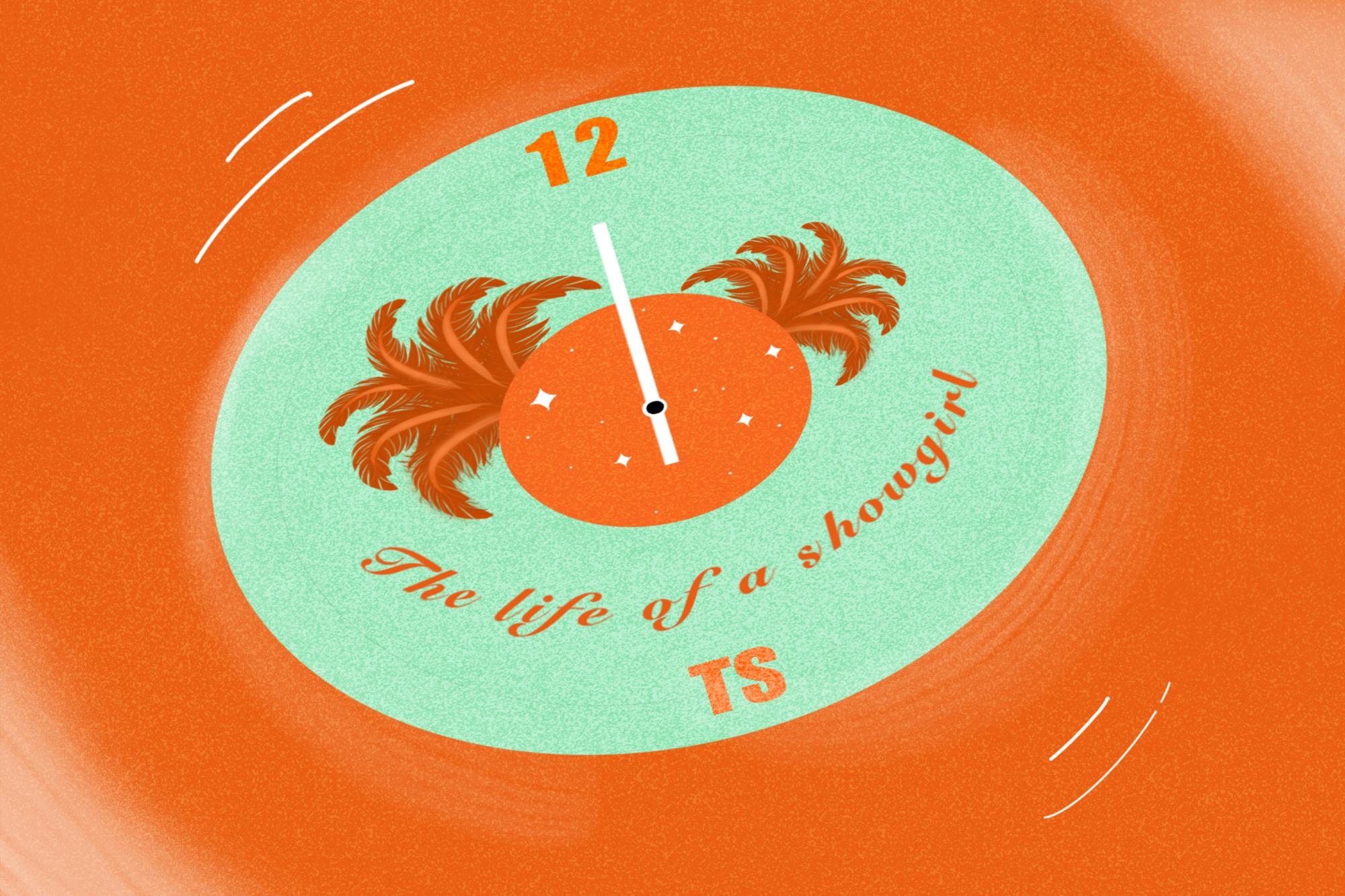
Feather boas. Bodies dripping with rhinestones. Burgundy stage curtains fading into shadow. This was the promotional imagery for Taylor Swift’s 12th studio album “The Life of a Showgirl.” Written and produced during Swift’s The Eras Tour by Swift, Max Martin and Shellback, this is a record about performance. It leans into spectacle, teasing some sort of confession behind its glittering facade that is never quite revealed. Over 12 tracks, Swift slips between contradictory personas, leaving the listener uncertain as to which, if any, are real.
Opener “The Fate of Ophelia” serves as a microcosm for the entire album: part dazzling and part awkward — and wholly inconsistent. The sparkling synth pop track rewrites the story of Shakespeare’s doomed character, Hamlet’s love interest. Such literary allusions are par for the course in Swift’s writing, and this one had the potential to be a powerful conceit; the title suggests a modern meditation on female agency and madness. Instead, Swift sacrifices commentary for incongruous language and flimsy metaphor, misremembering “Hamlet” and relying on overused tropes. The song also suffers from a lack of setting, which creates a sense of instability. The proximity of lines like “I sat alone in my tower” and “pledge allegiance to your hands, your team, your vibes” is disorienting — are we in a 15th century Danish castle or on an NFL football field? Despite all this, I’ve still found myself humming the chorus over the past week. Swift certainly knows how to write a pop hook, and supported by the production’s crisp drum line and melodic bass, this one is undeniably catchy. Yet as a believer in her lyrical storytelling, I’ve come to expect more than just an earworm from Swift. While alluding to depth, “The Fate of Ophelia” gets lost in its ambition.
Despite its sequin-studded aesthetic, the album seemed to promise a glimpse behind the glitter. “Elizabeth Taylor” is the most successful at this, immersing us in a world of Old Hollywood glamour and romantic desperation, and reflecting on the instability of love in show business. While the bass booms and Portofino beckons, Swift reveals a character who is utterly unrelatable — and not trying to be. “I would trade the Cartier for someone to trust … just kidding,” she quips. It works because Swift is able to support two coexisting truths: that she is both a billionaire superstar and someone who craves lasting connection like any of us. This tension comes through on this track, revealing the album’s “showgirl” protagonist to be someone whose experience is both very far from and very close to our own.
Too often, though, the dazzling exterior of this showgirl’s life is more salient than what lies beneath. True to its namesake, “Opalite” is bright, shiny and synthetic. The crisp, sterile production and nonsensical chorus lyrics create a mere illusion of meaning, a shadow puppet of a song cast against a shimmering surface. The same is true for “Actually Romantic,” the album’s obligatory diss track. In it, Swift patronizes the song’s subject with the choral line, “It’s actually sweet, all the time you’ve spent on me.” In theory, it’s a clever device, with the potential to scathe, but Swift’s deliberate apathy comes across as inauthentic and immature. Her performance of indifference doesn’t hit the marks, forgetting that there’s nothing wrong with admitting that you care.
On the other hand, “Ruin the Friendship” — the record’s subtle centerpiece as the sixth track — cares deeply, pairing emotional storytelling with compelling instrumentation. More stripped back than other tracks in its production and use of metaphor, the song also benefits from a clearly established setting. We are transported from the lights and luster of Hollywood to the simplicity of suburban high school life, recounted with bittersweet nostalgia. A wilted corsage, a 50 Cent song playing, polished wood floors and a cheap disco ball scattering white light around the room — all these details feel real. Through the clarity of this setting, Swift tells us a story of youth, death and regret — and we believe her. It’s profound and effective because it isn’t trying to be something it’s not.
The sincerity and restraint that makes “Ruin the Friendship” so affecting emphasizes the awkwardness of many of the record’s other lyrical choices, rife with clumsy pop culture references and forced slang. “Eldest Daughter,” the designated vulnerable and heartbreaking “track 5,” contains one of the most poignant and devastating lines of the whole album: “When your first crush crushes something kind.” However, the line’s emotional weight and atmospheric production are overshadowed by the plethora of surrounding “cringey” lyrics, such as “Every joke’s just trolling and memes” and “I’m not a bad bitch and this isn’t savage.” I could go on, but I honestly don’t want to. Similar lyrics punctuate “Wi$h Li$t” (“Boss up, settle down”), “CANCELLED!” (“Did you girlboss too close to the sun?”) and “Wood” (“His love was the key that opened my thighs”). The last was most disappointing to me, contaminating an infectious 70s-inspired pop arrangement with excessive phallic symbolism and innuendo that feels more embarrassing than sexy.
“The Life of a Showgirl” distances Swift from her listeners with its out of touch references, misleading aesthetics and unwieldy language. The sticky hooks and glossy production of the record shimmer like a mirage, sparkling from a distance but dissolving under scrutiny. I look forward to when Swift reemerges from behind the sequins and shows us the storyteller that shines at her best.