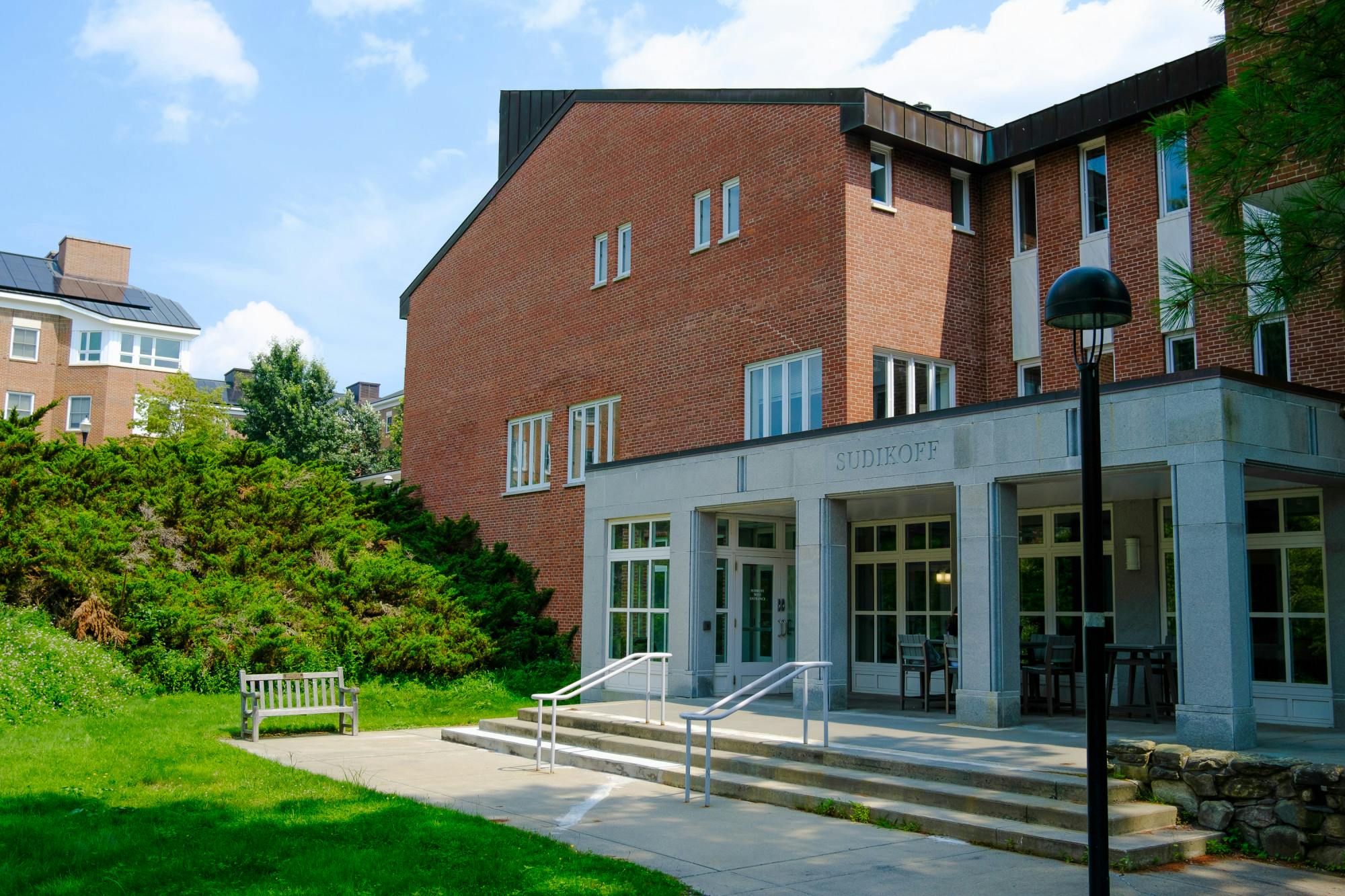
Nestled behind Baker-Berry on Maynard Street, Sudikoff Hall is a campus diamond in the rough. From serving as a computer lab to hosting temples and student study spaces, Sudikoff has lived many lives. But it hasn’t always been this way.
Before the College began using it, the building once served as a mental health ward for the Mary Hitchcock Hospital. Dartmouth purchased the hospital’s properties in the late 1980s, seeking new spaces. In 1993, the space was renovated into a new home for the computer science department, and it remained so until 2018. Since then, the building has been home to a rotating cast of occupants. The DALI Lab shifted from the first floor to the basement, Studio Sudikoff took root and even the Hindu Temple relocated there when Rollins Chapel underwent renovations.
But the most significant transformation came when the Hopkins Center for the Arts closed for renovation, forcing music and theater programs to relocate. For two and a half years, Sudikoff became an improvised music and theatre hall. Former classrooms became makeshift practice rooms for student musicians, prop rooms for the theatre program and instrument storage facilities.
Kate Graham ’28, a violinist in the Dartmouth Symphony Orchestra, was one of the many frequent users of the temporary music facilities in Sudikoff. According to Graham, since the building’s original design did not consider musical acoustics, student musicians had some trouble adjusting to the Sudikoff environment.
“It definitely was a temporary situation, which was evident in the quality of the noise canceling of the facilities,” Graham said. “The setup was not intended to be supportive of musical groups.”
Beyond the lack of infrastructure, musicians often also ran into challenges finding adequate space for practices. With growing demand for music facilities, Sudikoff occasionally lacked space to accommodate all musicians.
“One of the issues with the Sudikoff space was the amount of practice rooms did not match the demand for students that are looking to practice at certain peak practice hours,” Graham said. “I found myself often waiting a little bit of time, especially when other community members would come in to take lessons.”
Ultimately, although the facilities came with their challenges, there were still some upsides to being housed in Sudikoff.
“I do miss having a window,” Graham said. “You still could have natural light in a practice room, which you do not get in the [Hopkins Center], which definitely is a little sad. You’re in there for over an hour, and you come out and you’re like, ‘Oh, I haven’t really seen the light of day in a while.’ It’s a little depressing.”
Though Sudikoff presented challenges for music students, its adaptable layout allowed other groups to make the space their own. For the First Generation Low Income Office, relocating to the first floor of Sudikoff two years ago brought both more room and a more welcoming atmosphere. Having moved from the church to the first floor of Sudikoff, the difference is already visible to those involved, including Jay Davis, the director of the First Generation Office.
“It’s allowed us to have a space that the first gen students feel is their own space, where they’re comfortable,” Davis said. “[It’s a space] where they feel protected and where they can connect with their peers at any time of the day.”
The transition came alongside renovations designed to make the space more welcoming. According to Davis, new wall colors, added kitchen appliances and new supply closets helped transform Sudikoff’s once-empty hallways into a place of warmth and community. The expanded space has also allowed the FGLI office to host events for their students. From studying with fresh fruit to painting pots, the office has become a forum for community building.
“Those sorts of events I think are a big deal here because students feel that it’s a space they know they can come get something fun,” Davis said. “They can say hi to people. They can be here for one minute, or can they be here for three hours. And so I think an important part of our atmosphere is that it’s informal. It’s not a classroom space where people you know learn in a workshop. It’s more of a chance to connect with each other.”
Though the FGLI office continues to occupy the first floor, as the music department returns to the renovated Hopkins Center, Sudikoff is once again partially vacant, raising questions about its next use.
Campus Planning senior director Joanna Whitcomb helps decide the future of the building alongside the provost, Santiago Schnell.
“It’s an empty building,” Whitcomb said. “We’re looking at what makes the most sense and what are the needs across campus.”
In the meantime, the College is using the vacancy to address deferred maintenance: repairs, updates and general upkeep after years of heavy use and temporary retrofits. Beyond that, its future is unwritten.
“There’s a lot of space demands,” Whitcomb said. “The provost is the ultimate decision maker on who will go into what space and what makes sense … in terms of institutional needs.”
Whatever comes next, Sudikoff’s story is far from over. From its decades as a computer science hub to home for the FGLI office, Sudikoff has always met the College’s evolving needs, remaining a quiet cornerstone amid the ever-changing landscape of campus life.