
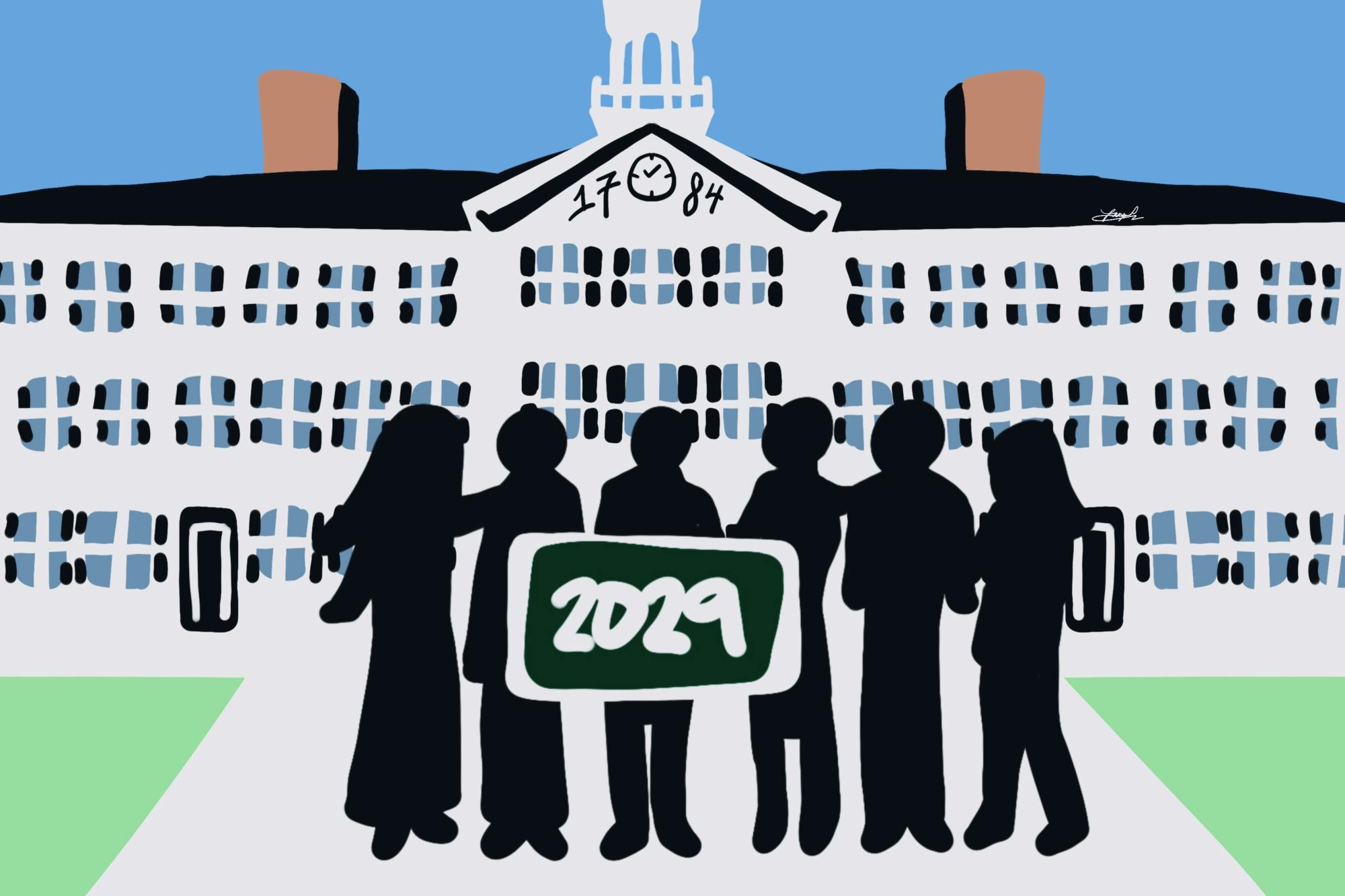
As autumn settles over the Green and the initial excitement of move-in day gives way to the steady rhythm of college life, Dartmouth's newest students are finding their footing in ways both familiar and uniquely their own. Three weeks into their first term, the Class of 2029 is navigating everything from confusing campus buildings to social spaces, all while picking up some Dartmouth slang along the way.
An overwhelming sentiment among first-years seems to be one of pleasant surprise at how naturally community has formed. Chris Cummiskey ’29 reflected on his early anxieties about finding his place.
“I was kind of nervous about finding community and being able to make a lot of friends,” Cummiskey said. “But I feel like that’s actually come really naturally. Everyone is super excited to be here, and the community is awesome.”
Sonja Talwani ’29 echoed this warmth, adding that "everybody here has been so welcoming and inviting.”
“Honestly, I couldn't ask for a better couple of weeks," she said.
Cummiskey has found that early sense of belonging to be present, not just socially, but politically, noting that Dartmouth “definitely feels like a very open campus.”
“I’m definitely more left on the spectrum, and I have friends that are more right,” Cummiskey said. “I’ve already been having pretty good conversations about stuff that's going on in the world and country. I feel like it’s definitely a very free speech kind of place.”
Much of this early bonding can be traced back to New Student Orientation, which Henry Brown ’29 described as notably distinct from regular academic life.
“There’s a stark difference between orientation and when classes start,” Brown explained. “It's kind of a special time when you don’t really learn anything or do any work, and it's more about community building than anything else.”
The cornerstone of that community building, Dartmouth's famous First-Year Trips, lived up to its reputation for most students. Talwani found particular joy in the quieter moments of her hiking trip.
"My favorite part was the Sklodj,” Talwani said. “It was really nice to just have a break from all the craziness of orientation before that, and have just a small group of eight people to focus on.”
For Miranda Algire ’29, who chose a cabin camping and cooking trip, the experience provided a much-needed respite from the intensity of orientation.
"The first three days [of Orientation] were go, go, go,” Algire said. “I was asleep for like an hour a day, perpetually exhausted. And then we went on Trips, and it was just awesome having five other groups hanging out in the cabin section.”
While Trips provided an introduction to Dartmouth, navigating the actual campus has presented its own learning curve. Most students have turned to technology for help, though even that has its limits.
“I’m in the dance program, and since [the Hop] just got renovated, no one knows, even people who worked there, where anything is,” Algire said. “So it's stressful because I'm sprinting from one room and spending 10 minutes looking for whatever the room was.”
For students dealing with physical challenges, the campus navigation becomes more complex. Sebastian Lema ’29, who is managing a leg injury, notes that “it’s not a very accessible campus.”
“I never really thought about that before, but I live in Mid Mass and there's no elevator, so [being on] the third floor makes it a little tough,” Lema said.
Once students find their classrooms, they’re discovering academic experiences that are opening new intellectual doors. Talwani is particularly enthusiastic about her NAIS 25: “Indian Country Today” course.
“I’ve never had the opportunity to study Native American and Indigenous Studies, and it’s like there’s been a door opened to a bunch of opportunities,” she said.
Beyond academics, students are discovering that Dartmouth’s extracurricular scene is far more competitive than many expected. Algire described her intensive dance audition process.
“Auditions took two full days,” she said. “With 120 [people] trying out, it was a really intense environment with so many rounds of elimination. I didn't expect it to be quite that competitive.”
Abram Twede ’29 expressed surprise about this level of competition, pointing specifically to finance clubs and pre-professional organizations.
“I was surprised at how competitive a lot of these clubs are to get into,” Twede said. “I just thought when I got into a selective school that I was going to automatically be able to do whatever I wanted. But then I realized that these kids are standouts as well, so they’re going to want to be in the best clubs and do the same things I want to do.”
Meanwhile, other students have gravitated toward different types of involvement. Cummiskey, for instance, has found his niche in outdoor pursuits.
“I’ve been to winter sports club meetings,” he said. “I’m an apprentice for [Ski Patrol], and then I plan to be in surf club.”
Talwani is exploring advocacy work alongside her other interests, expressing interest in Dartmouth Democrats and Fossil Free Dartmouth and finding those groups to be “very welcoming.”
“Right now, I'm kind of just trying out everything and seeing what sticks, because I can always drop something, but I feel like it's harder to get involved in the middle [of the term],” she said.
Due to Dartmouth’s policy barring first-years from Greek life until November, traditional fraternity and sorority activities are off-limits, requiring creativity for weekend entertainment. Lema offered a candid assessment of the current social scene.
“I think it’s a little weird, because you just get to some basement, and then [Safety and Security] comes, [you] get somewhere else, and then [DoSS] comes again,” he said.
Despite these interruptions, he maintained that there’s “a lot of just hanging in people’s dorms, and it’s been good.”
Rather than seeing these limitations as restrictive, many first-years have embraced alternative programming. Talwani, for one, has become an unexpected Collis Bingo regular.
“I get really into bingo,” she said. “I won sunglasses and a $30 gift card to the bookstore in town.”
As students adapt to these social realities, they’re also rapidly absorbing Dartmouth’s rich tradition of creative slang, picking up terms like “sagement,” a clever portmanteau of Russell Sage and basement, and "chunctions,” or Choates functions. The dining hall has proven particularly fertile ground for linguistic innovation. Talwani proudly shared her attempt at coining a new term.
“On my First-Year Trip, we all tried to coin the term 'aboco' for above Foco,” she said.“I'm really hoping that becomes a thing.”
Brody Gifford ’29 mentioned that his friend group asks if anyone is “DTF, or Down To FOCO,” while others have adopted “Falad Bar” for the salad station and “Fookie” for the popular dining hall cookies.
As the Class of 2029 settles in, they’re learning one Google Maps search and one “DTF” group text at a time. Their willingness to admit confusion is refreshing, as are their acknowledgements that getting into a good school doesn’t automatically make everything else easy. They’ve discovered that even at Dartmouth, weekends sometimes include getting kicked out of basements by campus security, that making friends requires more effort than they expected and that the dining hall cookies might actually be worth the hype. And perhaps that’s the most Dartmouth thing about them yet: the understanding that being here isn’t about having it all figured out, but being okay with figuring it out together.


