
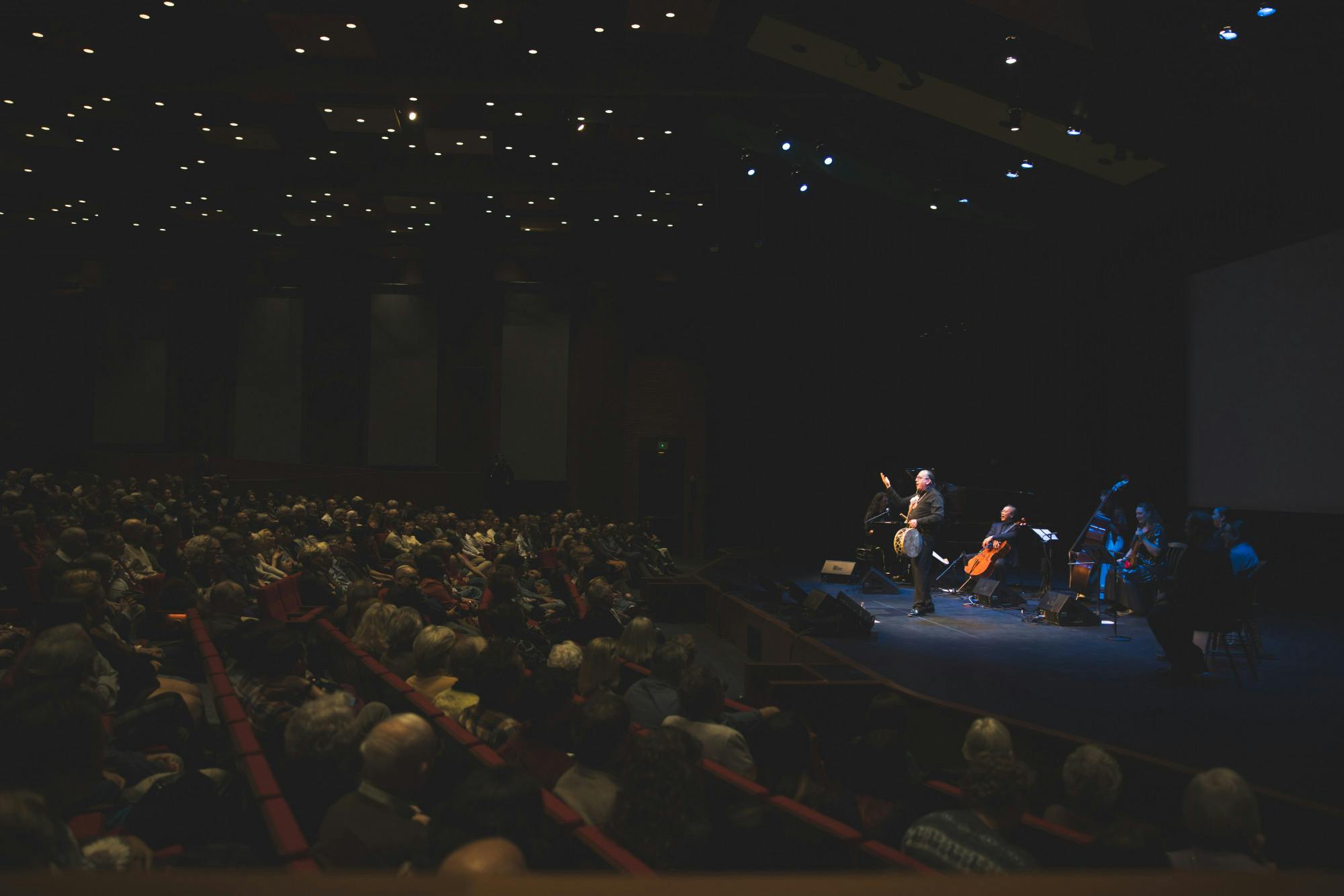
The Hopkins Center for the Arts hosted cellist Yo-Yo Ma for the world premier of “We Are Water: A Northeast Celebration,” a multi-medium performance including music, storytelling and poetry from both Western and Indigenous traditions.
The performance, which honored the Hop’s reopening, emphasized the connection between the College and the land on which it was built.
A recipient of the 2010 Presidential Medal of Freedom and 19 Grammy Awards to date, Ma has recorded over 100 albums and is known for bringing classical music to a wider audience. Alongside Ma, the performance featured Canadian musician Jeremy Dutcher and Indigenous musicians Mali Obomsawin ’18 and Chris Newell ’96 alongside the Icelandic writer and film director Andri Snær Magnason.
Following a Wabanaki musical performance led by Dutcher, Obomsawin and Newell, Ma performed Bach’s “Cello Suite No. 1 in G major,” which he recorded in his 2023 album “Nature at Play.” The evening was subsequently divided into shorter segments of music of both Western and Indigenous origins, including some segments that integrated music from both traditions.
“It was a bit different from your typical standard classical Yo-Yo Ma performance, where you maybe play a concerto and some Bach cello suites,” cello player and Dartmouth Symphony Orchestra member Tyler Grubelich ’26 said.
“But I really liked how [the performance] showcased both [Ma’s] own ability as well as the ability of all the other musicians that they bought out,” he added.
The prevailing theme of the performance was water. In an interview with The Dartmouth, Chris Newell ’96 described the connection between the title “We Are Water” and Ma’s process for “learning” the Bach piece — particularly the complicated “flowy” prelude.
“The way [Ma] ended up finally finding his groove was to imagine a river flowing and that he was simply jumping into the flow,” Newell said.
He added that the pieces Ma selected for the solo were “all connected to water by him in some way, shape or form.”
In an interlude to the musical performance, Magnason recited some of his poems related to his experience with climate change and water as an Icelander. During an event prior to the show, he explained that his poems were especially informed by his experience as an environmental advocate against the construction of dams for hydroelectricity and smelters.
His poems touched on the rapid increase of the rate of climate change, including its shift from geological to “human” timescales. He described his experience witnessing glaciers recede over lifetimes instead of generations.
Newell explained that the decision to include poetry in the performance reflected the artists’ desire “to first indigenize peoples’ understanding of water and waterways, to make them think about it a little differently.” He added that they wanted to “globalize” the discussion around the “crises of water.”
The performance also included segments of music accompanied by Indigenous storytelling specifically connected to Dartmouth’s land, highlighting its Wabanaki origins. These stories referenced rivers close to Dartmouth.
Executive director of the Hop Mary Lou Aleskie said this connection to the local environment was intentional.
“Here at Dartmouth, we’re graced by a very unique, beautiful rural environment and dominated by a river that we do not always think about,” she said.
The storytelling was accompanied by giant interactive animals, including a water monster and a giant frog-like creature. In the second story, a hero helped defeat the frog-like creature Aglebemu who had hoarded a river’s water, causing the water to be released again. To create the illusion of a river, pieces of fabric representing water were released from the frog’s mouth and passed through the audience throughout the story.
Other segments included performances of Western folk songs, including the Irish folk song “Only Our Rivers Run Free.” The evening ended with a traditional Abenaki healing song in which audience members were invited to learn and sing lyrics along with the performers.
Aleskie said “We Are Water” reflected her belief that art is an avenue for social change.
“I hope that we can have a conversation about the role of arts and culture in shaping the way we think about solutions to humanity’s deepest issues and deepest challenges,” she said.
In addition to the live performance, a livestream of it was available for audience viewing on the Dartmouth Green, where the Hop hosted pre-show square dance lessons led by dance caller Sarah Gibson with the Vermont band The Speckers.
Aleskie acknowledged that the nontraditional performance may have subverted audience expectations of Ma, who is typically known as “one of the most world renowned classical musicians.”
Yet with its unconventional format, Aleskie said she believed “We Are Water” offered a new and more nuanced experience of art.
“This isn’t your grandmother’s Bach concert,” she said. “You can go do that in a concert hall in Boston or New York and all over the world, and we’ve done it here — but this was different.”


