
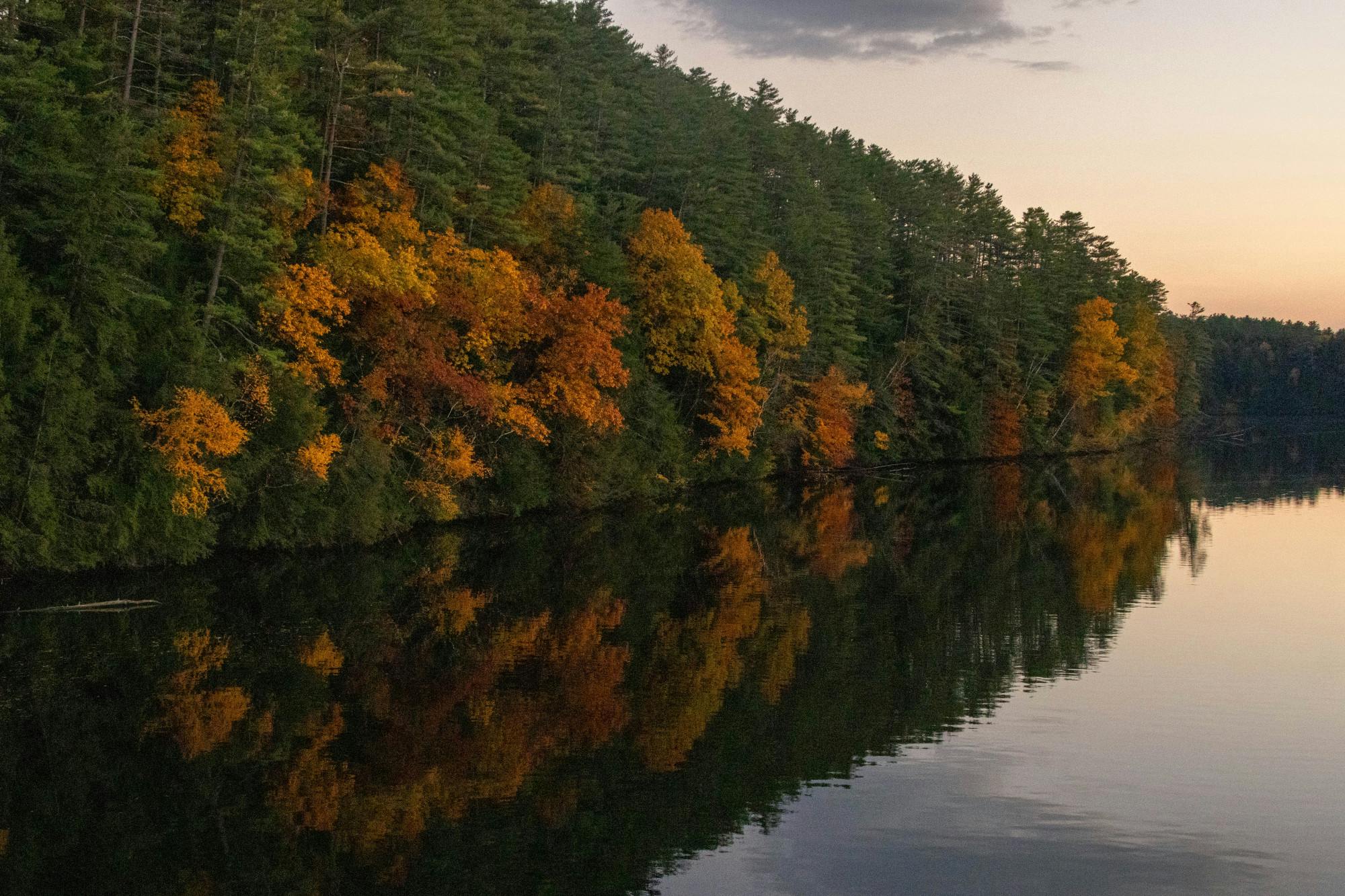
A wide swath of central New Hampshire, including Hanover, is currently facing its most extreme drought since 2000, according to the U.S. Drought Monitor.
The drought poses a variety of economic and ecological threats to the Upper Valley, including lowering agricultural yields and residential well levels, increasing wildfire risk and dulling New Hampshire’s iconic fall colors, according to geography and Earth sciences professor Jonathan Winter.
“Dry conditions dull the foliage, so the colors aren’t as vibrant,” Winter said.
Some towns in the area, including Lebanon, N.H., have implemented water-use restrictions, although Hanover’s reservoir levels remain “stable,” according to the town website.
This fall’s drought disrupted Dartmouth’s fly-fishing First-Year Trips in the Second College Grant. The Grant, a 40-square-mile parcel of land in Coos County, N.H., is experiencing a “moderate” drought.
Glenn Booma GR, who teaches fly-fishing to First-Year Trips in the Second College Grant, said the drought this fall has reduced the flow of the Dead Diamond river to its lowest level since 1952. He added that some of the smaller streams in the Grant “literally have no water in them,” and so first-year tripees this year have caught far fewer fish than normal.
On a First Year Trip in 2023, one experienced student "caught fifteen or twenty fish,” while in this year’s trip the top students only “caught two or three fish,” according to Booma.
Keith Fritschie GR, who studied trout in the Grant for his doctoral research, said that droughts can harm fish populations, particularly when they last for several years. He added that low water levels in streams and rivers can “severely disrupt” access to spawning sites for trout.
“This kind of drought in the fall can definitely hurt fish populations, but trout biology allows them to recover pretty quickly,” Fritschie explained. “The concern will be if we continue to have multiple years in a row where we have dry falls.”
Fritschie is continuing to study the effects of this drought in the Grant, and he said that a clearer picture of how the trout population is responding will be available in October. In the meantime, anecdotal evidence from First-Year Trips suggests that the number of fish in the Grant has declined.
“We didn’t catch anything,” Carmen Esparza Quevedo ’29, who went on a fly-fishing First-Year Trip in the Grant this fall, said.
Winter, who studies climate change, said that rising temperatures around the world can make drought conditions worse.
“We are always going to have periods when we have very little rainfall,” he said, but climate change may create drought conditions “more quickly” than usual.
While more heat in the climate system plays a role in drought, climate change can also increase rainfall in some areas, according to Winter.
Climate change “makes weather warmer, so we have this potential for drought, but … we’ve also seen an increase in rainfall,” Winter said. “So we’re not quite sure how it’s going to shake out on average. But we can say we’re in drought now.”
Geography professor Justin Mankin agreed, stressing that while anthropogenic climate change has caused “enhanced drought risk” in New England, warmer temperatures “tend to be” associated with “higher humidity” he said, which can cause “extreme precipitation events.”
“If you look at the observational era and look at precipitation trends over the Northeast, what’s really clear is that precipitation has generally been increasing,” Mankin said. “New England is getting [more] wet as the planet warms.”
Teo Steverlynck-Horne is a reporter from Maine studying economics and government.


