
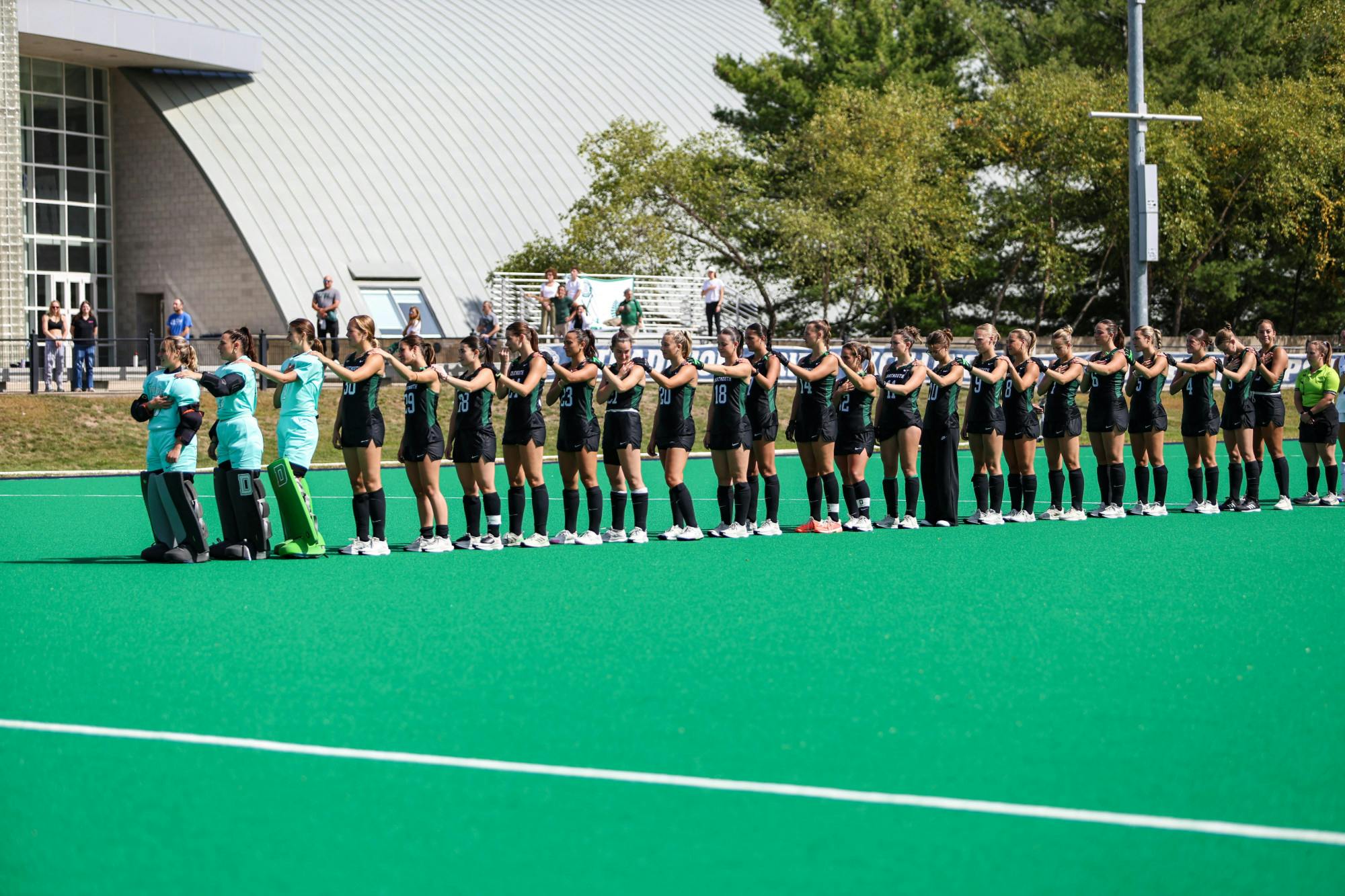
Dartmouth field hockey opened its season with consecutive victories against Bryant University and the University of Maine. While they have dropped five straight games since their hot start, the team has approached practice with consistency and intensity.
To prepare for playing two games each weekend, the team works through a tight practice schedule that includes multiple scrimmages, conditioning and drills. After dividing players into two teams, players focus on one or two specific skills for the week.
Head coach Mark Egner explained that the ideal Division I field hockey player has strong technical skills while also maintaining a rapid pace.
“There are many technical skills they need — to eliminate the opponents’ passing range, their depth of their technical toolkit and trying to be very specific about where [players] lead and how [players] move,” Egner said. “All while being part of a game of high-speed running.”
During practice on Sept. 25, with upcoming games against the University of Pennsylvania and Lafayette University, players focused on corners, which are technically difficult with a high probability of scoring. According to defender Ella Bowman ’27, practicing corners is critical because with eight players on offense against four defenders at the goal, “a lot of goals are scored.” Corners also provide an opportunity to implement highly technical set plays, which contrasts with the typical free-flowing game.
To keep the team at the top of their game, Egner and the coaching staff put the players on a rigorous training schedule. Players practice drills four times a week, including on Tuesday when the team plays a scrimmage to mimic game day. Along with on-field training, players have strength and conditioning training on Tuesdays.
Aside from physical fitness, Egner emphasizes the importance of reflection and community as a way to move the team forward. Time for careful analysis of team performance and opponents’ styles is built into training.
“[It gives us] a detailed idea of who we are playing, how they’re going to play, which of our strengths are really going to work toward shutting down their strengths,” Egner said.
At the end of the week, the team analyzes videos of each player as well.
To keep building on improvement, the team emphasizes the importance of community to moving players forward. Midfielder Olivia Galiotos ’26 said that the team has “revamped” their culture over the offseason, which is central to helping everyone improve.
“We’ve come up with four values that we try to impersonate every single day, and that helps us with our mindset and helps us have that pride,” she said. “[Those values are] joy, growth, unity and pride.”
Fellow senior Floretina Terra ’26 added that the team has a culture of equality, regardless of age or experience.
“We also have a mentality within the team that everyone’s on that same level,” Terra said. “No one is better than anyone just because they’re older.”
Being able to openly communicate as well as integrating freshmen into the community has been essential for team-building. Through trips to cabins and lakes, and hanging out with teammates outside of the field, the players have seen better results.
“Basically everything, offensively and defensively, hinges on great communication,” Bowman said. “We can communicate effectively and cohesively.”
Egner echoed this sentiment, and said that the team focuses on community-building even during high school recruitment.
He said they emphasize “who [athletes] are as a person” and whether they can help create a “healthy team culture.”
Watch the team play against Columbia University and the University of Massachusetts, Lowell, this Friday and Sunday in Hanover.


