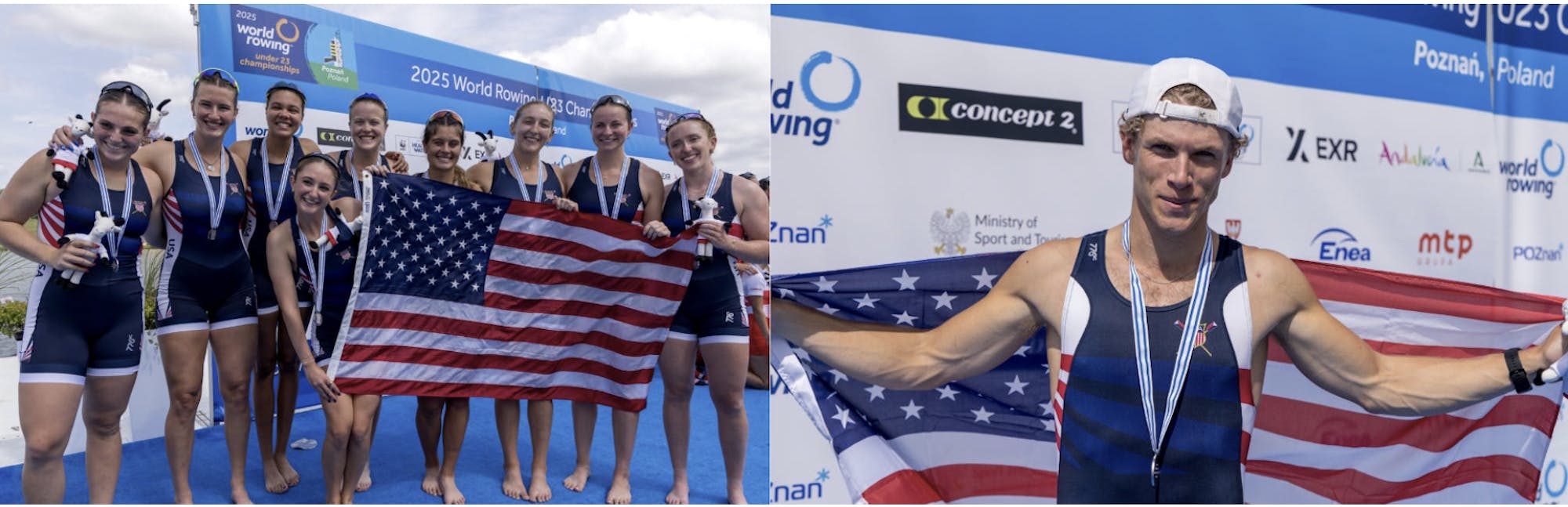
Last week, at the World Rowing Under 23 Championships in Poznan, Poland, Dartmouth rowers Cosmo Hondrogen ’28 and Áine Ley ’26 earned silver medals for the United States in the lightweight men’s single sculls and women’s eight, respectively.
Hondrogen, who was the youngest of the athletes in the individual sculls Final A event, finished less than three seconds behind Halil Kaan Koroglu of Turkey. Before hitting the national stage, Hondrogen was part of the varsity eight boat that earned the Big Green silver at the Intercollegiate Rowing Association lightweight national championships.
Ley made her second consecutive appearance on the United States varsity eight boat in the U23 World Championships, consisting of eight rowers. She received first team All-Ivy honors after helping Dartmouth women’s rowing reach the NCAA championships for the first time in 14 years.
The two rowers sat down with The Dartmouth to discuss their reflections on the tournament and their goals for the future.
Describe your experience at the World Championships. How did the races go?
CH: Honestly, it was intimidating. Since it’s U23, most of the guys competing at the event are at the end of their college career, while I’m just starting it. But it was pretty awesome to compete against some of the best guys at this level and learn from their experience. I was the most nervous for the first race because you don’t know where you stand, but my coach, Trevor Michelson, had full faith in me and I had a good heat. It gave me a lot of confidence going into the final that if I laid out a great race, I could win it all — or what I ended up with, a silver medal.
AL: Winning our heat by about five seconds was awesome. It’s a lot of fun to be up in a race like that and see the other crews behind you and know that what you’re doing is working. We definitely wanted to improve the second half of our race, though, heading into the final and I think we rowed cleaner and more aggressively in our second race. It wasn’t enough to beat a really strong crew from Great Britain, but I think everyone in the boat was really proud of our performance on Sunday.
What is the qualification process to get on the Worlds U23 roster? How was your experience?
CH: For the lightweight singles, there are trials at the beginning of the summer. You have to win that race and hit a certain competitive standard time. I wanted to keep the momentum from the Dartmouth season going so I trained for two weeks after the Dartmouth season ended in a single boat before going to trials. I was able to win that race and hit the time, and then Michelson brought me out to train in Oklahoma with the rest of Team USA. It was great to have a team to train with because training in the single can be a little lonely, and being surrounded by the best athletes in the country made me a lot faster.
AL: The national team coaches collect ergometer scores, physiological data and on-water experience/results and use that to determine the pool of athletes who are invited to selection camp. Once at camp, we do a ton of on-water racing in small boats to find the fastest combination for whichever boats are being selected at camp. Heading into camp last year, I was honestly terrified and told myself I would just see how long I could make it before getting cut. This year I definitely went in with more confidence, and it helped that I was familiar with the process and knew more of the coaches and my friends from last year.
How does it feel to represent the best of the United States rowing? How does racing at Worlds differ from racing at Dartmouth?
CH: Lining up the line and hearing them call the “United States of America” is a really special feeling. There is a little bit of a target on your back as the United States, and in a single it’s all on you. I had to make sure I was in the right place mentally and focus on what I was doing and not what rowers from other countries were doing.
AL: Representing the U.S. is an absolutely incredible feeling, and an opportunity I am so grateful for. The biggest difference is that when we are racing at Worlds, we’re able to focus solely on rowing. During the school year there are a lot of other obligations, and without that there are a lot more hours to spend on training, recovery and maximizing our performance. There’s also a lot more spectators, media and regulations than any race we have at Dartmouth, which can add to the nerves but is also so exciting.
What does it mean to represent Dartmouth on the national stage? How has Dartmouth developed your ability as a rower and as a person?
CH: The cool thing about Dartmouth is it’s so fun, both on and outside of the team. It doesn't feel like training is a chore because I get to go down to the boathouse every day and I love all the guys. It’s like a big family, and everyone has a lot of trust in our coaches and each other. It’s a great balance and it doesn’t wear on you too much because all the other guys are in it with you.
AL: I am so proud to get to represent Dartmouth on the national team, not only because I love Dartmouth but also because I owe so much to my teammates and coaches. Coach John Graves has taught me to be a better rower in all aspects of the word, and both my coaches and teammates have pushed me to be my best every day. I’m proud to call these people my teammates and friends, as they’ve shown me what it means to truly care for each other and for something bigger than yourself.
What are your goals, hopes and expectations for yourself and the Dartmouth team this upcoming season?
CH: We definitely have a fun season ahead of us. We returned seven out of the eight guys that were in the varsity eight that achieved a silver medal in the IRA championships last year, so we have pretty lofty goals. But honestly, for me, the important goal is to keep enjoying the progress and make sure the team is getting better every day. The results will speak for themselves after that.
AL: After accomplishing so much last year, I think we all want to see the team keep building off of that. I’d love to see us improve upon our finish at Ivies and go back to NCAAs and see how we measure up there. We had a pretty young team last year, have a big incoming class and in general there’s a lot of good energy right now. I’m looking forward to getting back to work!
This interview has been edited for clarity and length.
Sid Singh ’27 is a sports editor and reporter. He is from Bethesda, Md. and Singapore and is majoring in Economics and Quantitative Social Science. Sid is also an engagement manager for Consult Your Community and a member of the Raaz dance team.