
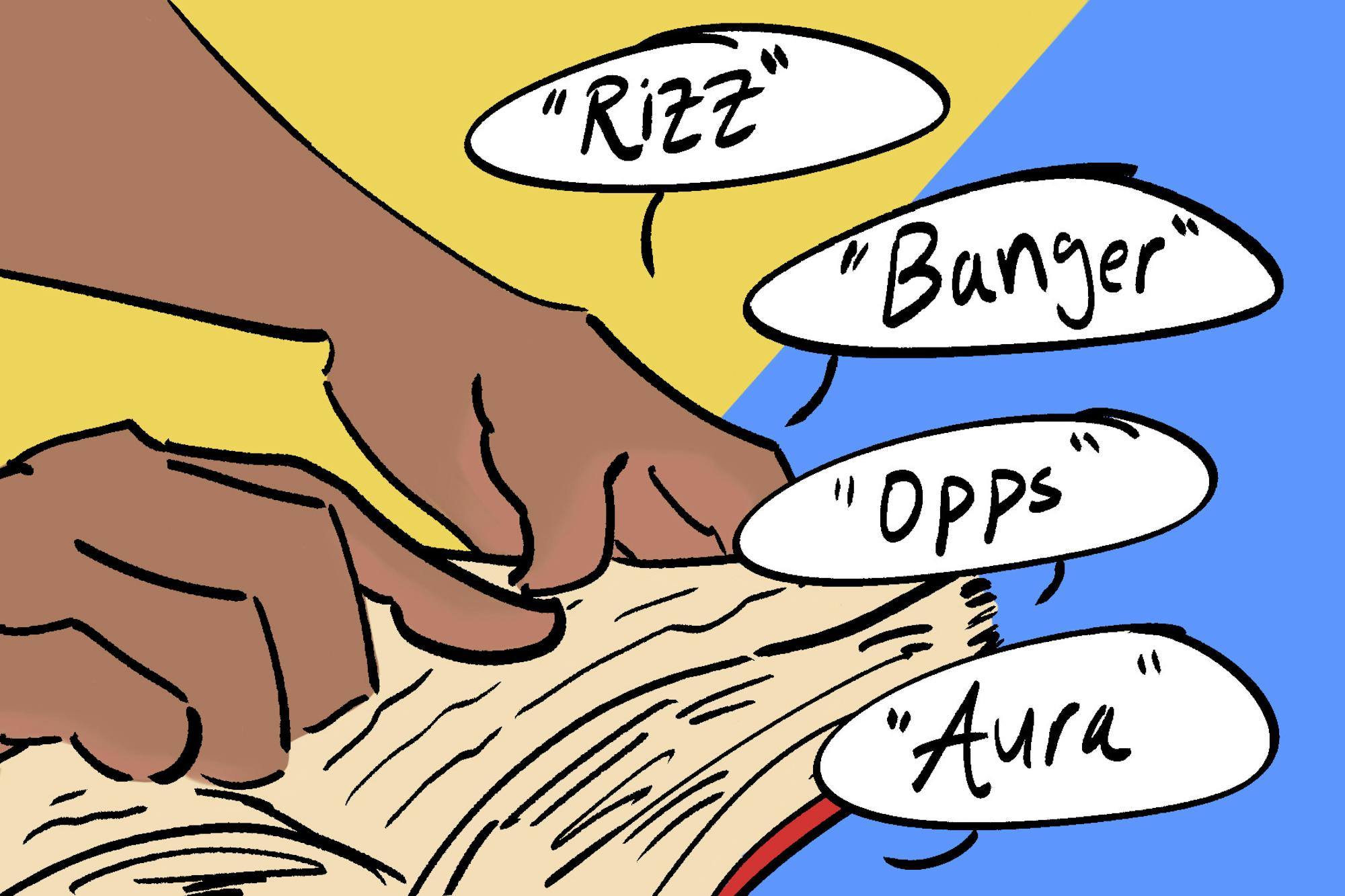
For international students like me, the Cambridge Dictionary isn’t just helpful for essay writing. It’s also a survival tool during dining-hall conversations and the occasional lost-in-translation group chat. Sure, it can help polish grammar and untangle obscure terms in class readings. But dig a little deeper and you’ll find something else entirely: words straight from the internet, slang that feels miles away from anything academic and is surprisingly similar to what your younger siblings are probably texting right now.
On August 18, Cambridge University Press announced that Gen Z and Gen Alpha slang words are among the 6,000 new entries added to its online edition over the past year. The lexical program manager at the Dictionary said that the internet is “changing the English language” in The Times of London on Monday.
The recently-added slang includes internet shorthand such as “delulu,” a play on “delusional,” which the dictionary defines as “believing things that are not true.” Other additions are clean abbreviations such as “inspo,” short for “inspiration.” The new words also include stylized spellings such as “lewk,” an alternative to “look” — meaning “a particular style, fashion, or outfit, especially one that is unusual and impressive.” In a press release, Cambridge highlighted how the term has been popularized by drag culture through shows such as RuPaul’s Drag Race. This addition reflects how the dictionary isn’t shying away from social media’s diverse mix of voices; rather, it treats them as central to the way in which the English language is evolving.
In the realm of relationships, Cambridge added definitions of the terms “green flag” and “red flag” that extend beyond literal signage. The dictionary now recognizes “green flag” as a “sign that something is good or is likely to succeed” while “red flag” can be a “sign that something bad is happening or could happen” — including specifically in a romantic relationship. With regard to workplace intimacy, the phrases “work wife” and “work spouse” were also added, referring to work colleagues with whom one’s relationship shares qualities of a marital one.
On the social-political front, entries included “broligarchy,” referring to a small group of “extremely rich and powerful” men in tech who “have or want political influence” alongside “tradwife,” an abbreviation of traditional wife referring to “a married woman, especially one who posts on social media,” who performs domestic duties.
The new words also touch on environmental politics with the inclusion of the technical public-health term “forever chemical,” defined as artificial chemicals that stay in the environment and accumulate in living things. The term demonstrates how climate anxieties are also part of today’s language.
In perhaps the most surreal example of all, the multipurpose word “skibidi” has found its place in the dictionary, too. “Skibidi,” according to Cambridge Dictionary, “can have different meanings such as ‘cool’ or ‘bad,’” or alternatively it can “be used with no real meaning as a joke.” Regardless of its meaning, its dictionary status is proof that a viral YouTube meme, once dismissed as meaningless “brainrot,” now sits alongside chemistry terms and political vocabulary.
However, some of this slang is far from being confined to the realms of social media. Earlier this year, Australia’s prime minister Anthony Albanese brought it into the domain of parliament, quipping that the former opposition leader Peter Dutton was “delulu with no solulu” during a heated exchange in the run-up to the federal election. This priceless moment showed just how far internet slang can travel from fandom jokes to the political floor.
In The Times, McIntosh said that he and the other Cambridge Dictionary editors only added words that they believed had “staying power.” It is fascinating how the made-up words we throw around half ironically end up formally within the English lexicon. Yet this process also makes sense upon some reflection. After all, humor shapes so much of our communication on social media: an engine that gives words reach and repetition. It would be fair to say that Cambridge has rizz for this one.


