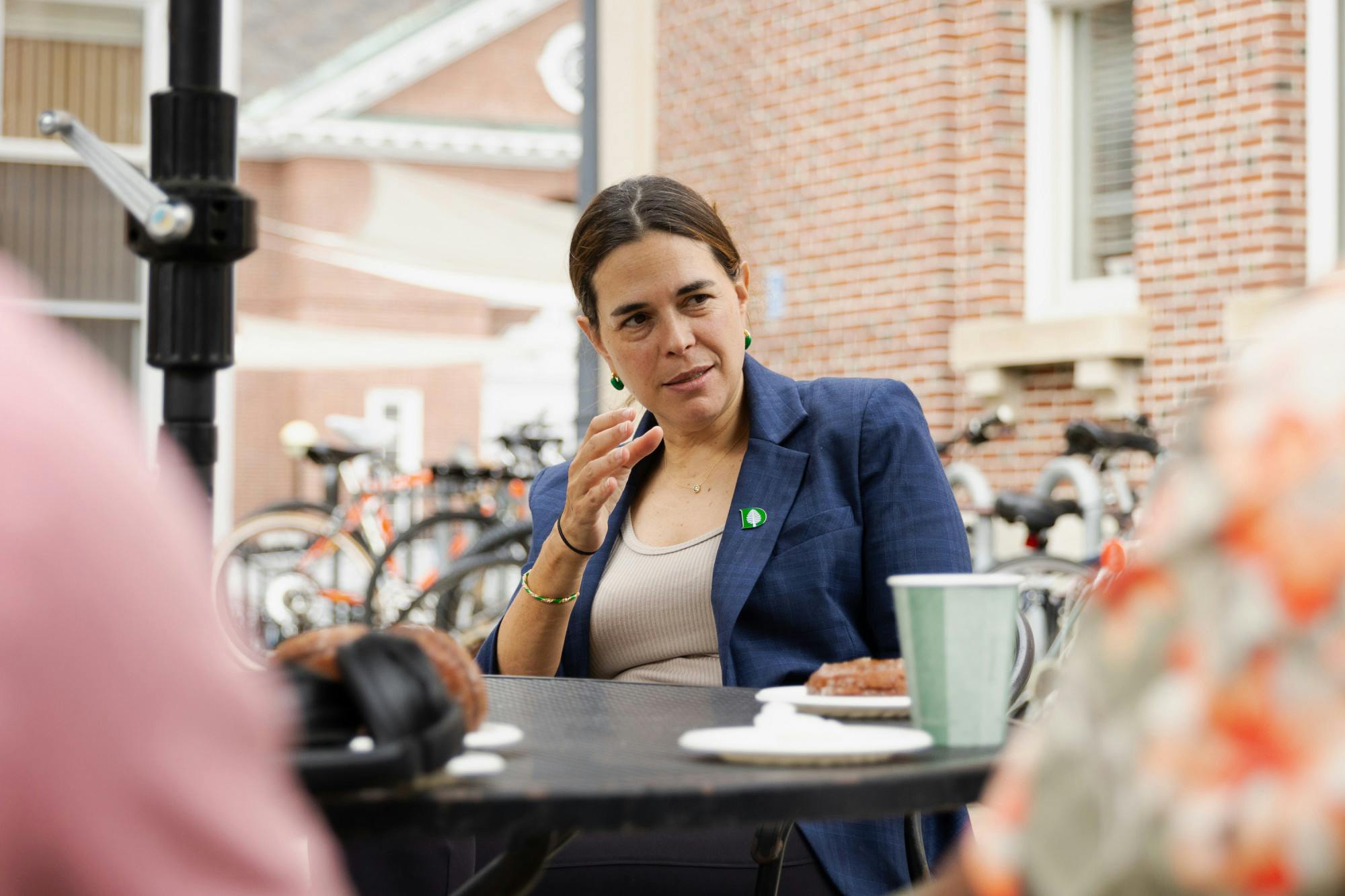
Throughout the summer, College President Sian Leah Beilock spoke across the country at multiple high-profile events about the future of higher education — including at the Sun Valley Conference in Idaho that brings together the country’s rich and powerful.
During talks at two non-profits in New York, she reiterated her belief in the importance of institutional neutrality as a tool for fostering campus debate. She also delivered the commencement address at the beginning of the summer for the Berkshire School, a boarding school in Massachusetts.
The first non-profit Beilock spoke at was the Chautauqua Institution, an organization in Chautauqua, New York, that “explore[s] the important issues of the day through lectures, performing and visual arts experiences, worship and interfaith programs and recreational experiences,” according to an email statement from the Institution’s director of communications Jill McCormick.
The topic of the lecture series that week was “Themes of Transformation: Forces Shaping Our Tomorrow.” Throughout her tenure, Beilock has gained national media recognition for leading the College’s institutional neutrality policy.
Notably, in September 2024, Beilock penned an article in The Atlantic titled “Saving the Idea of the University,” where she argued that college leaders should not impose their own viewpoints onto campus discussions.
“Our invitation was inspired by her September 2024 piece in The Atlantic and based on our typical vetting for a speaker’s ability to deliver a presentation that meets the high standards of the Chautauqua Lecture Series,” McCormick wrote.
During her talk, Beilock advocated for the “need” for a “new way of thinking,” according to the Chautauquan Daily.
“We need to redefine success not by prestige or ranking, or endowment size, but by actually providing that purpose in preparing our young people to lead,” she said.
Beilock reaffirmed her belief that colleges should foster education, ideological diversity and discourse, reflecting the arguments she laid out in The Atlantic.
McCormick declined to comment on how or whether Beilock was compensated for her talk.
Less than a week later, Beilock participated in a panel titled “The View from the Top” with Colgate University president Brian Casey, University of Denver chancellor Jeremy Haefner and Wesleyan University president Michael Roth in New York City.
The panel was hosted by Heterodox Academy, a membership-based non-profit organization of university faculty, staff and graduate students “committed to fostering a culture of open inquiry on college and university campuses,” director of communications and events Nicole Barbaro Simovski wrote in a statement to The Dartmouth.
Sixteen Dartmouth professors are members of HxA, including economics professor Meir Kohn, sociology professor and Political Economy Project program coordinator Henry Clark and Tuck School of Business professor Charles Wheelan, according to HxA’s website. This means they “embraced” the HxA’s statement “I support open inquiry, viewpoint diversity and constructive disagreement in research and education,” the website reads.
The panel — part of the organization’s 2025 conference, themed “Truth, Power and Responsibility” — was the second specifically with university presidents, Simovski wrote. HxA invited panelists who “demonstrated principled leadership” in their role as presidents and would be able to “offer expert insight” to its audience members.
“We valued [Beilock’s] principled leadership of Dartmouth with regard to fierce defense of the free exchange of ideas and her view of the critical value of constructive disagreement in education,” Simovski explained. “Beilock has been leading Dartmouth in ways that align with the HxA mission since she began her tenure as president, and we were thrilled to bring her expertise to the main stage at our conference in New York City.”
Beilock declined to be compensated for speaking at the conference, Simovski wrote.
At HxA, Beilock advocated for colleges to “go back to their mission” as “educational institutions,” rather than political institutions or “social action” institutions. She praised the Dartmouth Dialogue project, which she launched in January 2024, for “building that muscle to have different perspectives on campus.”
Beilock, Roth and the other speakers debated throughout the panel about whether institutional neutrality was an effective way to foster campus dialogue. Beilock, a cognitive scientist, argued that it psychologically benefited students and faculty members’ abilities not to have top-down pressure influencing or silencing different beliefs.
“I think the most important thing Dartmouth is doing around dialogues is not about having different viewpoints on campus, although I think that’s important. It’s training as a muscle the ability for young people to have conversations with people that they don’t have the same backgrounds, beliefs or values [as],” Beilock said.
Roth, in contrast, argued that “building the muscle” is best facilitated when institution leaders are vocal and students are able to “shout back.” He said he was concerned that the recent trend of adopting institutional neutrality was driven by “fear of controversy” after Hamas attacked Israel on Oct. 7.
“The principle [of institutional neutrality] has been there since 1967, when it was generated by fear of controversy because of the Vietnam War and the Civil Rights movement,” Roth said. “… I think modeling conversation, even debate; admitting when you’re wrong — these are all good things for presidents to do.”
Annabelle Zhang '27 is a reporter and editor from New Jersey. In the classroom, she studies Geography and Government modified with Philosophy and Economics. She enjoys creating recipes, solving puzzles and listening to music.