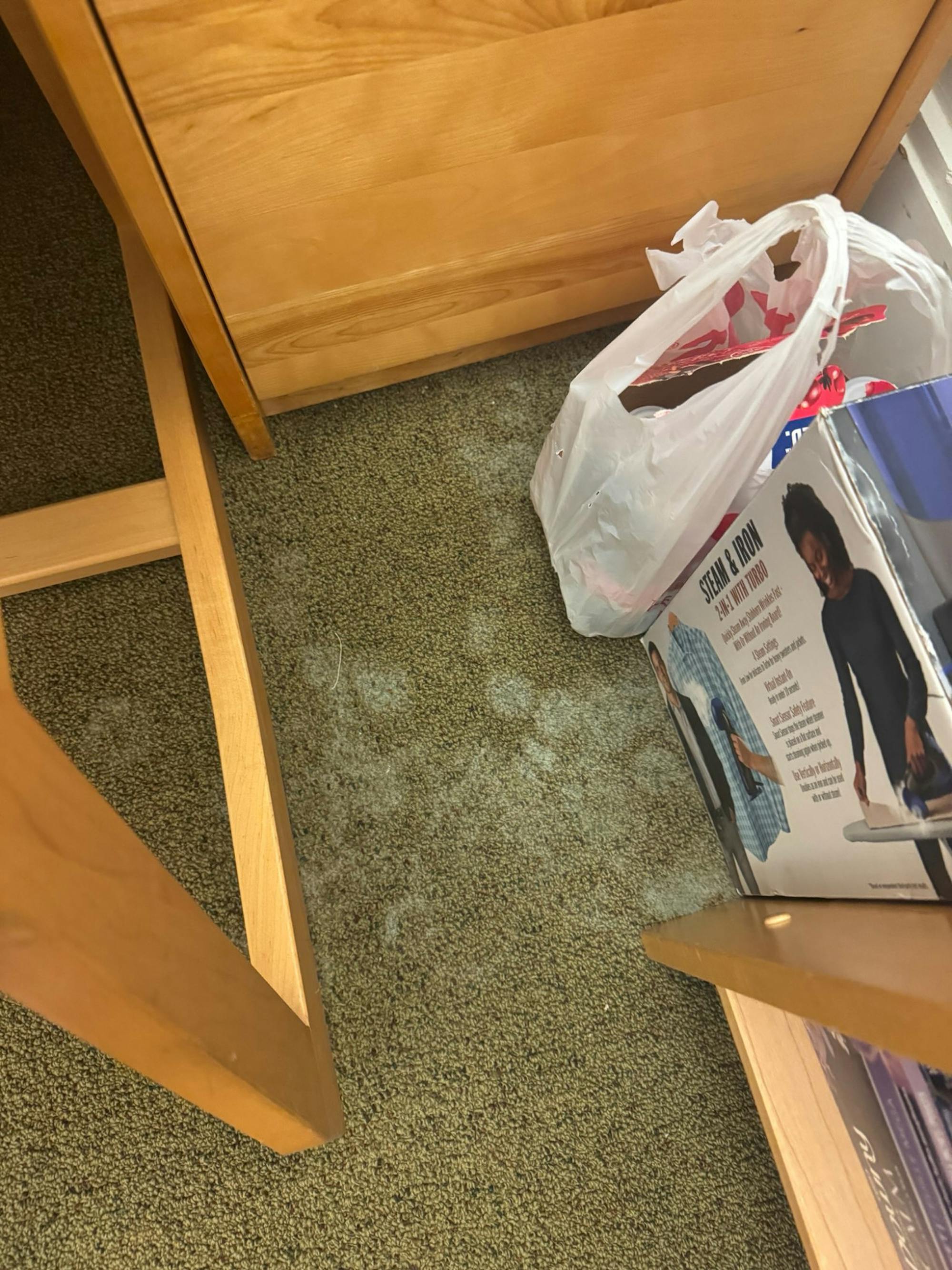
Throughout July, residents of the McLaughlin Cluster dorms have reported microbial growth in their rooms to the Office of Residential Operations. On the evening of July 18 into the early morning of July 19, a custodial team sent by the Residential Operations identified 14 rooms with microbial growth and “cleaned and sanitized” them with the “best practices,” according to a campus-wide email update sent to campus by student body president Sabik Jawad ’26 and student body vice president Favion Harvard ’26.
The Dartmouth Environmental Health and Safety department also “walked the building” with Residential Operations to “review spaces” on July 21, according to an email sent to residents of McLaughlin dorms that day by Residential Operations.
Roommates Anvi Kalyana ’27 and Maanasa Reddy ’27, who live in Thomas Hall — one of the dorm buildings in the McLaughlin Cluster — said they first observed “very blue” and “spore-like” growths on their carpet that they believed was mold on July 13.
“It genuinely looked like the kind of mold on bread,” Reddy said. “It was very blue and was spreading pretty fast.”
She and Kalyana reported the mold to Residential Operations on July 13 because they found “spots were all over … the floor” of their room, she explained. A custodian sent by Residential Operations identified it as mold later that day and treated it with what he called a “temporary solution” by “spraying disinfectant and blasting a fan at the mold,” Reddy added.
Kalyana said they were “fearful” a more permanent solution, such as tearing out the carpet, may have required her and Reddy to temporarily move to other housing. Reddy said she had felt noticeably ill leading up to the identification of the mold.
“I kept getting headaches, and I thought maybe I was sick or something,” she said.
Reddy and Kalyana also noticed mold-like “black spots” in the vents of the communal bathroom on July 17, which is still present.
She and Reddy purchased dehumidifiers to manage the humidity in the room and prevent surfaces such as the carpet and furniture from becoming “constantly damp,” Kalyana said. A damp environment promotes mold growth, according to the Center for Disease Control and Prevention.
Jawad and Harvard wrote in their statement to campus that they “believe these issues were caused by a myriad of circumstances,” such as “an extremely hot and humid string of days” and “issues with the climate control system” in the dorm cluster.
Kalyana echoed their sentiment, mentioning the air conditioning in McLaughlin.
“There’s a constant mildew smell … I don’t think there’s proper ventilation,” she said. “And I don’t know if the AC is ever actually on.”
The mold the roommates had reported on July 13 was not the first time they had observed mold in their room. Reddy, who moved in during the summer interim, said she saw spots on the carpet — later confirmed to be mold by the custodian — when she first arrived at the dorm, but did not report them at the time.
Jawad said the College does not expect to make structural changes to the building to address the growth and believes the mold will be “completely resolved” after the current treatment.
“From the information we have right now, it does not seem to be a structural problem,” he explained. “But if it was identified as a structural problem, usually what I’ve seen is that the College does tend to invest in large-scale renovations of those buildings.”