Sociology professor Brooke Harrington criticized offshore financing, or the movement of money out of a country to foreign centers, and its impacts on democracy in an event on May 6.
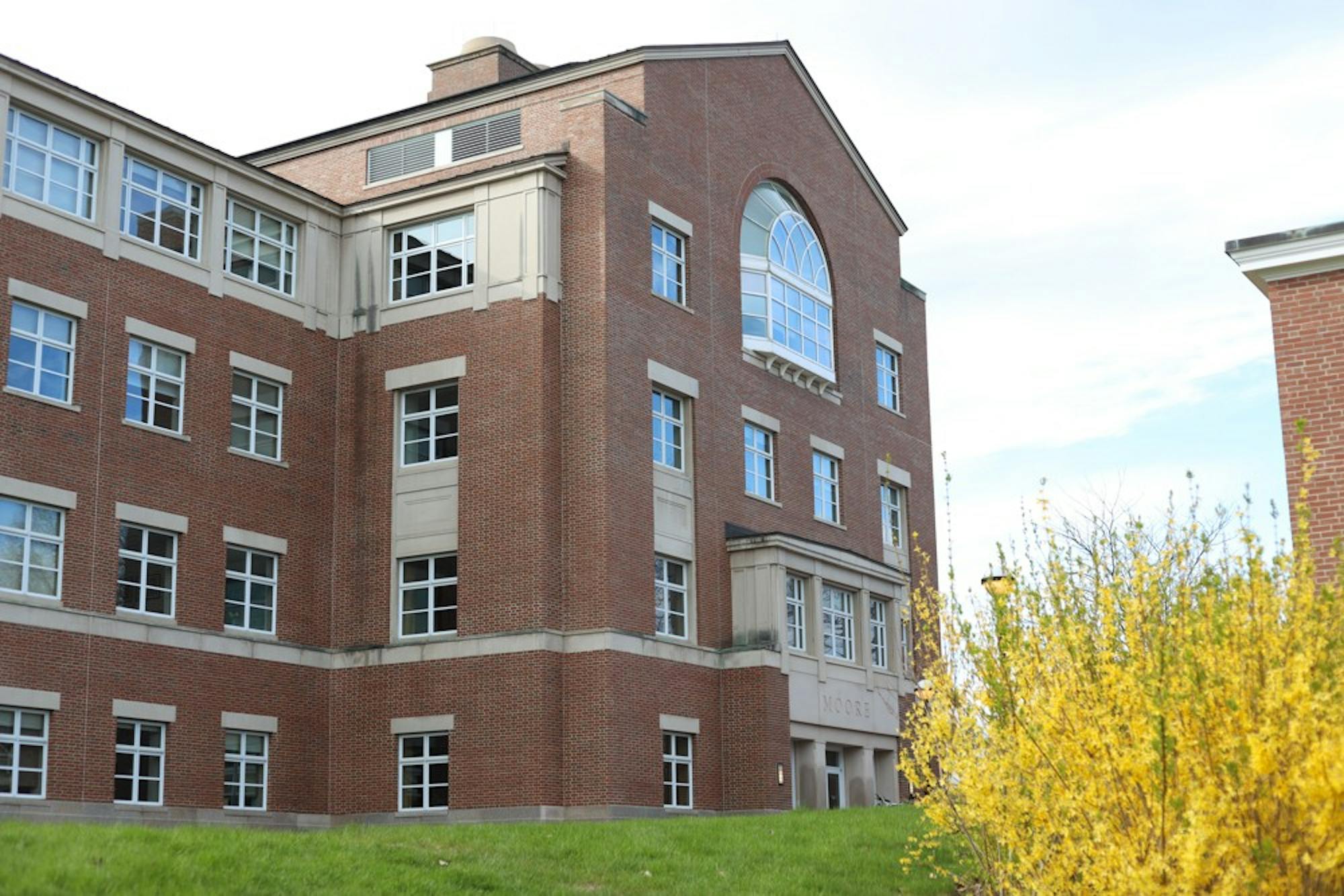
Approximately 50 individuals attended the event in Moore Hall. The talk, “Trump’s Broligarchy,” was co-hosted by the Political Economy Project and the sociology department and was moderated by PEP program coordinator and sociology professor Henry Clark.
Harrington began the talk by defining offshore finance — which she began investigating in 2007 — as “a social technology that produces secrecy.”
“All the economic effort in the world for one year, 12% of that, as a minimum, is offshore and that’s just the part that belongs to individuals,” Harrington said. “There’s a whole other set of offshore activity that belongs to corporations.”
Harrington initially launched her investigation by training to become an offshore wealth manager, in order to access information on the topic.
“I went looking for the sources of global inequality, and I found what I can only describe accurately as a kind of illegal insurgency against a lot of what we described as modernity,” she said.
After completing her training, Harrington spent time interviewing and observing offshore wealth managers and experts across the world. In 2012, one offshore wealth manager named Erica who worked for Greenpeace told Harrington just how much power the users of offshore finance have.
“[Erica] said ‘These people, our wealthiest clients, are above the law. They’re above nationality and laws, and it’s potentially very dangerous,’” Harrington said.
Harrington also found information in the Panama, Paradise and Pandora papers, a set of leaked confidential documents detailing offshore financial activity among billionaires, corporations and world leaders. Each leak consisted of multiple terabytes of data.
“What [the papers] showed was that virtually every rich person above a certain level of wealth uses the offshore financial system,” Harrington said.
The leaks named politicians and influential figures, including former Chilean president Sebastian Pinera, American billionaire Robert Mercer and Russian president Vladimir Putin.
Harrington said she believes that offshore finance is not just about avoiding taxes.
“They want to undermine democracy and capitalism and public health and the environment,” she said. “Basically everything good that keeps us all alive, they want to undermine it because it compromises their ability to get a little bit richer and a little more powerful.”
Harrington noted that elections are heavily influenced by offshore finance. According to Harrington, electoral funding via offshore money allows the rich to avoid national election laws.
“You’re not supposed to be able to pour billions of dollars in foreign money into a sovereign nation’s election process,” she said.
In an interview with The Dartmouth after the event, Clark said he hopes the event allowed students to reflect on the “global economy and global finance today.”
“I would [hope] that my class, which is a course called Markets and Their Critics, think about what role markets play or what role government regulation plays in producing the kind of offshoring phenomena [Harrington] discussed in her talk,” Clark said.
Attendee Rachel Senn ’27, who attended the event for class, said the talk was “very fascinating.”
“I think my biggest takeaway is the legal workarounds that individuals can find to make huge implications that the rest of us don’t even see,” she said.