
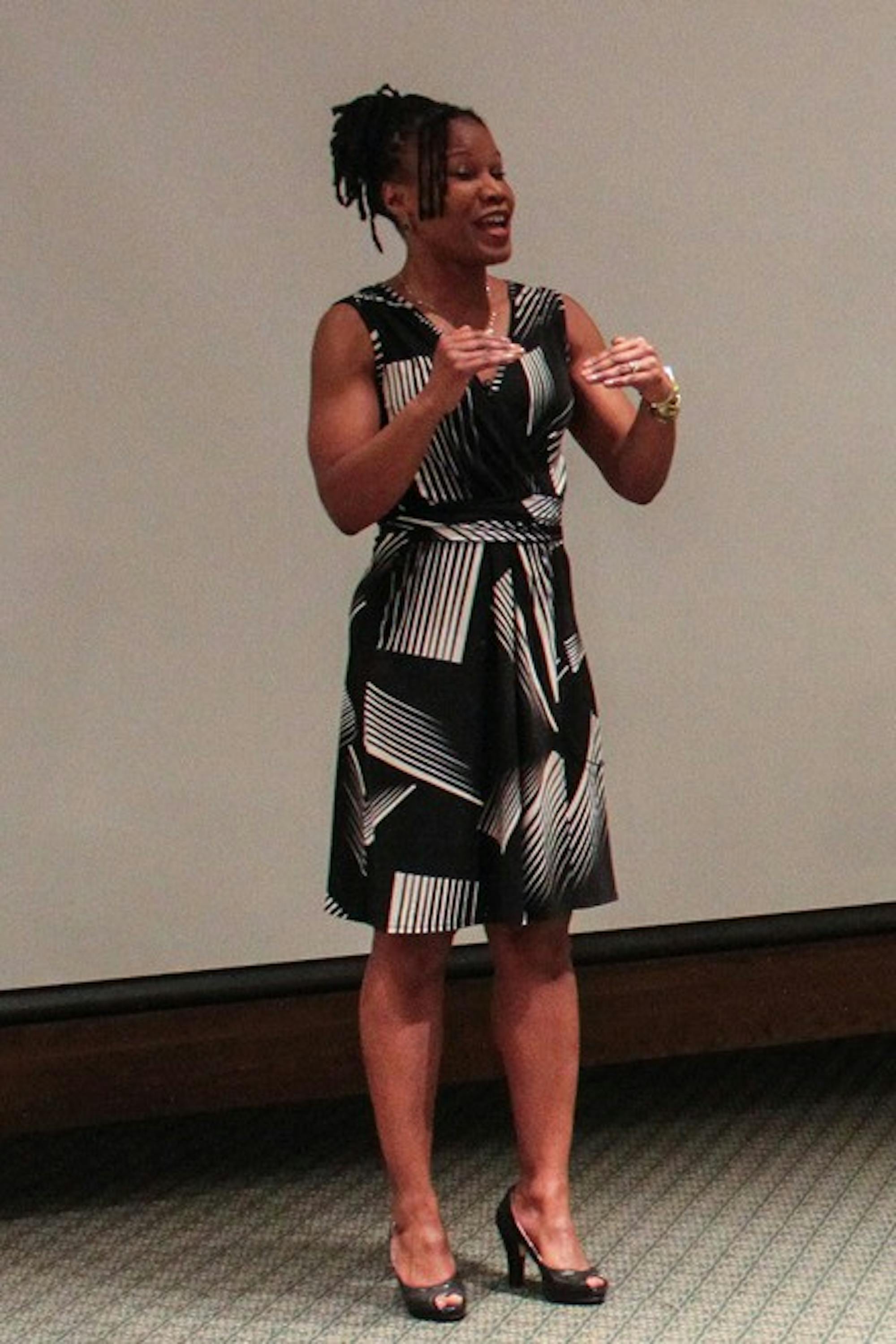
"People had no idea that such beauty could exist," she said. "We were told from our earliest days that nothing good could come here."
Expecting positive change is necessary for achieving equality, Carter told a packed Filene Auditorium audience on Thursday night. Carter, an urban revitalization strategist who grew up in the South Bronx, spoke to students, faculty and community members about her life's work.
In her presentation, "Hometown Security and Environmental Equality," Carter said she aimed to improve overall standards of economic and commercial development in urban design, not create "diamond in the rough" communities that do not further other neighborhoods' progress.
She pointed to the redesign of a former Amtrak station, which became a strip mall when it ceased rail service in the 1940s. It soon evicted all tenants, leaving another empty, boarded-up building in the South Bronx.
Just three days after contacting Amtrak about the space, she spoke to the company's head of real estate to negotiate a lease. Carter's company, Home(town) Security Laboratories, plans to create cafe and exercise areas in the building. This type of center contrasts with liquor stores and 99-cent stores, examples of commercial development in low-income areas.
Neighborhood kids and teens, pictured splattered with yellow paint as they drew shadowed outlines of human figures against bright backgrounds, designed a public art project on the building's gates.
"Some of the kids are the kinds of kids that, quite frankly, people would be afraid to walk by on the streets," she said. "But when given an opportunity to do something good, they did."
Other projects include Startup Box: South Bronx, which brings technology and entrepreneurship to the community.
The Massachusetts Institute of Technology brought a mobile "fab lab" unit to the South Bronx, linking personal computers with design machines. Carter showed a picture of a resident who made a chair from the hardwood of pallet boxes. High school freshmen have also coded tech applications through the project.
Audience members asked Carter about the line between entrepreneurship and gentrification. Economic shifts in the community can lead to a "new cohort of people" entering a community, a senior said, asking if this concerned Carter.
Carter said she wanted to practice a controlled level of gentrification, as people of every socioeconomic status appreciate safe neighborhoods and decent places to shop.
"Gentrification is such a loaded term, but basically what everybody wants is a decent place to live and work and play," she said. "If you don't economically empower people, they are very easy to push around, and they only people they get mad at is each other."
Preparing for this shift through tech projects like Startup Box: South Bronx can provide the infrastructure to help people remain in their neighborhoods.
"I'm not interested in helping poor people stay poor, I think that poverty is not romantic," Carter said. "Been there, done that. I don't want anybody to have to go through it."
Like in her February 2006 TED Talk "Greening the Ghetto," one of the first six videos posted to the organization's website, Carter told audience members pieces of her personal story, growing emotional when she spoke about her brother, a Vietnam veteran who was shot to death several blocks from her house.
Her parents moved to the Hunts Point section of the South Bronx, a working-class area, from the Jim Crow South. When blacks began to move to the area, many white residents left, and the city constructed a strip of highway over the area.
As the area's economy fell apart, landlords did not seek rent and instead torched their buildings.
"One day, there would be people I'd grown up with, and the next day they'd be gone," she said.
Carter attended the Bronx High School of Science, Wesleyan University and New York University. When she could not afford housing in New York to attend NYU's creative writing program, she had to move back home, she said.
Though her return initially seemed like a defeat, getting to know her community and neighbors again was the "most amazing thing in the world," she said. Her first project, reinvigorating the land near the Bronx River, stemmed from this move.
Carter referenced recent campus events in her opening remarks, asking audience members if they expect greatness from themselves and from each other.
"When you try to see that no one rises to low expectations, when you expect greatness from everybody, when you build an environment for that to happen, it's absolutely possible," she said.
The packed lecture attracted many students and some community members.
Daniela Koller, a fellow from The Dartmouth Institute, said the lecture taught her that people can return to their origins and find success.
"You can take your knowledge back," she said.
Previous speakers in the George Link Jr. Environmental Awareness lecture series, which began in 1993, include Bill Cronon, author of "Changes in the Land," and visiting environmental studies professor Terry Tempest Williams, a Montgomery Fellow and Robert Marshall Award recipient.


