
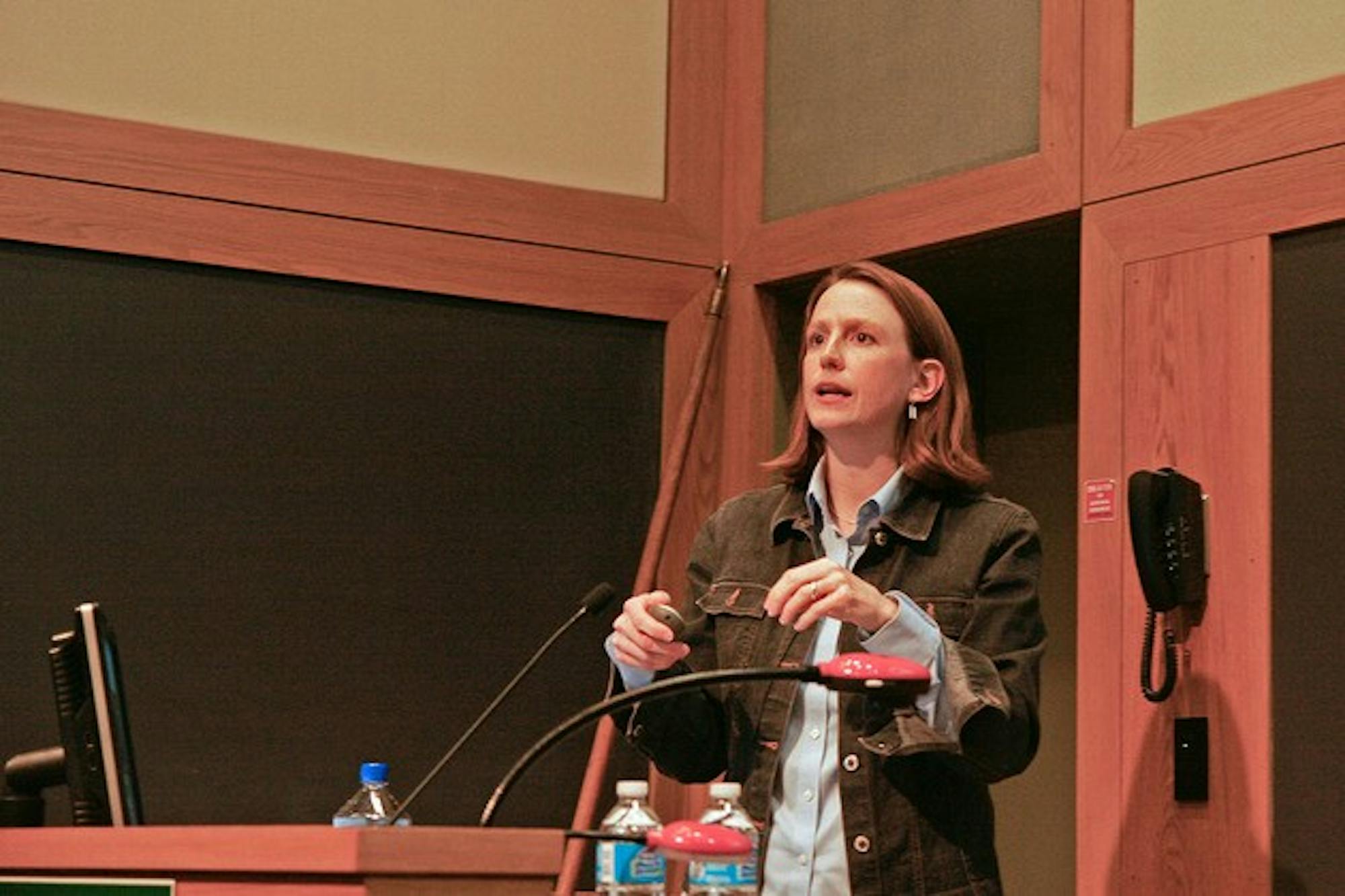
While most teenagers preferred using email to communicate online 10 years ago, today most prefer social media sites.
"You want information now and you want information relative to where you are," Lenhart said.
She also emphasized that teenagers are increasingly moving away from social networking sites such as Facebook and toward platforms like Twitter and Instagram. Unlike Facebook users, Twitter users can interact more directly with their favorite public figures and celebrities.
"Twitter is about brevity, simplicity and takes the synchronous nature out of social media," Lenhart said.
Touching on the relevance of mobile devices, Lenhart spoke about the shift toward "self-destruct" applications like Snapchat, which allows users to send images that disappear in seconds. While images and posts on Facebook are publicly available, Snapchat and other similar apps are attractive because they allow more privacy.
"[Teens] want to make sure they project the right image to parents, admissions officers and even that church lady who just requested them on Facebook," Lenhart said.
Lenhart said technology could play a crucial role in K-12 education. The Internet allows young adults to access information in low-risk ways that are removed from the structure and pressures of a classroom environment. Currently, 70 percent of teenagers use Wikipedia to access information outside of school, she said.
The majority of teachers are still "thinking inside the box," Lenhart said. Teachers overwhelmingly believe that new technology does not benefit education, and 87 percent of K-12 teachers believe that technology has created an easily distracted generation with short attention spans, she said.
In spite of this notion, some teachers utilize technology creatively by distributing spelling quizzes via text messaging and implementing "flipped classrooms," where instruction is delivered online and class time is used for practical hands-on activities, Lenhart said.
At the college level, recently accepted and matriculated students often use College Confidential and Facebook to find other members of their class and make connections before they arrive on campus. She warned that mobile devices and social networking sites could detract from the formation of a robust social community, because they make it easier for students to maintain connections with friends and family back home.
Going forward, Lenhart said educators must balance technology's distractions and opportunities.
Dean of Admissions and Financial Aid Maria Laskaris attended the lecture, and said Lenhart's remarks would influence how the Admissions Office approaches prospective students.
Admissions is already aware that young adults want information in "smaller chunks" and is working in conjunction with the Office of Public Affairs to create a dialogue with prospective students, she said. She praised the College's "growing social media presence."
Aadam Barclay '16 said he is not convinced that technology has a positive impact on young adults in the classroom. Barclay's high school attempted to integrate technology into the curriculum by giving students laptop computers, which he said became problematic.
"I saw study habits degrade and teachers lose control of their classrooms," he said.
Barclay said he laments the condensation of information encouraged by technology.
"As a culture, [we have] little patience for anything that occupies more than a few minutes of time," he said. "If you have SparkNotes, how many people are going to take the time to read the whole book?"
Lenhart's talk was the 17th lecture in the "Leading Voices in Higher Education" strategic planning series.


