
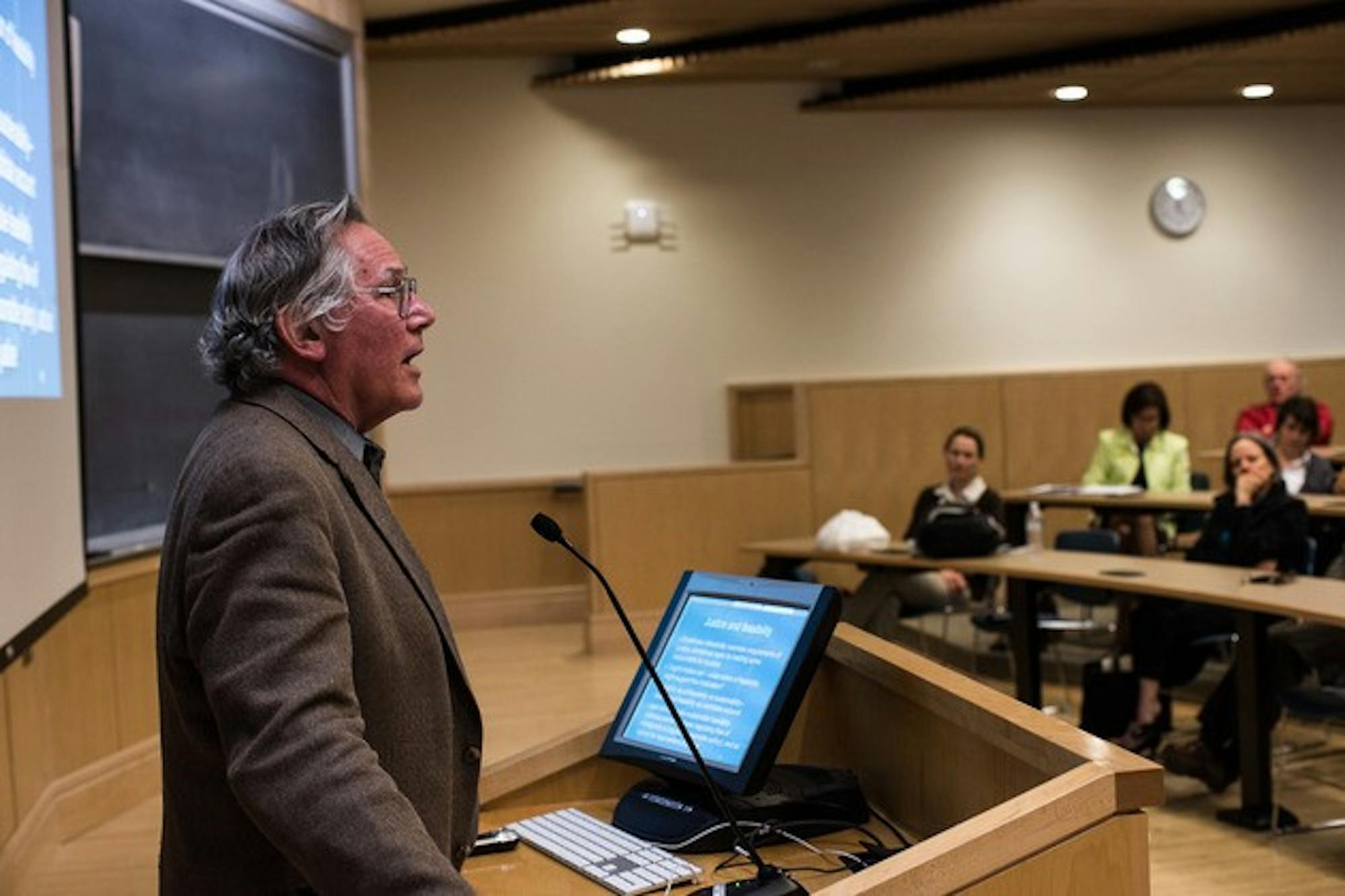
The lecture focused on the moral implications of providing health care to undocumented workers rather than the question of whether universal health care for unauthorized immigrants is politically or economically feasible.
"The stresses of immigration wear people down who are otherwise inordinately resistant to that kind of impact," Daniels said.
Daniels based his argument on the principal of reciprocity, which holds that those who contribute to a shared product ought to share in its benefits. Since undocumented immigrants work and pay taxes, they should receive health care benefits as well, he said.
Daniels discussed the history of Latin American immigration to the United States, focusing specifically on the Bracero Program that temporarily invited Mexican workers to the country to satisfy labor demands during World War II.
At that time, there were no immigration quotas on Latin workers, and Daniels said the U.S. was simply "being neighborly."
This policy changed when the United States militarized its border with Mexico in 1993, trapping many immigrants within the country and preventing them from returning home. Immigration issues escalated when farm workers were forced to seek jobs in the U.S. after the North American Free Trade Agreement was signed, impoverishing millions of Mexican citizens.
Taking these events into account, Daniels asserted that unauthorized immigrants should be considered full-fledged members of their communities.
"They work, they pay taxes, but they also participate in a broad range of institutions schools, churches and civic groups," Daniels said.
He said he believes undocumented workers should be governed by the same principles that govern all members within their communities.
Undocumented workers are currently able to access health care through the provisions of the Emergency Medical Treatment and Active Labor Act, which compels hospitals to provide treatment to patients in an emergency regardless of their ability to pay. Daniels is not convinced that this policy is enough.
"It's a hard line to draw in many cases what counts as emergency care," he said.
Refuting popular arguments, Daniels said that those who claim that undocumented immigrants are breaking the law forget that every murderer and rapist in the prison system currently receives health care benefits. He added that providing unauthorized workers access to the Affordable Care Act would not be an incentive for people seeking health care to immigrate to the U.S.
Daniels said he does not consider universal health care a panacea for larger problems.
"Although I endorse universal health as a strategy, I don't think that settles the issues around health that ought to be raised," he said.
Rachael Siegel '14 attended the lecture for her class on immigration law and said she appreciated Daniels' balanced discussion. She said she was interested in learning how to practically implement Daniels' ideas.
Ma'Ko'Quah Jones '14, a government major, said that Daniels' moral perspective surprised her. As a Native American, she said the lecture reminded her of the shortcomings of the Indian Health Service, a division within the Department of Health and Human Services that provides services to members of recognized tribes.
Even though more Native Americans have access to health care, the government's "application of the IHS is immoral," Jones said.
Jones said she fears that the American health care system is so broken that extending universal health care to undocumented workers would result in failures similar to those of the Indian Health Service.
The Dorsett Fellowship was established in 2001 in honor of Burt Dorsett '53 to bring ethics scholars to campus to conduct research and deliver lectures.


