
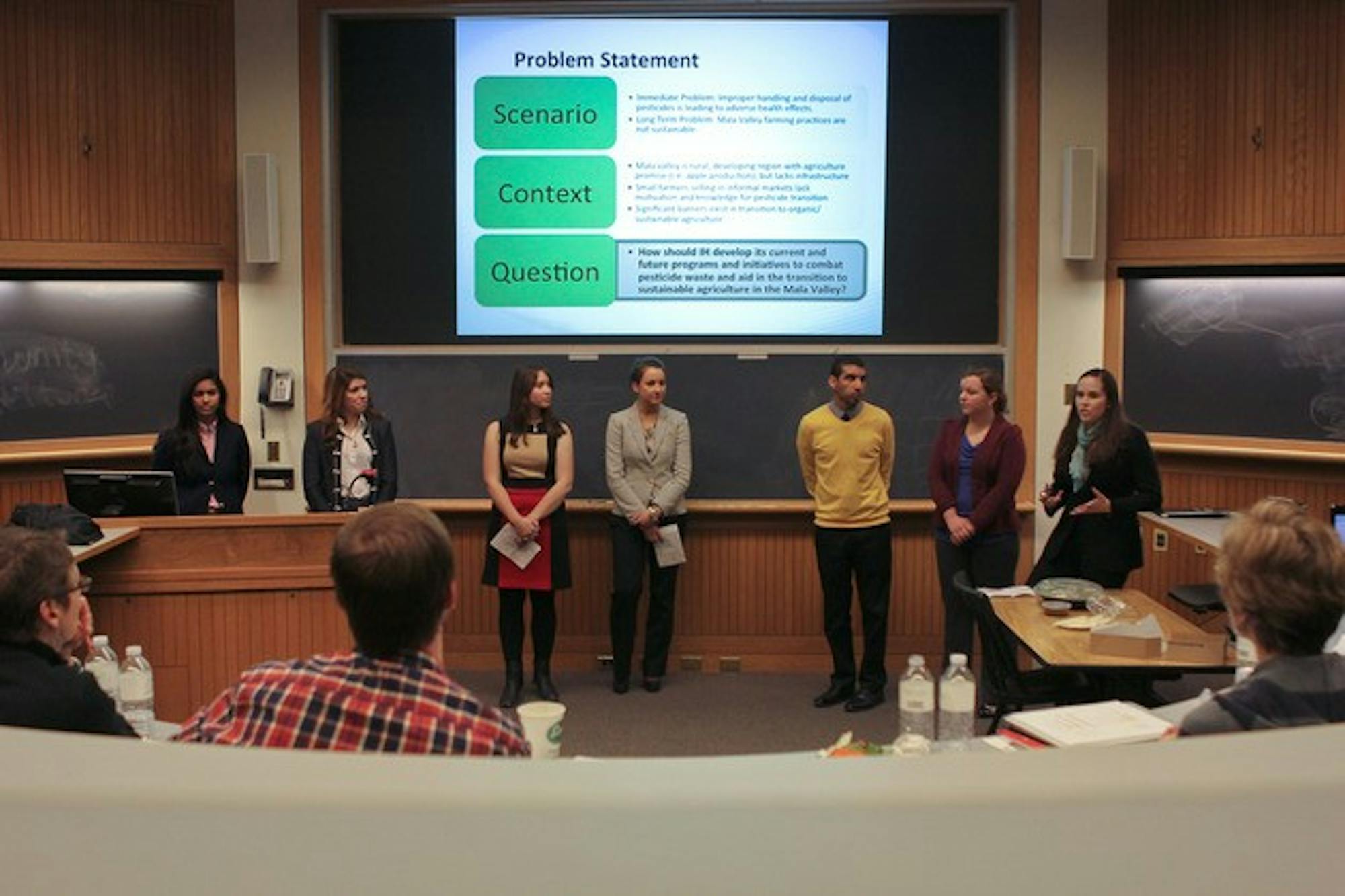
The winning team Fed Ghali Med'16, master's in public health student at The Dartmouth Institute for Health Policy and Clinical Practice Faseeha Altaf GR'13, Thayer School of Engineering PhD student Jennifer Tate GR'13, Hatty Pearson '14, Victoria Trump Redd '14, Brenna Liponis '14 and Emily Fletcher '13 highlighted the importance of establishing baseline and ongoing health and environmental measures in the region.
The runner-up team, which included Rachel LaRocca Med'16, Liqiong He Tu'13, Michael Seitz '14, Kate Bradshaw '14, Garrett Wymore '13 and Troy Dildine '13, advocated promoting public health principles and taking better advantage of the region's existing water distribution system.
The winning team earned an $1000 prize while the runner-up team won $500. The prize money will help the teams implement their proposals in the Mala Valley.
Competition judges considered the proposals' economic feasibility and environmental sustainability.
The Mala Valley regional government will incorporate ideas from all teams to solve health and development problems.
The case competition organizers found inspiration from students who had traveled to the Mala Valley region of Lima, Peru last summer. The trip, sponsored by the Dartmouth Center for Health Care Delivery Science, exposed students to harmful farming practices and accompanying health problems.
Most farmers in Mala Valley, a region that is highly dependent on agriculture, use conventional farming methods such as potent pesticide to eliminate insects and other threats to crops.
Pesticides compromise the farmers' health because frequent exposure to agrochemicals causes pesticide poisoning and other complications.
The chemicals endanger the local environment because many farmers do not properly dispose of pesticide containers, and agrochemical residue subsequently contaminates water, air and soil.
Since the region's current farming methods harm residents and the environment, the case documents presented to competitors suggested a transition to organic farming as an alternative to conventional farming and educating farmers about safe and responsible pesticide.
The laws already in place to address the implications of pesticide use are not comprehensive enough to tackle the region's core problems, said competition judge Abel Guerra, Lima's regional natural resources and environment director.
The competition was modeled on the Emory Global Health case competition, which promotes pursuing multidisciplinary approaches to a global health issue. The most important difference between the two competitions is that proposals at Emory do not have a direct connection with the people affected by the problem, whereas Dartmouth's competition seeks a solution to a real-life issue that will ultimately be implemented in the region.
Because the College has many initiatives and experts in global health, encouraging undergraduates and graduates to collaborate is essential in addressing complex problems such the Mala Valley's health and development issues and their societal implications, cp-organizer Ben Nguyen '14 said.
"Health is not just figuring out the treatment to the problem," he said. "It's also about figuring out how to manage for the society."
Diksha Gautham '15, who participated in the competition, enjoyed interacting with graduate students and considering the broader implications of the case.
"I think the issue in the Mala Valley is very important," she said. "If we tackle it on a small scale, the solution could also be applied to other regions in Peru."
Justin Chang Th'13, who is pursuing a master's of engineering management at Thayer, said his background in biomedical engineering and personal interest in health care consulting prompted him to participate.
The board hopes to make the competition an annual event and include other colleges and other international initiatives.
The competition, the first global health competition the College, was co-sponsored by eight Dartmouth organizations, including the Dartmouth Coalition for Global Health and Social Equity and the Dickey Center for International Understanding.
Fletcher is a former member of The Dartmouth Senior Staff.


