"His pieces are inventive and exquisitely made, and we are excited to have him on campus," Gerald Auten, studio art professor and director of artist-in-residence program, said.
The artist-in-residence program, which began at Dartmouth in 1932, hosts three or four distinguished artists each year. In 1934, the program invited Mexican artist Jose Clemente Orozco, known for his famed "Epic of American Civilization" mural located in the library reserves.
Newman was selected by a committee of studio art professors to remain on campus for 10 weeks this winter, according to Auten.
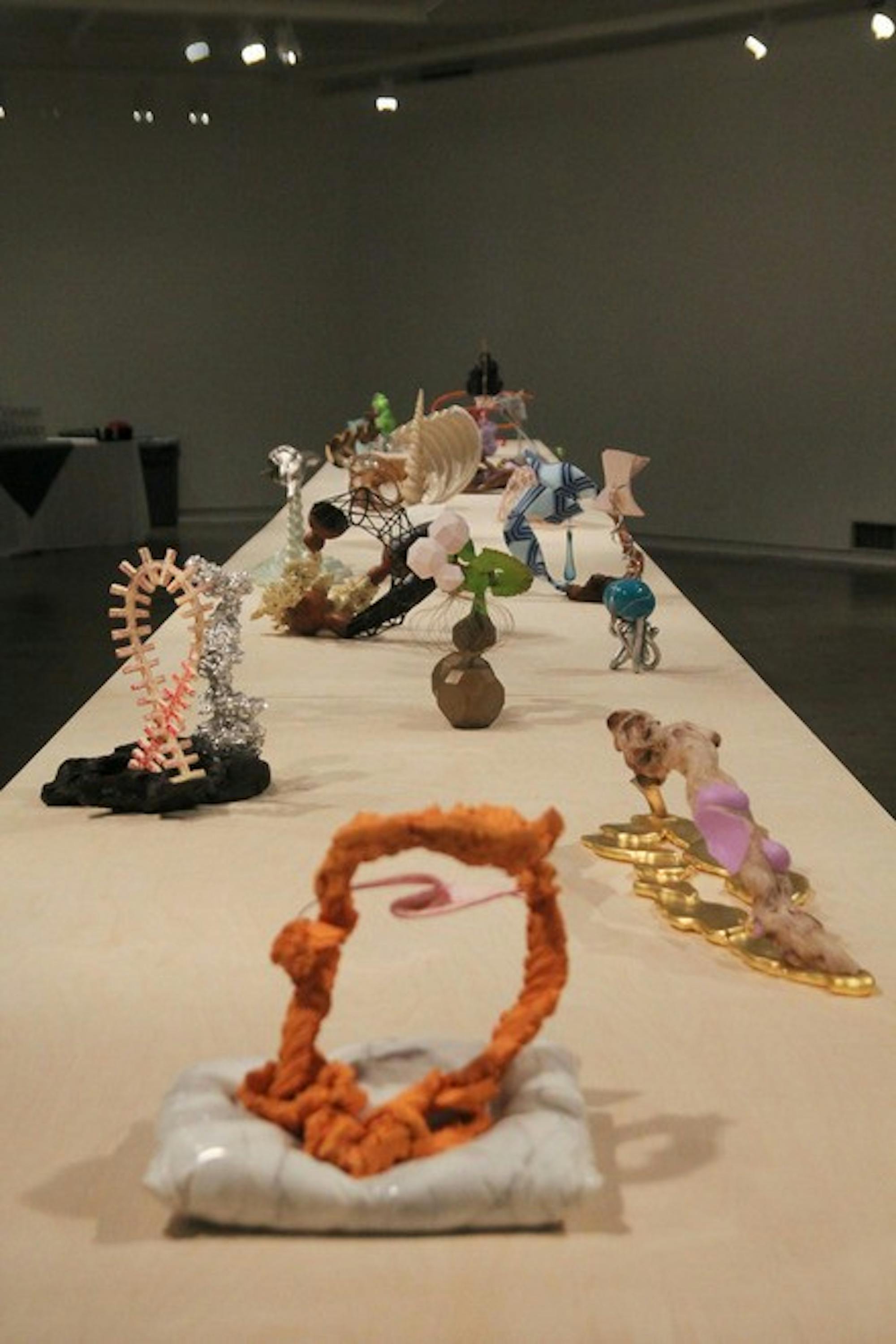
The title of the exhibition, "Everything Is on the Table," is literal, as Newman's sculptures are arranged along a 40-foot-long wooden table in the narrow gallery space. Jokingly, Newman said that the title is also a pun in reference to President Barack Obama and Speaker of the House John Boehner's constant refrain during the recent fiscal cliff negotiations.
Newman said that he initially struggled with a way to display his collection to the public. A student of minimalism in the 1950s, Newman said he identifies to some extent with the values of this movement. Artists of this era tended to present their sculptures without a base, as they desired the viewer to more closely interact with the piece, he said. Similarly, Newman said he prefers not to exhibit his sculptures on pedestals, regarding them as "clunky" hindrances that prevent the viewer from experiencing the art more fully.
In Newman's eyes, the wooden table against the unadorned white walls of the gallery creates the atmosphere of a workshop or laboratory, he said. This simplicity diminishes any aspect of "showiness," and instead puts more emphasis on the individual objects and how they were made, according to Newman.
Early in his career, Newman was primarily known for his large-scale sculptures. However, after years of teaching graduate sculpture at Yale University, Newman said he decided to travel to India, Japan and Africa to expand his artistic vision.
"I felt something missing [in my work]; like any good farmer who feels that the minerals have been depleted from over-planting, I went looking for another plot of land," Newman said.
While abroad, Newman began to notice the beauty of smaller sculptures as he observed the significant relationships people had with objects of this size. These pieces often possessed spiritual or religious connotations, such as the miniature power gods and household saints showcased in African homes.
Newman said he appreciated the personal connections people seemed to have with these objects, and felt that this kind of intimacy was deficient in contemporary sculpture.
"Intimacy requires closeness, and in that there is an inherent sense of humility and vulnerability," Newman said. "[I] wanted to somehow include aspects of that emotional range in my new sculpture."
When Newman returned to the United States, he began constructing smaller sculptures and experimenting with a variety of materials including glass, marble, tulle, papier-mache, tree bark, aluminum, organza and steel wire.
The disparate materials and methods used throughout his work aim to create a kind of metaphorical vocabulary for sculpture. For example, lead has a particular significance by itself, and elicits certain memories and associations distinct from those of other materials. Inserting lead into a sculpture will not only allow the piece to appear different aesthetically, but will also imbue the piece as a whole with a new meaning. Newman said he enjoys creating harmony among objects of different colors, shapes and textures, and likens his process of combination to that of a kidney transplant. Each component of the complete sculpture the "body" is ultimately necessary, and if one aspect fails to be functional or cohesive, it must be discarded, he said.
"His art is an innovative combination," Auten said. "He takes details of things we are familiar with but does not represent them literally. You wonder how he did it, but somehow it looks right."
Newman said he considers each of his pieces "singular" with a specific "identity," and that each sculpture in the exhibition has its own unique character, temperature and feeling. Auten noted the playfulness of these sculptures, as they seem to engage in a "dialogue" with one another from across the table. Every one of Newman's sculptures is different, as he strives to create something fresh each time he enters the studio, he said. The 20 sculptures brighten up the Jaffe-Friede Gallery and endow the space with a buoyancy and vitality distinct to Newman.
"The sculptures catch my eye every time I walk through the Hop," Sarah Gertler '16 said. "There is a kind of energy to [the pieces] that really draws you in."
To create this open viewing environment, Newman purposefully does not provide the public with an extensive amount of information in the form of a formal artist statement, he said. He does not want the artist's intention to be the only intention, and thereby limit the viewer's understanding of the piece.
Newman said that people often come up to him confused, declaring that they do not know how to "correctly" interpret his work. Newman said he appreciates this response, as he believes that within this initial discomfort lies an experience. He regards sculpture as an "instrument for consciousness-raising," and finds value in the raw, visceral reaction a viewer can have with a piece.
"I want to leave you with what I fear is a very grandiose statement that I am hesitant to make. But what I would really like to say is that my task my goal is to make something you have never seen before," Newman said.
Newman's exhibition will be on display through March 10.