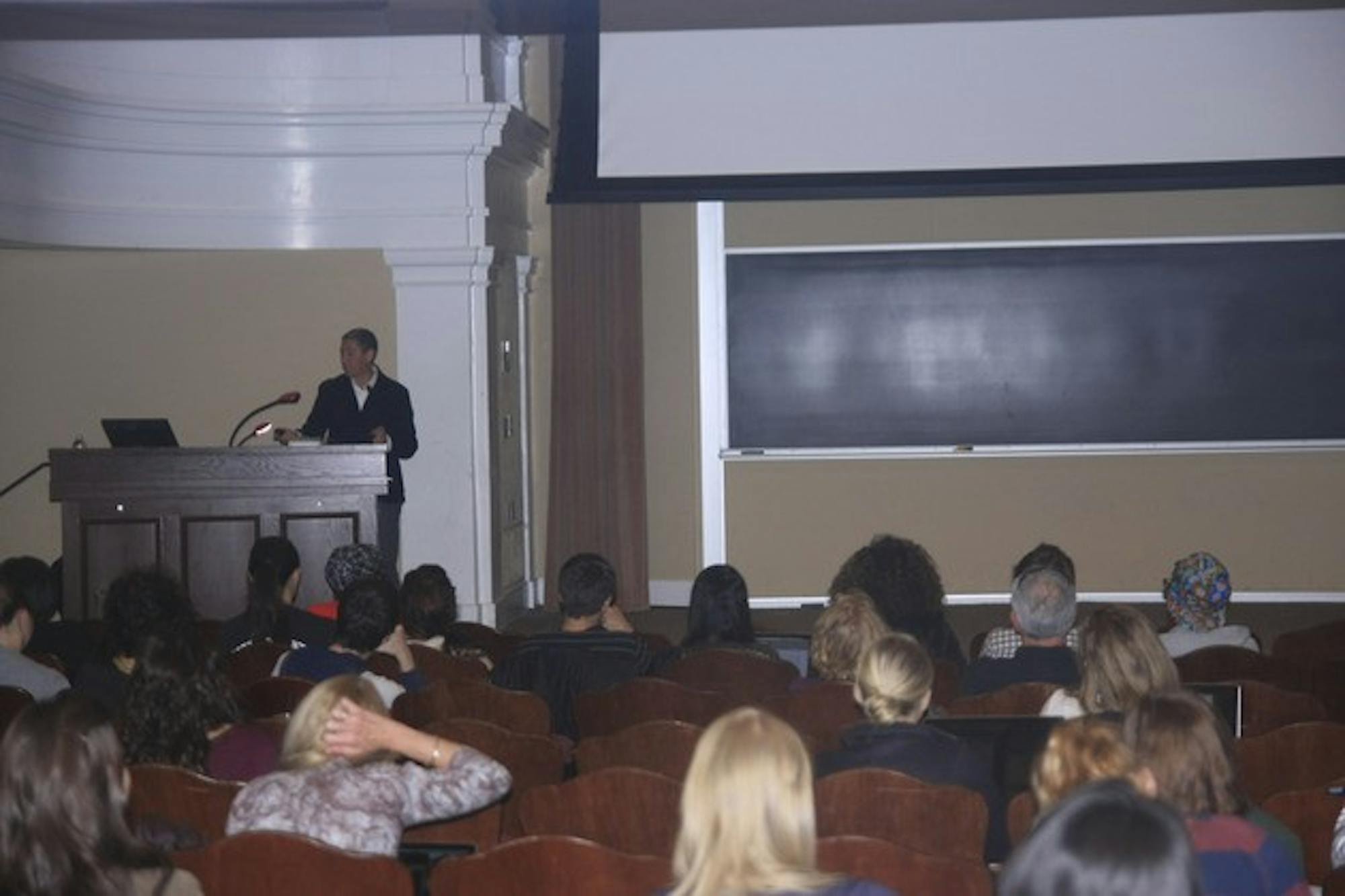
Halberstam is a professor of English, American studies and ethnicity and gender studies at the University of Southern California, but he is also USC's Director of the Center for Feminist Research. His books "Skin Shows: Gothic Horror and the Technology of Monsters" and "Female Masculinity" have made significant contributions in redefining subcultures and "low theory," a means of using varying levels of discourse to appeal to a variety of different audiences.
Halberstam's lecture focused on the overall concept of "going Gaga" and looking at her as a "global media symbol" representing change "in sex, gender and politics."
He began the lecture by defining low theory as what speaks "to people who aren't trained in the expertise of the academy." Halberstam went on to explain that low theory is about making the complexity of academic arguments available to multiple audiences, and this theory can provide some answers to the frequently debated topic of the humanities' relevance in the academic sphere. He mentioned that one of the most basic points of his "Gaga Feminism" is to determine if low theory has any merit in academia.
Lady Gaga is a perfect icon because she is socially relevant, and as a result, she virtually cannot be ignored, according to Halberstam. For these reasons, the "Gaga Manifesto" describes the main points of "going Gaga" as making connections, finding each other and "being fantastic."
"The image of Lady Gaga saturates pop culture," he said. "Think of her as an Andy Warhol figure, a figure for understanding shifting relationships with money, art and the workplace, as a figure by whom to think about massive scale cultural shifts."
Halberstam showed a clip of Lady Gaga performing alongside artist Yoko Ono in order to demonstrate what he meant by "going Gaga" while also demonstrating female pop figures that preceded her, ranging from the lesser-known Grace Jones to Madonna. The clip, which depicted Gaga in a shimmering black body suit moving almost spastically while scat singing, presented the artist in a much different light than her "Born this Way" music video, for example.
"[Ono and Gaga] encourage each other to go to ever increasing levels of dynamic frenzy," Halberstam said.
He used the London punk movement and the Occupy Wall Street Movement to convey his belief that "in times of great crisis, we want to intensify crisis and not resolve it."
Halberstam praised the Occupy protests for challenging the modern perspective on what is normal and for its element of interventionism and performativity.
He also introduced lyrics from the Fleet Foxes song, "Helplessness Blues," into his lecture in order to call identities into question.
"Identity is the most crude way of thinking about what people have in common," he said.
While the song initially praises individuals for being unique, the message shifts to a more dystopian vision in which humans simply function as cogs in larger machinery.
"It is only when something goes wrong that the body becomes unique," Halberstam said. "Songs rarely achieve the message of serving a higher purpose."
Halberstam displayed uniqueness as a form of marginality in a scene from Wes Anderson's stop-motion film "Fantastic Mr. Fox" (2009), which depicts a lone black wolf on the side of the road. The scene has become controversial since the foxes raise their fist to his presence, resembling the Black Power symbol. Halberstam used this scene to demonstrate the collision of high and low culture through cinema.
"The gesture is about solidarity and about reaching for a kind of alliance that isn't here yet," he said. "We should be ready at a moment's notice to throw up a fist to show our solidarity with the low, the queer and the Gaga."