
In fact, it was in preparation for the 1771 Commencement ceremony that the first major road to Dartmouth was paved. Wentworth issued an ordinance to clear a road that would allow for safe passage to the area, beginning at the governor's house in Wolfeboro, N.H. and continuing on through Plymouth, N.H. It was "from thence on the straightest and best course to Dartmouth College in Hanover," according to the 1771 ordinance. The road was of "great public utility" and was intended to "promote the design of that valuable institution."
Students and other members of the early Dartmouth community made their way over the Dartmouth College Highway, as it was later named, via horse-drawn carts. Others walked. At the time of the Revolutionary War, it took travelers six days to get from Boston to Hanover, often navigating the primitive roads with horses and ox-carts that were frequently overturned by rocks and stumps. At one point, roads were bookended by stone markers on which steel engravings boldly proclaimed statements such as "the Dartmouth College Road" and "over this route Eleazar Wheelock passed to found Dartmouth College."
But, the history of transportation to the College is not unlike other histories it is comprised of a series of evolving trends that were guided in turn by new technologies and a need for speed. Over time, roads improved, and placards were replaced by route numbers. By the end of the World War II, the glory of the Dartmouth College Highway waned. The road was the route to Dartmouth College in name only, later replaced by superiorly designed and surfaced roads.
Nevertheless, the sound of the wheels of stagecoaches rattling over the roads became emblematic of the early 19th century and was often referred to as "home-spun thunder." The relative efficiency, safety and glamour of stagecoaches catapulted them to a position of prominence among other media of transportation for people traveling to Dartmouth. Although the drivers initially would not allow themselves to believe that some new mode of transportation could make their beloved profession obsolete, it must have been quite clear to even the most stubborn stagecoach drivers that they were being supplanted by the 1850s. Indeed, the era of railway travel heralded a new age of transportation to the College.
It was a sunny November afternoon in 1847 when the first train, which departed from Concord, came to a screeching halt in the recently opened Lebanon station. The Northern Railroad, better known as the Boston and Maine Railroad by the early 20th century, contributed to the 450 miles of railroad track already in New Hampshire by 1847 and would ultimately shuttle thousands of students to and from campus.
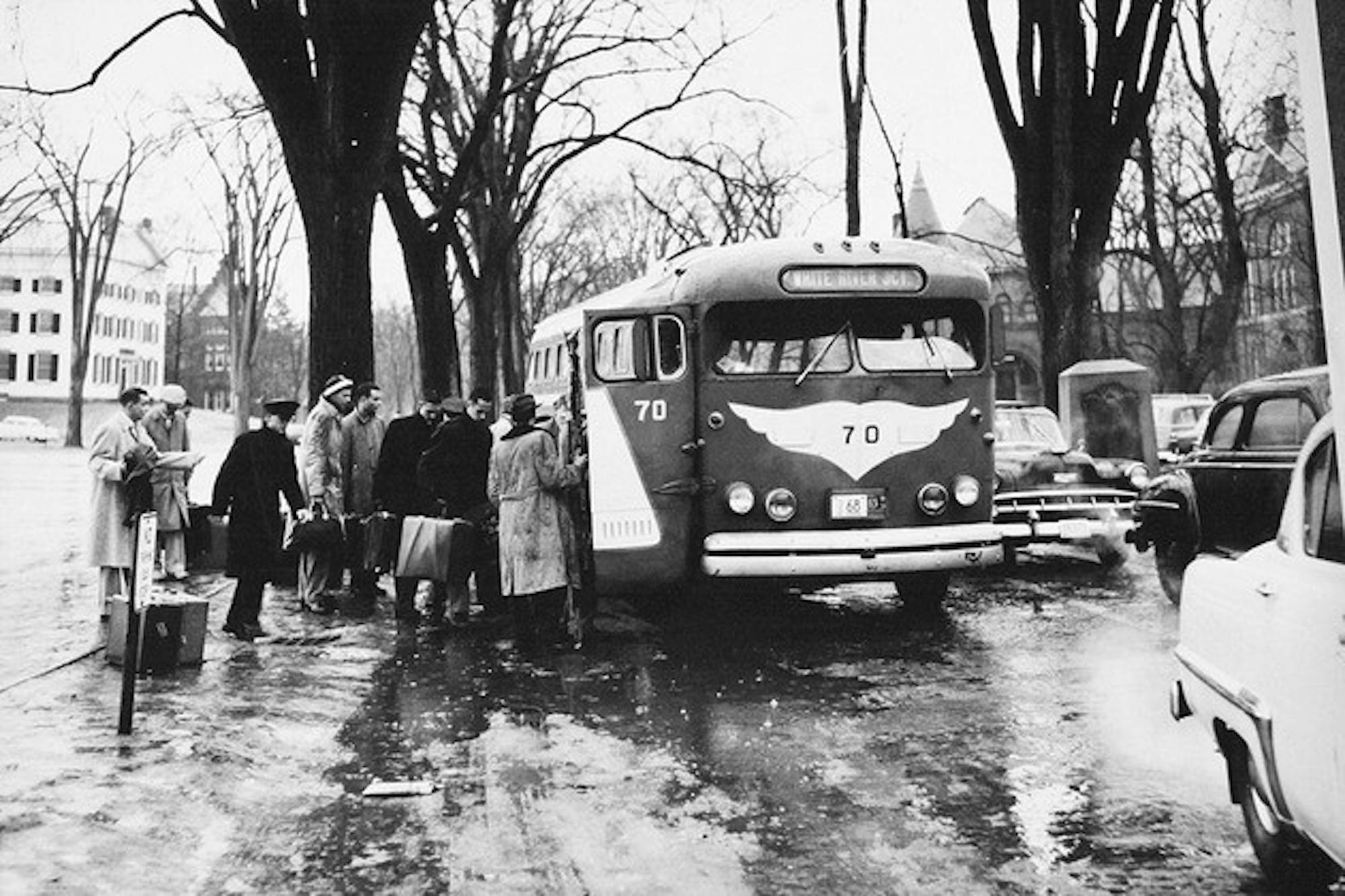
Railroads remained the dominant form of transportation in and out of the Upper Valley area well into the 20th century. In the 1960s, some nostalgic residents mourned the railroad's closing as they reflected on the days when the station was bustling with soldiers heading to boot camp and to war. When announcing plans to close the Boston and Maine Railroad in 1959, Patrick McGinnis, the president of the company at the time, predicted that private automobiles, buses and airlines would shuttle 100 percent of all passenger service between major cities in the next 10 years. Not even eight years later, a front-page headline in the Valley News read, "Era Comes to End for Old Rail Center." Richard Olmsted, an administrator of the College, said that Dartmouth did not oppose the closing of the nearby station, as it had known of the impending close for quite some time and was "prepared to handle the freight and traffic ... in other ways."
Since then, the rise of private automobiles and development of air travel have made our world much smaller. We are reminded ad nauseum of Dartmouth's vibrant cultural complexion, which would not be possible without sustained improvements in our means of travel. As our expectations for adequate transportation climb ever higher with the changing times, let us remember the words of Chandler Smart '49 "May we keep building."


