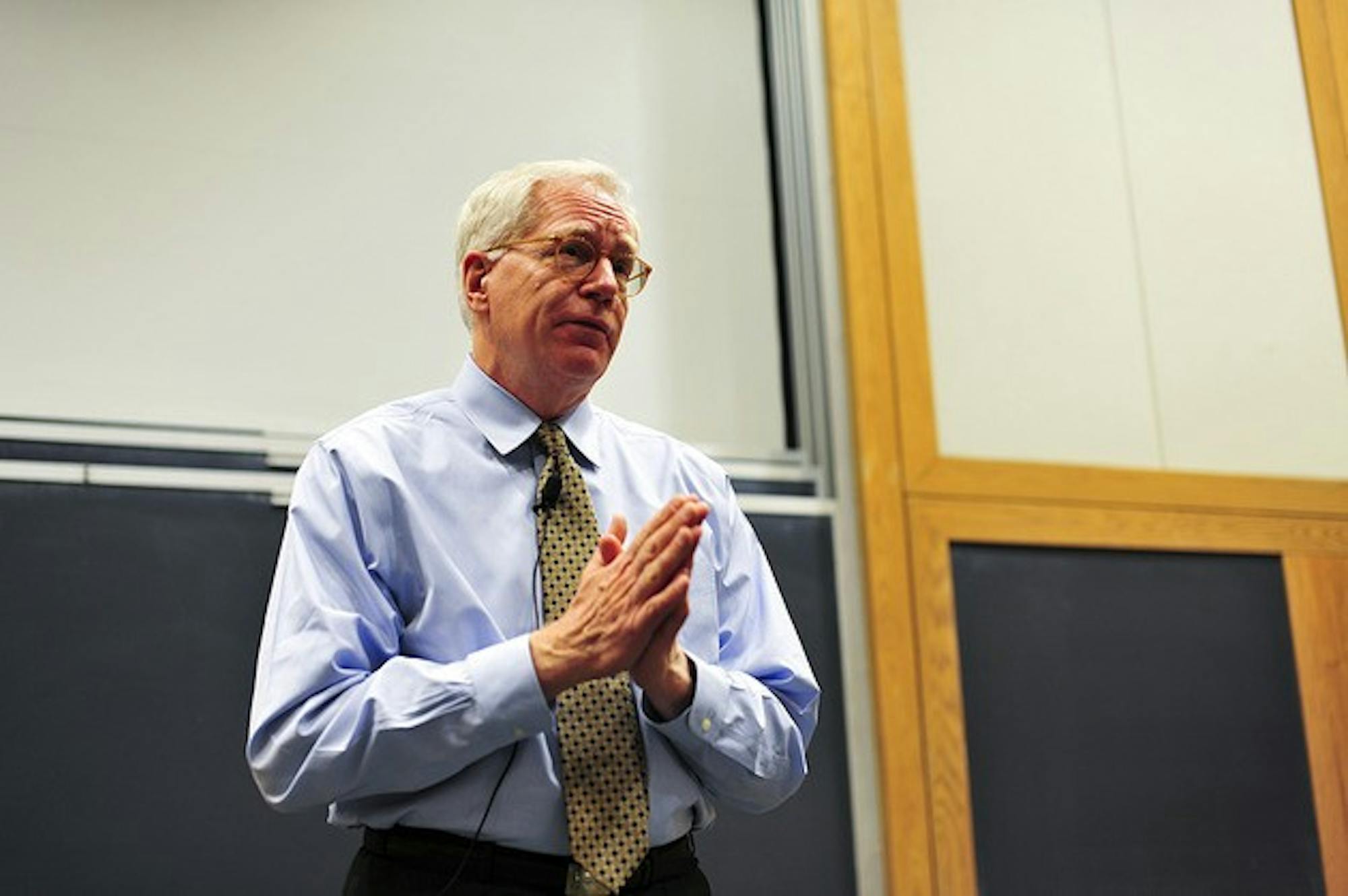
In the lecture titled "Entrepreneurship and the Future of the Global Economy" Schramm said that entrepreneurship is especially important during times of recession, yet it remains undervalued, and academic institutions do not teach entrepreneurship properly or take it seriously, he said. Furthermore, government policies intended to facilitate entrepreneurship, such as those of the United States and China, inherently restrict its positive effects, Schramm said.
"Many governments think that they can solve all problems," Schramm said. "The problem is that the government is intrinsically outside the market and so cannot pick winners or losers with any efficiency at all."
Thus the government, at the taxpayers' expense, commits money to different ventures that do not succeed, Schramm said, citing the Solyndra Corporation bankruptcy as a case in which the government wrongly stepped in to fund a private sector company. In 2009, Solyndra Corp. received over $500 million in guaranteed loans from the government only to file bankruptcy in 2011.
The risk involved in entrepreneurship frightens people, according to Schramm. Risk and creativity, however, are imperative for growth, he said. This growth is not limited to the business sector and finance, according to Schramm.
The failures as well as the successes are what make the U.S. entrepreneurship model remarkable, he said. One of the unique traits of U.S. entrepreneurship is its acceptance of failure, according to Schramm. Other nations, particularly China and India, are changing their economies to copy American flexibility, Schramm said.
Schramm has experience with furthering entrepreneurship through his work as the president of the Kauffman Foundation, an organization dedicated to encouraging entrepreneurship.
"If there's one thing I can be happy about, it is having taken entrepreneurship and seating it in the context of economics," Schramm said.
Kairos Fellow and the founder of the Dartmouth Kairos chapter Dexter Zhuang '13 identified Schramm as a potential speaker in the hope of "promoting campus dialogues." Zhuang said the global nature of the economy is a reason to "encourage a more entrepreneurial way of thinking."
Parker Hinman '13 said he appreciated Schramm's perspective on the relationship between government and entrepreneurship.
"As a government major, it was interesting to hear a proposal for a reduced government role in improving the current economy," Parker Hinman '13 said.
Others, however, said they did not agree with Schramm's strictly economic perspective.
"It seems like he only endorses one model of entrepreneurship," Kripa Donjol, a visiting prospective student, said. "In terms of the bailout, are you willing to take the risk that people will immediately become innovative?"
Before working at Kauffman, Schramm was a health policy and management professor at Johns Hopkins University for 15 years, an entrepreneur and the founder and CEO of Schramm and Company, P.C. He has also served on government committees and panels and is a George W. Bush Institute Fellow and visiting scientist at the Massachusetts Institute of Technology.
Schramm's lecture was sponsored by the Rockefeller Center and the Tuck School of Business.