
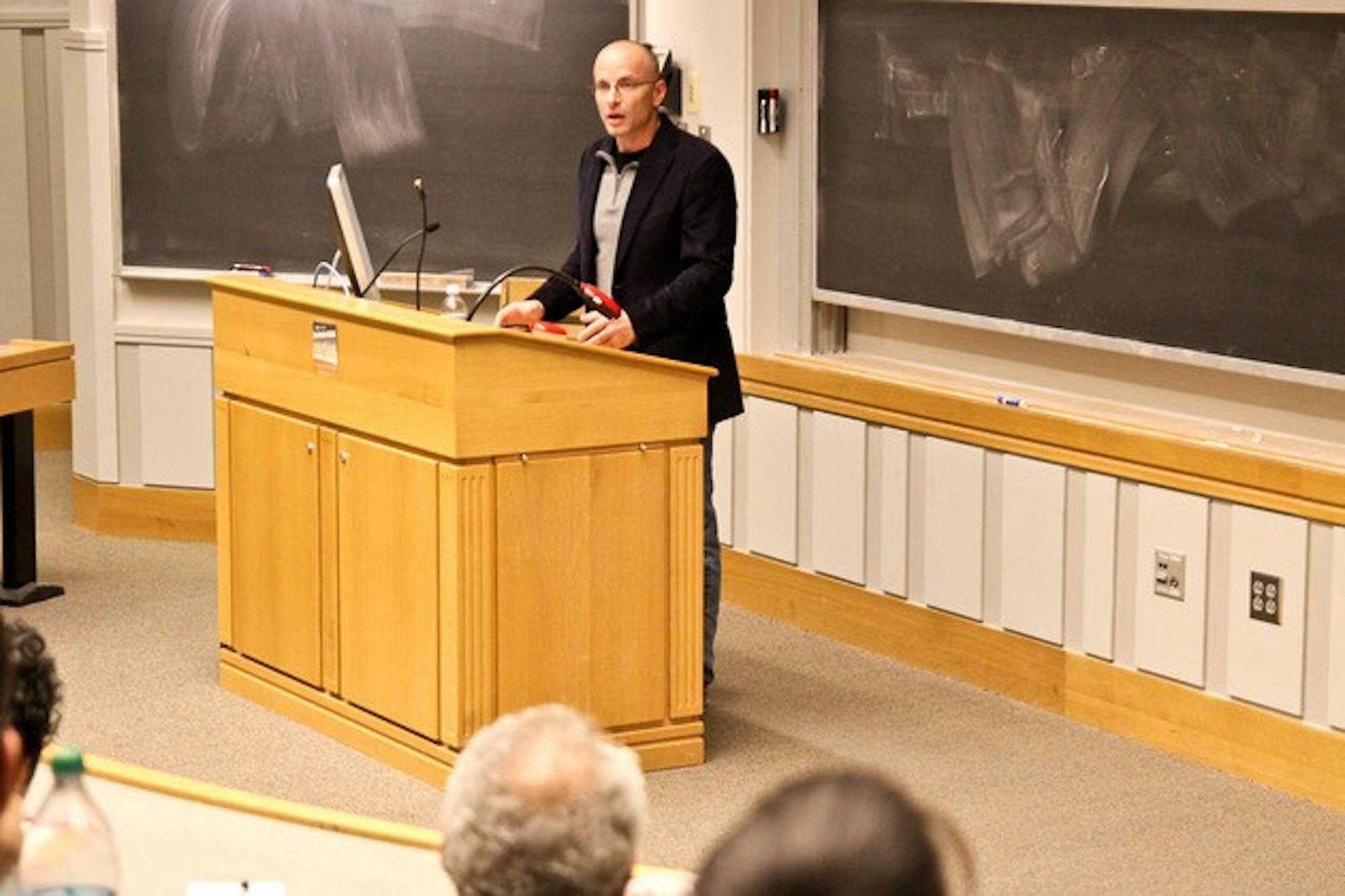
Treuer spoke Wednesday in Carson Hall in a talk titled "Rez Life: Moving Beyond the Tragic Trap," during which he focused on the events that inspired his book, a semi-autobiographical work that includes profiles of his own extended family. Treuer also visited history professor Benjamin Madley's "History of the American West" class on Monday and Native American studies professor Melanie Benson-Taylor's "Indian Killers: Murder and Mystery in Native American Literature and Film" class on Tuesday, according to Benson-Taylor.
"Treuer is one of the few figures who has worked competently in all these realms writer, critic and now quasi-journalist," Taylor said. "I can't think of anyone else in Native studies who has worked in these different realms so constructively."
In his visit to Taylor's class, Treuer spoke about his novel-writing process and the major themes he has tried to articulate through his works.
"Every book is kind of a riddle I pose to myself," Treuer said. "That's the start, then hopefully the book becomes the answer."
In his first novel, Treuer said he tried to create fully-realized characters as opposed to recreating popularized molds of inauthentic characters that non-Native and even Native writers have used to portray Native Americans in literature.
"In Native American literature, too often the characters that writers create are not people but stand-ins for experiences or representative of the contemporary experience," Treuer said. "I wanted to create authentic-seeming characters, though obviously not actually authentic characters, because I was still writing fiction and fiction is always a lie."
Treuer said he wanted to create characters to read as independent people, with their own unique associations, experiences and psychologies. Although he felt that he failed to successfully do this in his first novel, he found he had greater success in his second novel when he destroyed his protagonist's relationships with his reservation and with nature.
"In Hiawatha,' I wanted to divorce readers from an easy understanding of nature and spirituality," Treuer said. "Simon [the protagonist] doesn't represent, doesn't stand in for any experience except his own. The novel is about a personal mistake."
In his visit to Taylor's class, Treuer also talked about the need to create a more nuanced, complex understanding of Indian reservations within the American public, a driving theme behind his newest work.
"There's a perception that reservations are separate from and apart from the rest of America that's just not true," Treuer said. "The borders are fluid. Travel is fluid and intense and back and forth with people visiting, people staying, people not staying and these people are both Natives and non-Natives."
Treuer said both non-Native and Native people have a limited perception of and appreciation for modern Native Americans.
"This was my task in Rez Life,' to try to give readers a way to think about reservations in a way that is productive not reductive," Treuer said. "I wanted to write a book with some utility. It felt deep and very personal."
In his talk in Carson, Treuer expanded on the biographical influences that inspired his first work of non-fiction, which he said he started to write after the media coverage of a shooting at a local high school in 2005 angered him for its skewed depictions of Native Americans.
"I kept hearing, Tragedy strikes poor, remote Indian reservation,'" Treuer said. "It was not just painful that this happened, but it was doubly painful that this is how they were reporting it, focusing on class and ethnicity."
The event gave him the idea to write specifically about the reservation on which he grew up, but he felt he did not have a specific outline for a story until after his grandfather's suicide in 2007.
"I had two tasks after my grandfather's death to clean the room where he killed himself and to write a eulogy to deliver at his funeral," Treuer said. "Writing my grandfather's euology, I came around to the two tasks that I really wanted to accomplish in Rez Life' I wanted to find something true about reservations and say it, and I wanted to tell a tale not about tragedy or about hope, but about the complicated, nuanced consistency of reservation life."
Taylor said that while her course focuses on Native American literature, it uses Native American history and contemporary experience as a lense through which to view larger trends of systemic economic crises in capitalistic nations like the United States.
"The course pushes students into thinking about pervasive issues of violence and crime that appear in textual discourse, and not just among Native peoples but also among non-Native peoples responding to cyclical trauma," Taylor said.
Taylor said she was glad to hear Treuer discuss the complexities of issues like loss, vengeance and individual tragedy in his visit to her class. Taylor has been working with her class in a fashion similar to Treuer to try to see beyond these negative realities and to try to look forward in a productive, optimistic view.
"What I've been saying in my class from day one is that this is about all of us, that the Native experience is unique, fascinating, but also symptomatic of what's happening to many communities in America," Taylor said. "[Treuer] doesn't like to use the word hope,' but so much of his work tries to point forward in productive ways, looking at the relationships that we can use to work forward to a peaceful existence."
Treuer was invited to campus to speak as both an intellectual and an artistic resource, Taylor said. Native American studies professor and department chair Bruce Duthu organized his visit.
Treuer grew up on the Leech Lake Indian Reservation in Minnesota and graduated from Princeton University in 1992. He later went on to complete a doctorate in anthropology at the University of Michigan.
Treuer has written three novels so far "Little," in 1992, "The Hiawatha" in 1999 and "The Translation of Dr. Appelles" in 2006. "The Hiawatha" is on the syllabus for Taylor's class, and students finished reading the novel last week, Treuer said.
"He had a great attitude about talking about these issues, and he made his topic very relatable," Nancy Seem '14, a student in Taylor's class, said. "He did a really good job of placing Native issues into a time that people understand, and he touched on the same economic issues we've been discussing in class."


