
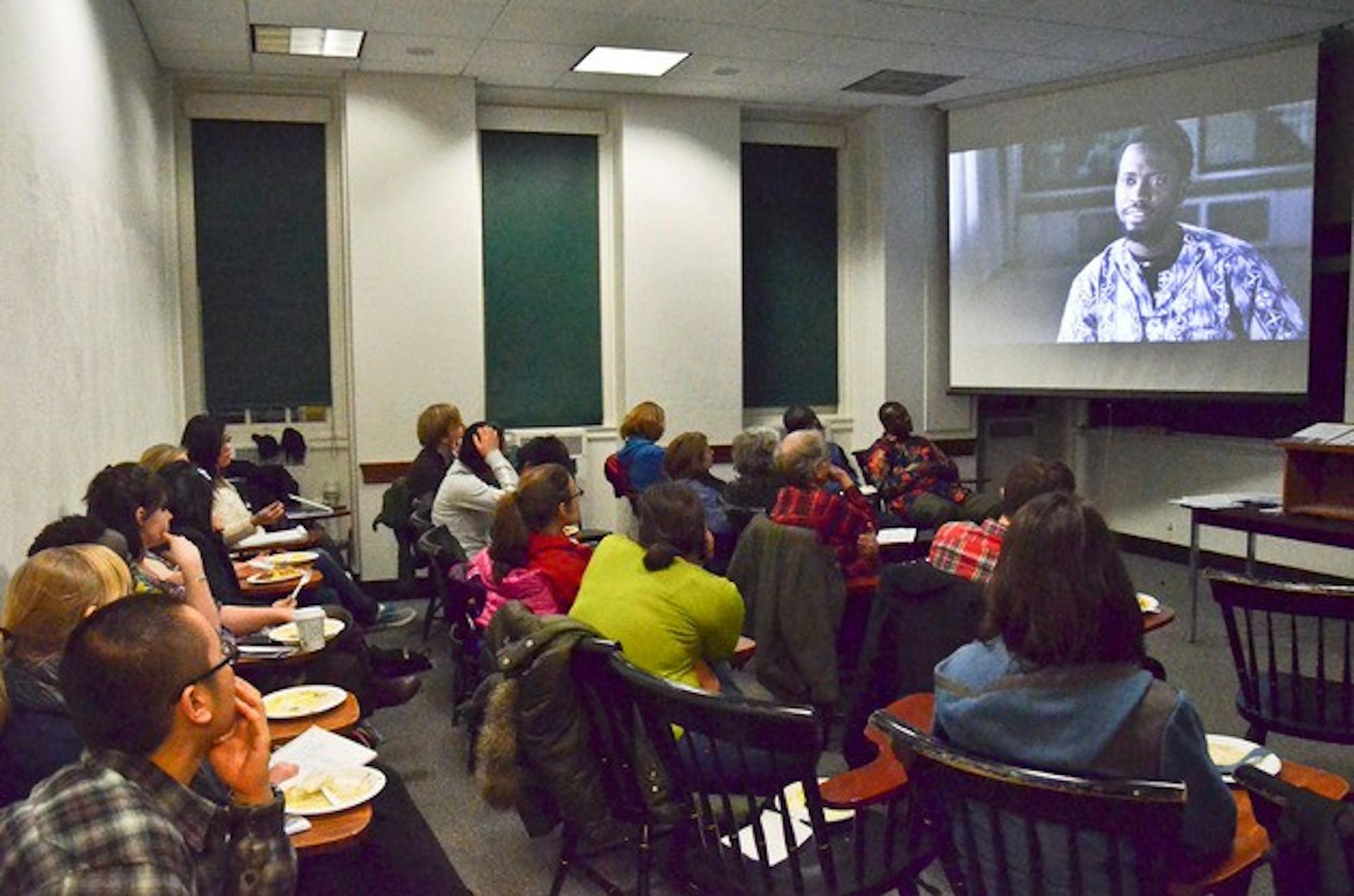
The initiative, which aims to raise awareness about conflict and violence in the Congo and to assist in the rebuilding of the region through education, was started by Congolese refugees in 2011. Members of the group have given lectures and screened short films at several universities and colleges in Vermont and New Hampshire.
Cleophace Mukeba, a Congolese refugee who currently lives in Burlington, Vt. said the culture of "breaking news" is hypocritical, as the media places great importance on events that are actually frivolous while overlooking the crisis in the Congo. As a result, civilians in the Western world often overlook the issue.
"I was taught that the United States was a great place," Mukeba said. "Everyone can practice their own culture. But every 15 minutes, there is another breaking news. Now, we have a culture here of not realizing what is important in the world that doesn't include breaking news."
Mukeba showed a 26-minute video released in June 2011 in which academics, CEOs, civilian witnesses and reporters speak on specific topics related to the Congo, including its war-torn history and declining standards of human rights.
The video reported that over six million people have died in the Congo since 1996, mostly as a result of assaults from Rwandan and Ugandan rebels. These assaults have occurred in the past with impunity due to inaction on the part of the United Nations, the United States and other Western nations. Rape has become one of the most commonly used forms of violence in the region, according to the video.
Mukeba presented statistics reported by the non-profit organization Human Rights Watch, which stated that 48 women in the Congo are raped every hour. The proliferation of HIV/AIDS adds to the trauma and damage done to individual women, he said.
Mukeba said he acknowledges that the conflict in the eastern Congo is vast and difficult to resolve.
"Advocacy takes time," he said. "We hear of [Mohandas] Gandhi, Martin Luther King, [Jr.], but in order to come to a better result, we always need time. We cannot stop the war in the Congo, but we can try to help."
The Vermont Ibutwa Initiative is currently trying to raise money to build a school in the Mwagna District of the South Kivu province of the Congo for orphans and children born out of the rape pandemic, according to Mukeba.
Members of the initiative have also asked college students to ask that educational institutions allow only the use of conflict-free minerals in electronics.
The organization's name is drawn from the word for "renaissance" in Lega, the language of the Mwanga District of the Congo. The initiative hopes to assist in the rebirth and renaissance of the eastern population in Congolese conflict zones, according to the group's website.
In fall 2011, representatives from the Vermont Ibutwa Initiative contacted Dartmouth's Social Justice Alliance to propose a partnership for the winter, according to Social Justice Alliance co-chair Liz Ballantyne '12. The Dartmouth group addresses a different issue every term before voting on a topic to discuss for the following months.
"This term is different because it's the first time we're looking at a geographic area instead of a general issue," co-chair Ian Schneider '14 said. "We now get a better overview of why things are the way they are."
Ballantyne said that the SJA receives its funding from the Tucker Foundation and was first called Dartmouth Ends Hunger.
"There weren't as many social awareness groups when SJA first started about general social justice issues," Ballantyne said. "In the past, we've looked at clean water, HIV/AIDS and general violence, and more recently also food security."
The group reads articles and watches documentaries about the issue chosen for the term and discuses the information. Schneider also said that the greatest attraction of the group for him was that it is not tied to a greater national, international or local organization, affording greater flexibility for critical analysis of issues.
Schneider said that like the Vermont Ibutwa Initiative, Social Justice Alliance balances education and fundraising. It currently has approximately 30 to 40 members and sponsors the Grassroots Soccer Tournament and Rice and Beans Dinner each year.
"Our group is member-driven," Ballantyne said. "I think people are very drawn to SJA for our intimate discussions. SJA provides a forum for people who want to talk about particular issues to really build a greater understanding of those issues."
Grassroots Soccer was founded by Dartmouth alumnus Tommy Clark '92 DMS '01, and Dartmouth was the first school to host the tournament. It has since become an international education group that aims to teach young people about HIV/AIDS through innovative and athletic means. SJA has helped organize the event each year held in Leverone Field House.
The presentation by Vermont Ibutwa Initiative "The Crisis in the Congo: Uncovering the Truth" took place in Dartmouth Hall and was co-sponsored by Dartmouth Coalition for Global Health, Amnesty International, Women of Color Collective and Dartmouth for UNICEF.


