
Farnham faced hazing himself while an undergraduate at UVM as a Sigma Phi Epsilon member and football player. He was UVM's athletic director in 2000 when the university canceled the men's hockey team's season in response to hazing allegations made by a freshman trying out for the team.
"It was degrading to me as the head of the program to have to put up with that," Farnham said.
Farnham emphasized the scope and depth of hazing, naming athletic teams, music groups and student clubs as examples of potential hazing settings. Fraternities and athletics teams, especially on college campuses, receive the most attention for illegal initiation activities that occur throughout society and amount to "a cultural phenomenon," he said.
Theta Delta Chi President William Mueller '12 and Theta Delt social chair James Smith '12 emphasized the wide range of organizations that engage in hazing.
"The goal is to have a campus-wide event, not just to focus on Greek life," Smith said.
Theta Delt, along with Alpha Delta fraternity, recently finished probation imposed by the College following hazing violations in the fall.
Exclusive groups everywhere take advantage of hierarchy systems to humiliate initiates, Farnham said. In sports, the need for participants to prove their athletic abilities to coaches is twisted into a need to prove themselves socially to teammates, he said.
"Students feel that the more underground, the more subjective, the humiliations are, the stronger the bond," Farnham said. "And they'll drive it underground, and they'll deny it."
People participate in humiliating and dangerous activities because they fear social rejection as a consequence of refusing to participate, Farnham said.
"You have to have the courage, the heart to walk away," he said.
Yet even the least aggressive or violent forms of hazing are dangerous, according to Farnham. Subtle degradation such as nicknames start a process that can end in harassment and violence, he said.
"I call it the tributary effect," Farnham said. "Every little thing that you say is OK adds up."
Farnham conceded the difficulty in knowing where to draw the line. He said he remembered his fraternity initiation, involving a blindfolded trust-fall, as meaningful and brotherly, yet an audience member pointed out that blindfolding is an act of hazing at Dartmouth.
"I didn't consider it part of hazing at the time, but maybe it was part of the tributary effect," he said. "I really don't know."
Claims that hazing is team-building, fun, harmless, traditional and optional are false, Farnham said.
"It causes mental anguish and psychological problems," he said. "That's real."
Farnham instituted a hazing prevention program at UVM in response to the 2000 hazing crisis. The university required all sports teams to attend programs similar to the Dartmouth forum, hold hazing discussions, sign a non-hazing agreement and participate in community outreach.
Farnham said he has worked with the NCAA to continue his anti-hazing work.
Mueller said the forum was a successful event and was particularly pleased with the number of people that showed up.
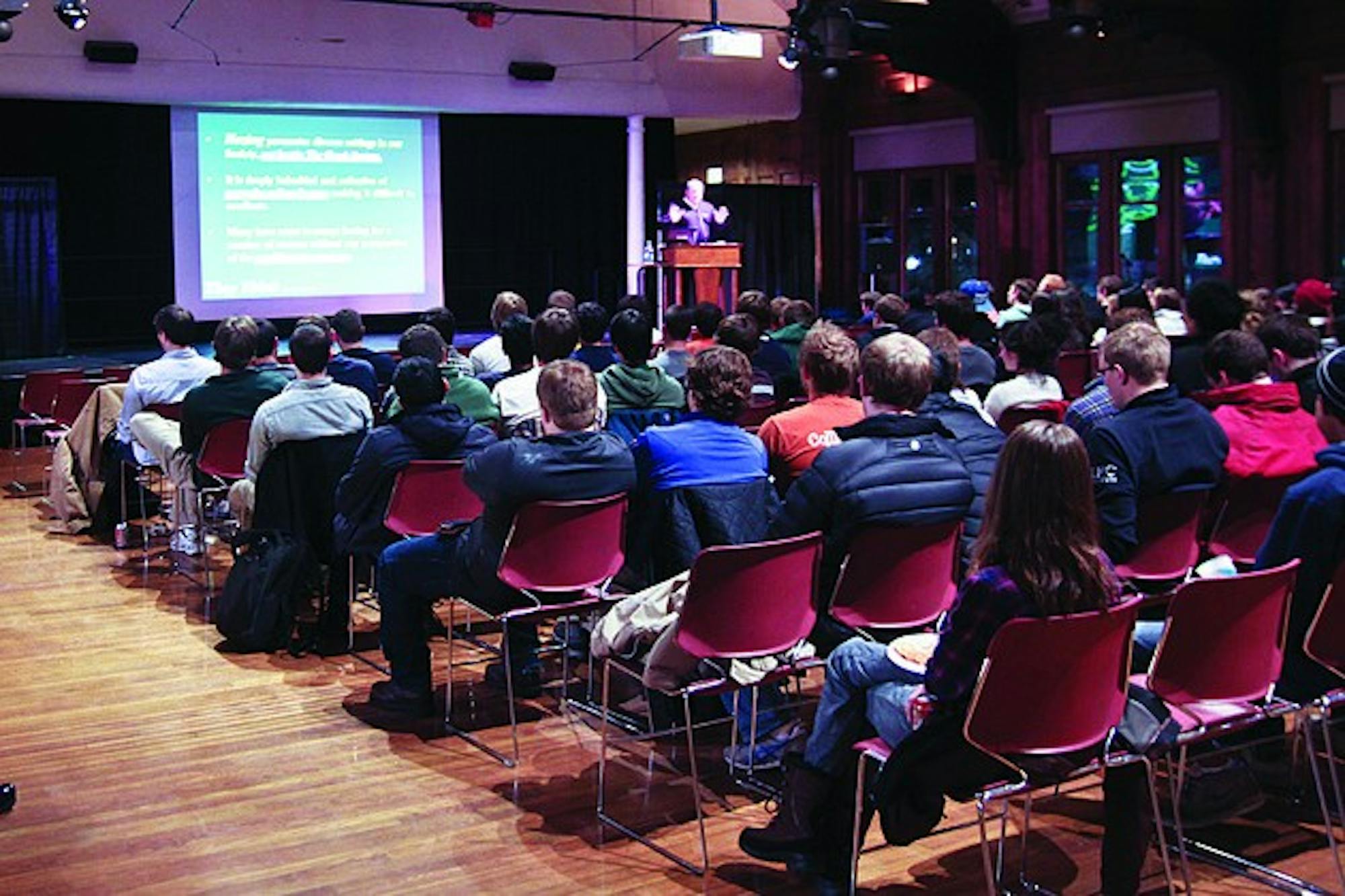
Theta Delt invited Farnham to discuss hazing's causes, effects, manifestations and its acceptance in society in collaboration with the Greek Letter Organizations and Societies office, the Dartmouth Athletic Department, the Panhellenic Council and all other campus fraternities and sororities. The forum took place in Collis Common Ground.


