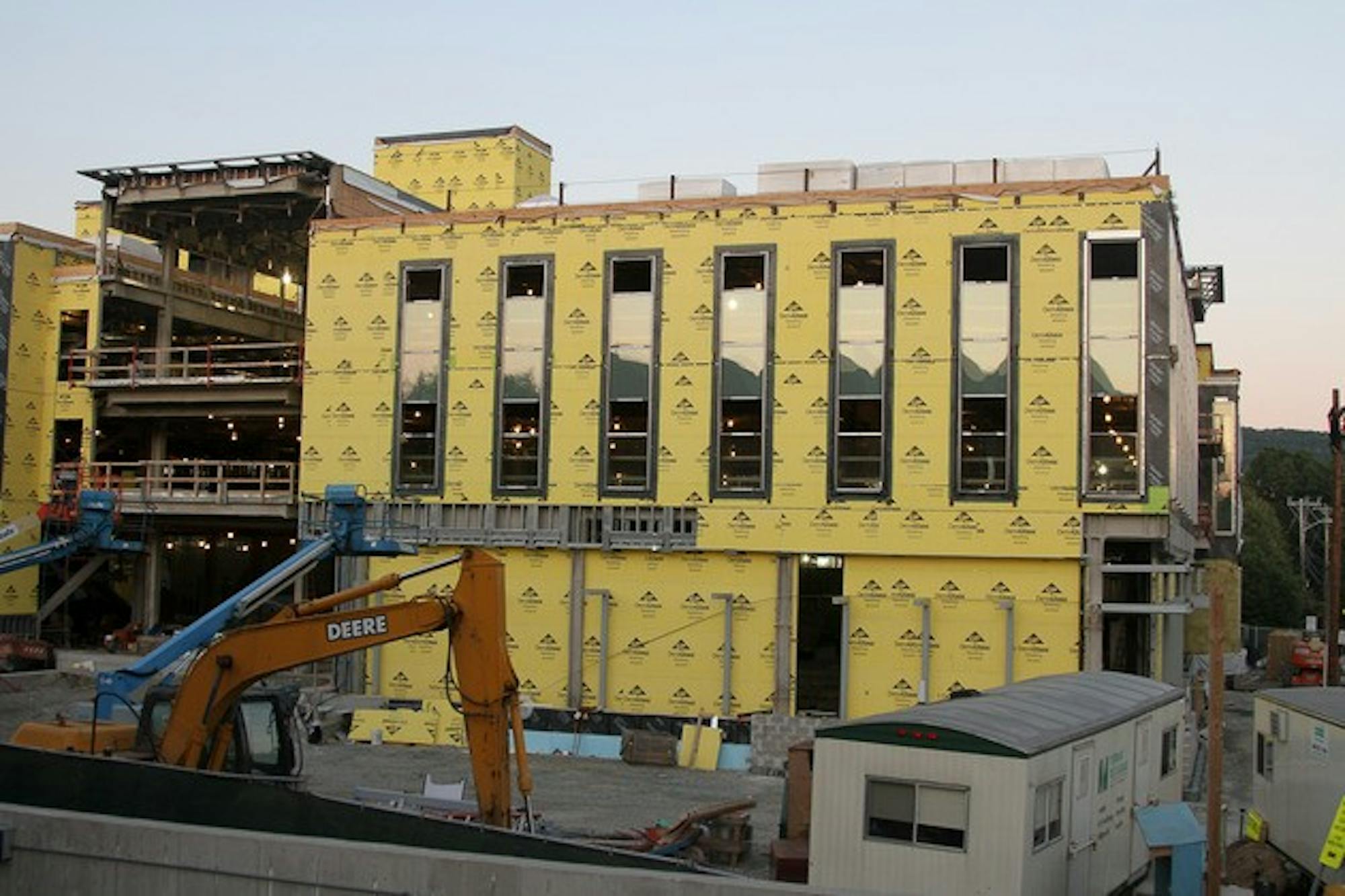
Although Hurricane Irene caused major damage to areas of the Northeast in late August, workers at both building sites made preemptive efforts to ensure that construction would not be threatened.
Prior to the storm, workers at the LSC implemented additional erosion control on bare trenches and open ground to protect these areas from wind and rain, Senior Project Manager Joseph Broemel said.
"Since most of the site is being prepared for receiving topsoil, the ground was already cut down below the sidewalk level," Broemel said. "The sidewalks and curbing then acted as a dam to keep the soil from running off of the site. Storm drain catch basins still have the silt sacks in them to keep the dirt from washing into the storm drains."
Workers at the VAC secured loose roof material, installed extra pumps and dehumidifiers and placed a temporary roof over the area where skylights will be installed, according to Matt Purcell, director of project management, campus planning and facilities. A small amount of water leaked into the basement but was pumped out and did not cause any problems or delay construction, he said.
The LSC is "very close to completion," with only landscaping and sidewalk construction remaining, Broemel said.
The College met the Sept. 1 goal date for full occupancy of the building, as all professors and staff members scheduled to move into the building relocated by the last week of August, according to Broemel. The new building located near Dartmouth Medical School's Vail building on the northern end of campus will be officially dedicated on Nov. 5, he said.
Faculty members seem "very happy" with the new facilities so far, according to biology professor Rob McClung, who moved into his office in the LSC at the end of Spring term.
"It's a modern state-of-the-art facility Gilman was OK, but a lot has changed in what one needs to be a biology building since it was put up in the '60s," he said.
The biology department, which has grown considerably over the past several years, will occupy the majority of the building, according to McClung.
In past years, the department was decentralized and biology professors' offices were scattered among different locations, including Gilman Hall, Remsen Hall at Dartmouth Medical School and the Centerra Bio Laboratory in Lebanon.
Starting this fall, virtually all labs and the majority of lecture classes and seminars will be held in the LSC, McClung said. Some members of the chemistry and anthropology departments will also have offices in the new building, he said.
The new facility features "interactive" classrooms modeled after those currently in use at Stanford University and the Medical Institute of Technology in Tennessee, Broemel said. New whiteboards, cameras and flat screen televisions will significantly improve the exchange of information inside and outside the classroom, he said.
The new classrooms are also designed so that students in large classes can easily break into small groups to collaborate with each other, McClung said.
Along with a 200-person auditorium, the building will feature digital interactive signs to help people navigate the new facilities, an expanded rooftop greenhouse and a public gallery space. Within the gallery, students will be able to plug their computers into flat-screen televisions in order to share their projects with their peers, Broemel said.
Some minor "site work" still needs to be completed, Broemel said. The Town of Hanover mandated a narrowing of the intersection in front of the building in order to shorten the pedestrian walkway. The construction team will push the curb lines further into the street to accommodate this request, according to Broemel.
The total construction cost of the LSC is approximately $92 million, while the cost for the entire project started at $135 million and was cut to $127.5 million, Broemel said.
"The difference between the $92 million construction cost of the LSC and the $127.5 million total cost covers a number of costs that are both hard costs and soft costs," he said.
Hard costs include running new steam and electrical lines to the area and the demolition of the three buildings that were previously on the construction site. Soft costs include "architectural and engineering design fees, project management, furniture, audio visual equipment, moving expenses and several other miscellaneous costs," Broemel said.
"We're actually well under budget during the cutbacks a couple of years ago they had us cut $7.5 million out of the project an we're trying to cut another $2 million out," he said. "It will be another few months before all the paperwork comes in and we know exactly where we stand."
The Class of 1978 raised a portion of the finances for the building's construction, Broemel said.
The LSC is intended to be the most energy efficient building of its kind in the country. Broemel said he hopes the building will achieve Leadership in Energy and Environmental Design platinum certification, but it is currently "right on the border line." College officials will likely find out by November whether the facility earned the recognition, he said.
Construction on the Visual Arts Center is approximately 50 percent completed, Purcell said. The project is expected to meet its completion deadline of June 1, 2012, and will likely be a fully functioning building for the 2012 Summer term, according to Purcell.
The VAC will house the studio art department and film and media studies department. Both departments were previously located in Clement Hall, which was torn down as part of the recent construction.
The building will feature a three-story atrium that will facilitate interaction between students and faculty, and will provide space for digital arts labs and a screening room, Purcell said.
The exterior envelop will not be complete until January, while the construction on the interior walls are now being started, he said.
The initial construction of the building, which began in Spring 2010, was delayed by two months after it was discovered that the ground beneath the site contained more granite than initially expected, complicating the foundation-laying process.
The VAC's design was originally subject to controversy as members of the College's Liaison Committee which acts as a link between Dartmouth and the local community raised concerns that the new building was too urban and did not fit with the New England architectural style. College officials, however, pointed to the campus' eclectic architectural styles, and the Hanover Planning Board sided with the College and allowed construction to commence.
The VAC, which was funded by a $50-million gift to the College from an anonymous family, has remained on budget, Purcell said.