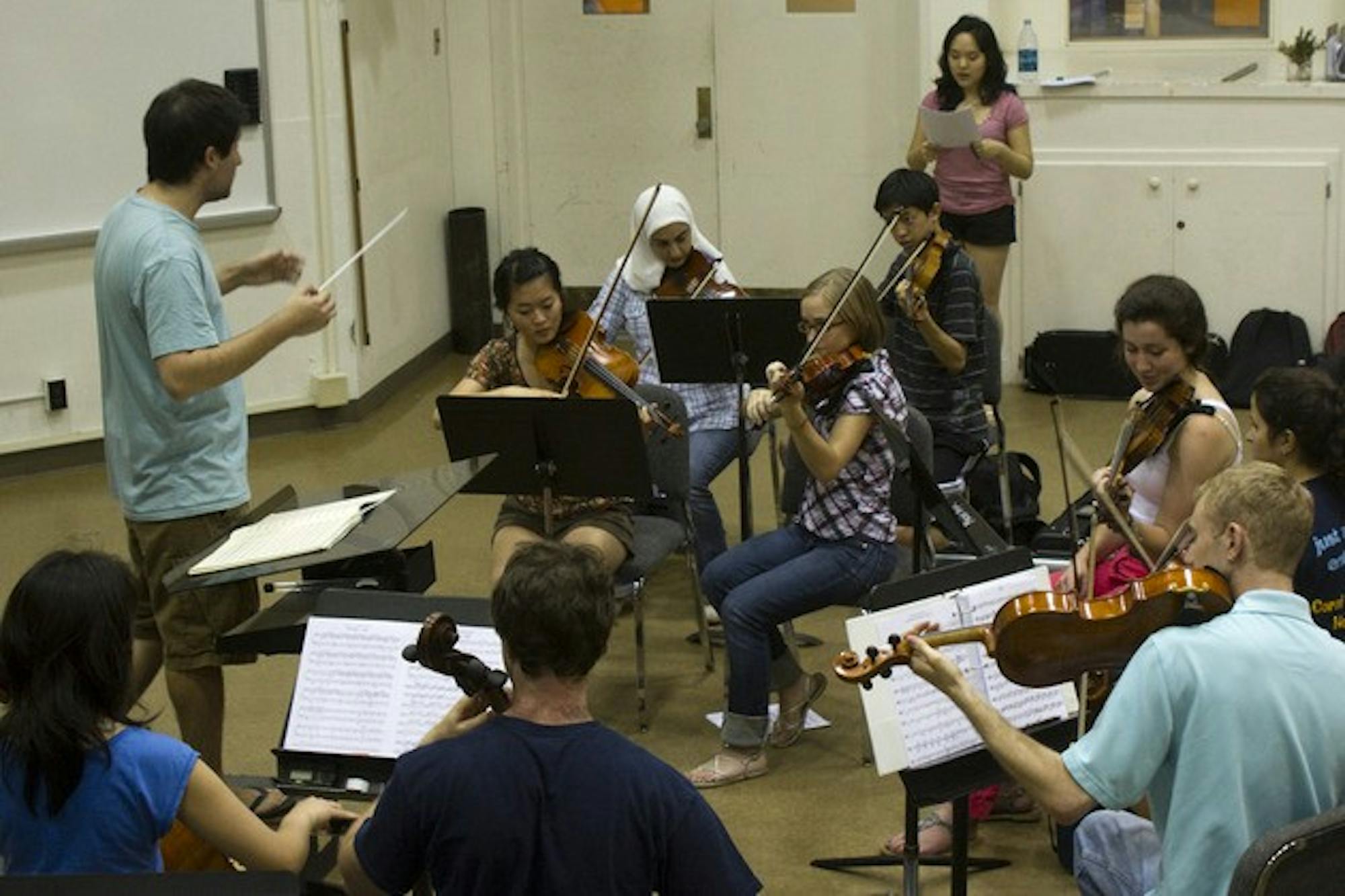
The Summer Orchestra is a group of musicians in the class of 2013, many of whom play in other Hopkins Center ensembles such as the Dartmouth Symphony Orchestra or the Dartmouth Wind Symphony during the regular school year. After practicing throughout the summer, the orchestra will give a large performance at the end of the term.
Paul Finkelstein '13, who wanted to create a musical outlet during the summer where none had previously existed, put the group together.
"I thought, Why don't we take everyone who's in ensembles during the year and that don't really have much to do during the summer and see what happens?'" Finkelstein explained. "Do something student-run and have fun as a class."
Finkelstein began the process of putting the Summer Orchestra together in early May, and was surprised by students' interest.
"The sheer number of responses I got was just mind-blowing," Finkelstein said. "Within a week I had 35 people who wanted to do it."
Indeed, the variety of the members is astonishing. Most play in another ensemble throughout the year, but there are a few musicians who have not played since high school. A large number of non-music majors are also looking forward to the Summer Orchestra.
"I'm excited because the more relaxed pace of the Summer Orchestra allows for all non-music majors to really give attention to the music," commented Colin Harris '13, a government major.
The attitude of the Summer Orchestra will be more relaxed than the larger Hopkins Center ensembles that perform during the regular school year.
"I want it to be much more self-directed because of sophomore Summer," Finkelstein said. "I don't want people to be kept in rehearsals three nights a week ... We all can put in whatever work we think we need to put into it."
That is not to say that the musicians will not take the music seriously.
"It's definitely more relaxed, but at the same time you have a sense of responsibility," commented violinist Sabrina Jimenez-Pantoja '13. "You don't want to let your fellow musicians down and you still want to play well for the concert."
The Summer Orchestra will play four pieces at its final concert: works by Rossini, Faure, Beethoven and Haydn. Fascinated by the history of musical pieces and why they were written, Finkelstein picked works with riveting histories and contexts.
The Beethoven piece, "Coriolan Overture," is based on a novel that was written just three years before Beethoven composed it in 1807. It tells the tragic story of a Roman solider who fought with the Roman Army before defecting and then raising his own army against Rome. When he attempted to attack the city of Rome, the army sent his mother and wife to the gates of Rome to beg him not to attack.
"[The story] is completely evident in the music. It starts off with very loud, bombastic stuff that's the army marching at the gates," Finkelstein explained. "And then there's a nice, soft, quiet melody that's the mother and wife pleading. The piece gives the feeling that music transcends words."
The solider decides not to attack, but instead descends into madness as he sees himself as a traitor on both sides, and eventually commits suicide. While the Beethoven piece is fascinating, it is the work by Haydn that seems to be a favorite amongst Orchestra members.
"It should be a lot of fun," violinist Chris Johnson '13 said about the Haydn piece. "It's definitely different."
The group will play the challenging last movement from Haydn's "Farewell Symphony."
"In order to play [Haydn's] music, you need to have a lot of talent," Finkelstein said. "I thought that this sort of group was the perfect opportunity to do that sort of music."
"Farewell Symphony" was composed in 1772, back when smaller groups of musicians played for a court, therefore rendering the piece outside of the realm of larger professional orchestras.
The performance of the piece has a captivating history. Haydn and his musicians had been playing at the summer home of an Austrian prince, but had been kept far too long. Because they were servants, however, they couldn't actually complain to the prince.
"So instead Haydn composed this piece in a way that he hoped the prince would get the message that they wanted to go home," Finkelstein explained.
What results is that, at the end of the piece, the instruments begin to drop out one by one. When their particular part was over, the musicians got up and left the stage.
The not-so-subtle hint worked. The Austrian prince got their message and allowed them to go home to their families. As it is the last piece to be performed, the Orchestra is going to emulate the number's original performance.
"We're going to do that too, but we're going to try to make it a little funny," said Finkelstein.
As a student conductor, Finkelstein said that his experience so far has been a little odd.
"It's awkward as a student trying to lead this process because, personally, I don't feel like I'm any more of an authority on this music than any other '13," Finkelstein said. "We've all had similar or the same amount of music experience."
Finkelstein is looking into a senior fellowship program for conducting, and is planning to continue with conducting after graduation. Originally a tuba player, he found that practicing and performing as an instrumentalist was not satisfying. Instead, he is fascinated by the art of performing, directing and coordinating.
"I also like history and the theory behind [music]," Finkelstein said. "I think that all of that art is brought together in the role of a conductor."
The Dartmouth Summer Orchestra currently has a tentative concert scheduled for August 15. Until then, the Orchestra will be practicing every week.
"I'm just amazed with our class more than anything," Finkelstein said. "I think it's a really awesome thing to be doing during our sophomore Summer."