Knowles described the art form as "the displacement of the everyday event into somewhere new," in an interview with The Dartmouth. In Knowles' Fluxus art, she aims to shock and puzzle and attempts to include the audience by getting them to perform and interact.
The "Appetizers" portion of the show featured performances of original event scores by Theater 65 students. As part of the class, the students participated in a collaborative workshop in which they were shown archival footage and clips of Fluxus work, and interacted one-on-one with Knowles to receive feedback on their work.
"The whole idea of Fluxus is to create the idea of art, without creating the art itself," Maan Tinna '13, a Theater 65 student, said. "By creating the event scores, we created the art."
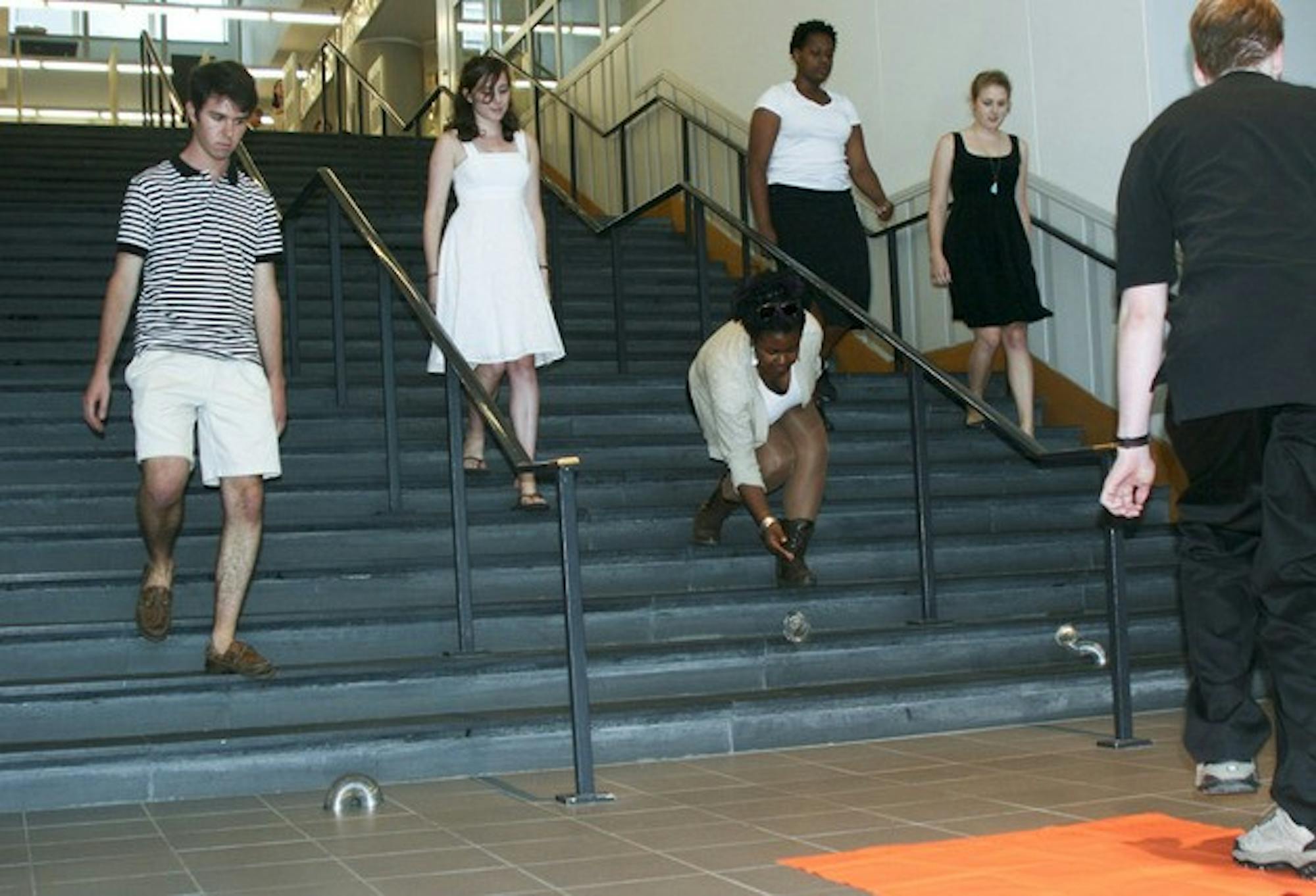
Tinna's performance piece, "Compositional Writing," involved students writing on a piece of paper on the floor. Each student wrote one word at a time until the group of students created an entire composition. When the composition was complete, the students then ripped the paper into many small pieces and arranged them on the Berry Library stairs. This led into a piece by Luke Murphy '13, titled "Paper Trail."
"The thing that is really so surprising to me is the work (the students) have come up with," Knowles said. "It's as if they have studied the genre."
Fluxus art became a phenomenon in the 1960s and '70s. Although it is frequently characterized as a movement that resists classification altogether, many believe the function of Fluxus art is to help people practice life and learn what it means to be themselves.
As the main event at yesterday's show in Novack, Knowles led the group in a performance of her 1962 event score titled "Make a Salad." The piece was first performed at the Institute of Contemporary Arts in London. When it was performed at the Tate Modern in London in 2008, Knowles assembled the salad by dropping the ingredients from a tall bridge into a large tarp below. It was then served to the 3,000 audience members.
Knowles first came up with the idea for "Make a Salad" while she was eating at a cafe in London with Dick Higgins, another famous Fluxus artist, while she was brainstorming ideas for a piece to create for a commission.
According to Knowles, Higgins asked her what she was going to create.
"I looked down and said, Well, I'll make a salad'," Knowles said. Knowles emphasized the importance of introducing the piece before performing it because she believes audiences react differently when they know that the making of the salad is an artistic event.
"It's a performance we're doing," Knowles said. "It's my view that if people take these simple events and they know they're viewing a performance, suddenly, an audience is there and everyone is seeing it and understanding something about their lives."
After Knowles introduced the piece, the students began creating the salad. Some peeled cucumbers, while others chopped carrots and scallions. Microphones were placed on the 12-person assembly line, allowing for the sounds of chopping and murmuring to be picked up.
After 20 minutes, Knowles completed the salad accompanied by the sounds of a Mozart concerto. She mixed cucumbers, carrots, eggplants, tomatoes, bell peppers, scallions, lettuce, herbs and dressing into a large metal bowl.
The salad was then served to the audience.
"This is possibly the best-looking salad I have ever seen in my life," audience member Medha Raj '13 said.
Knowles said that audience reaction to "Make a Salad" varies with each performance.
"It's always different, and that's the nature of Make A Salad,'" Knowles said. "Some of these are ideas are so radically different from what people think art is."
This Fluxus performance was done in conjunction with an exhibit at the Hood Museum of Art titled "Fluxus and the Essential Questions of Life." The traveling exhibition displays Fluxus works from the George Maciunas Memorial Collection at Dartmouth, as well as several works from the Museum of Modern Art, Harvard University and the Walker Art Center.
Juliette Bianco, acting associate director of the Hood Museum, explained that while Fluxus art is supposed to be interactive and experienced by the viewer, art museums are forced to put objects behind glass cases, separating the viewer from the art.
"One of our goals when we did this exhibition was that it would not be static and that it would not be experienced just as a viewer," Bianco said in an interview with The Dartmouth. "By inviting Alison here in residence for the week and working with students and helping them perform such a well-known Fluxus piece, but then to write their own and perform them that's the experience we wanted them to have."
Those who missed yesterday's performance can still experience Fluxus art by visiting the exhibition at the Hood Museum through August 7 or exhibit of books on display in the main hall of Berry Library.