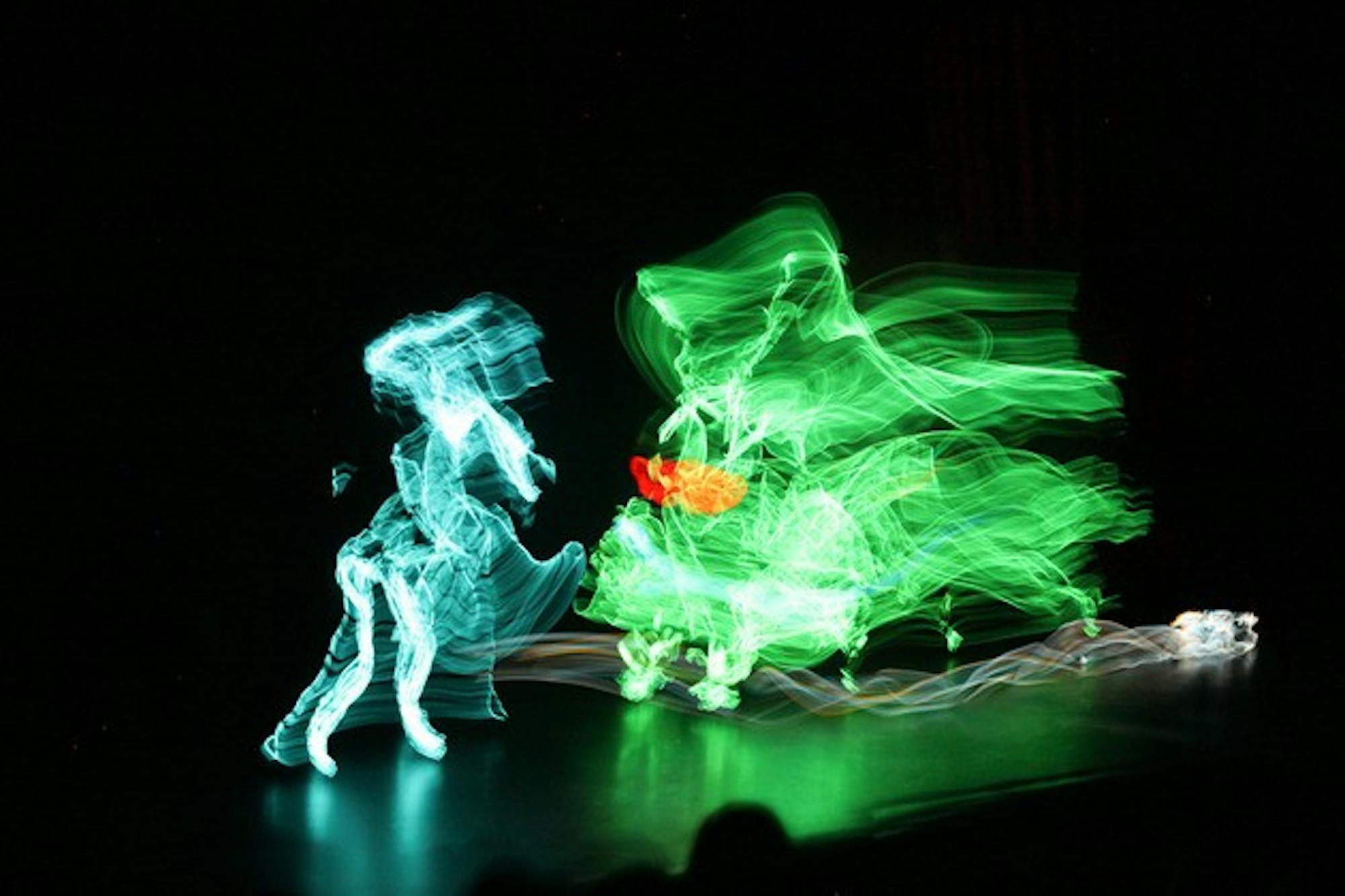
This playful show was directed by co-creators Ian Carney and Corbin Popp, founders of the New Orleans-based CORBIAN Visual Arts and Dance Company. The show features performers dressed in all black who operate puppets and props illuminated by electroluminescent wire.
"Darwin the Dinosaur" tells the story of Professor Henslow, a magical scientist who creates Darwin, a dinosaur in need of a heart to quell his carnivorous, beastly, prehistoric cravings. Upon receiving a heart from the professor, Darwin romps around and falls in love with Peche, a beautiful fish he cannot yet be with due to obvious differences in breathing mechanics.
The idea behind "Darwin the Dinosaur" stemmed largely from the wire itself.
"We decided to start making puppets out of it, and something that inspired us a lot was the idea of a backwards knee, the leg of dinosaur," said Carney.
This "knee" fascination can be seen throughout the show the main characters include Darwin, a green dinosaur, Verla, a playful ostrich, Brutus, the frightening "other" dinosaur, and two large stork-like birds that stretch from stage to ceiling.
One scene that highlights the elevated level of artistry in the performance comes from a dance between Verla and Darwin to the tune of "Baby Elephant Walk" by American composer Henry Mancini. The two twist and bend in tandem, engage in a dance-off and then high five, all highlighting the beautiful mechanics of the backwards knee.
The combination of a world music soundtrack and this storytelling style is, at times, delightfully confusing. After an initially frightening introduction of Brutus, the dinosaur bounces back on stage and defecates. The glowing products turn into large, playful flowers. Later, an upbeat sequence featuring magnificently multi-colored fish employs the only spoken dialogue in the show: "Welcome to the voodoo lounge."
This offbeat inclusion of dialogue seems unnecessary when the rest of the show vibrantly attacks your visual senses. The use of puppets and ekectroluminescent wire more than makes up for the lack of speech, a characteristic that Carney says makes the show so appealing to global audiences.
"Darwin the Dinosaur" has been compared to the story of "Pinocchio," and similarities do exist both tell the tale of an inanimate object suddenly springing to life, and a story of love that follows, which is often classified as a "Gepetto story." But this classification is about the only thing the two stories have in common.
"We were never trying to make a story that was like [Pinocchio]," Carney said.
The combination of the electroluminescent wire, the visual style of storytelling and movement of the dancers is far more beautiful than most renditions of "Pinocchio" could ever be, a feat that can be attributed to Carney and Popp's extensive experience with professional ballet.
"Darwin the Dinosaur" is a show for adults as it is for children, according to Carney.
"The more life experience you have, to me, the more weighty the story is," Carney said.
This is especially true in the most thrilling scene of the performance, in which Darwin defends Professor Henslow from a snarling, hungry Brutus. The fight sequence, incredible in itself as the illuminated creatures dance and jostle across the stage, is made more evocative when time is stopped so the two dinosaurs can procure lightsabers. The combination of dinosaurs and lightsabers is a recipe for instant child happiness, and the theme of protecting loved ones is one that adults will cherish.
The conclusion of the show is also a treat, as the lights come on and the previously hidden performers show their faces and smile at the audience, continuing to dance with the puppets they have each been operating. This reveal is far from a destruction of belief in fantasy, but rather inspires a belief that one can have both fantasy and reality at the same time.
"[Darwin the Dinosaur'] really does get audiences, particularly kids, excited about being in the theater, and that's a huge deal these days, because we're up against DVDs, video games, blogging and cell phones," Carney said. "The human experiences of audience, performer, a show being unique to that one day these are things we're moving away from."
Carney said he hopes the show can inspire today's children to keep returning to the theater. The impromptu roaring and the clashing of newly-purchased lightsabers at the back of the theater at the performance's close suggest that kids most certainly will.
"Darwin the Dinosaur" will return to the stage on Monday at 9:15 a.m. in a special matinee performance for public, private and homeschool groups in grades 2-8.