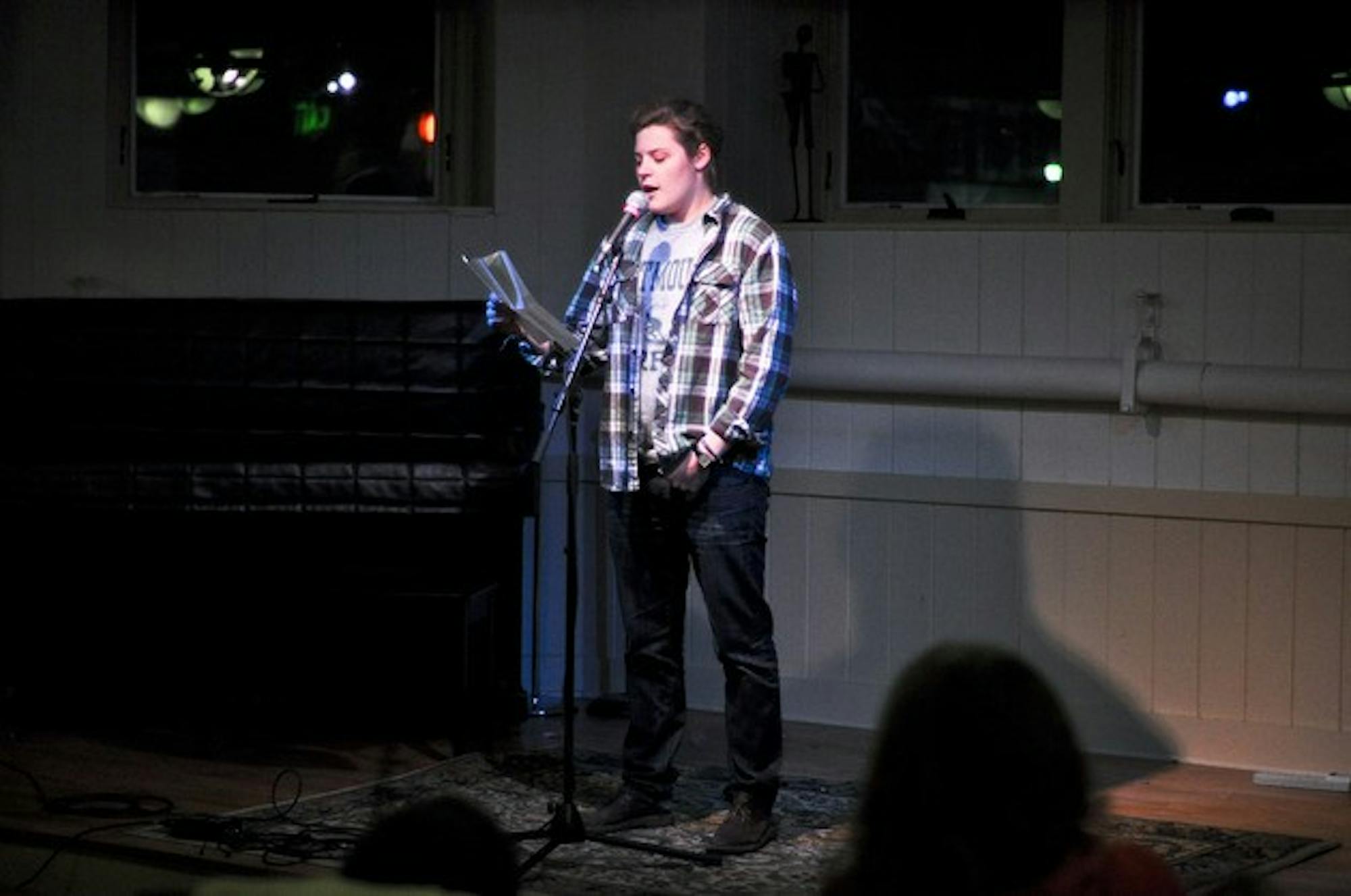
It was Glover's sophomore year when she ended her career as a dancer. As Glover searched for another creative outlet, her mother suggested slam poetry. Slam poetry is a combination of writing and performing, a middle ground between rapping and reciting. More so than other forms of writing, slam poetry is meant to be heard the poet delivers her or his poem, often speaking to a rhythm accompanied by hand gestures.
"At first I thought, I don't want to write poetry, this will be boring,'" Glover said. "I'd thought of poetry as romantic Emerson-type stuff. But I searched slam poetry online and ended up spending five hours on YouTube that night."
Glover joined the Soul Scribes, a student group dedicated to bringing slam poetry to Dartmouth. The group was formed in 2005 by a small collection of students who felt that there was a lack of verbal arts groups on campus aside from a cappella and comedy troupes.
Glover is not alone in her story many of the Soul Scribes had little or no previous experience with slam poetry, and made their way to the group via various channels once on campus.
"I saw the Soul Scribes as a prospie, during Dimensions," Alan Keegan '14 said.
Like Keegan, Bobby Esnard '14 was first exposed to the Scribes during Dimensions weekend.
"I thought the visceral reaction everyone had to it was so cool," Esnard said. "I knew I wanted to get involved."
Anna Winham '14 met Keegan at the English department open house and was swayed both by Keegan's endorsement and the welcoming atmosphere of open mics she attended, Winham said.
The open mics are open to all students and are held in One Wheelock every other week. The atmosphere is casual and relaxed students often finish poems mere minutes before performing them. The Scribes have also brought renowned slam poets to Dartmouth including world slam champions Buddy Wakefield, Derrick Brown, Anis Mojgani and Andrea Gibson to workshop with the group and perform for campus.
The Scribes occasionally travel to New York to perform at open mics with other colleges. They also compete in regional college slams such as the Wade-Lewis Slam.
Michael Gordon '12 never expected to become involved with a poetry group in college.
"I came here as a recruited athlete [for lacrosse] and if you'd asked me what slam poetry was, I wouldn't have been able to tell you two things about it," Gordon said. "It's been a nice surprising part of my Dartmouth experience."
Gordon and Anna-Kay Thomas '12 were in the same Writing 5 class their freshman year. Members of Soul Scribes performed for the class to supplement the course's section on slam poetry, Thomas said.
"I remember being intrigued by it and I started going to open mics," she said.
Thomas has been the president of the Scribes since Spring 2010.
"She has really stepped up and done a phenomenal amount with organizing the structure of the group," Gordon said.
Thomas noted that the '14s have also helped the Scribes flourish this year.
"We're really lucky the '14s joined us and are such a large group," Thomas said. "They really helped us to become a force on campus."
Thomas has urged collaboration between the Scribes and other performing arts groups on campus in her tenure. The Scribes will perform in a show pertaining to the hookup culture, from casual sex to sexual assault, alongside SHEBA, the Dartmouth Dance Ensemble and the Aires on May 8 at Alpha Delta fraternity.
"I think it's important to bring in other elements of art I always encourage everyone to push boundaries," Thomas said.
Unlike other performance groups, there are no auditions involved.
"Soul Scribes is very open," Glover said. "People drift in and out I think that's the beauty of it. If you're at that point in your college career when you're disenchanted, Soul Scribes is the place to put that out there. It's there for you when you need your three minutes onstage."
But even for experienced poets, the task of sharing their innermost thoughts onstage can be daunting.
"There is a certain self-consciousness that goes along with that," Gordon explained. "Is what I'm saying worth putting on a page, worth performing?"
For the Scribes, slam poetry renders the performer vulnerable but is empowering at the same time.
"You're putting your feelings out there, but few people can say something [if they aren't performing themselves]," Glover said.
Each member has a different approach to the creative process.
"There's no real process, there's no I'm going to pace back and forth three times and write this,'" Glover said. "But I get this feeling that I can't focus on anything until I get a poem out. I'll be in class writing it in my mind."
Other members take their cues for poetry from conversations they have with other people.
"I frequently get ideas from things people say that I disagree with," Winham said.
Esnard often draws inspiration from conversation, but like Glover, has no definite habits in writing poems.
"My process is very rarely like, Let's sit down and write a poem,'" he said. "I keep a list of wordplay that comes up in conversation that I find interesting."
Keegan prefers a more habitual approach to writing.
"Usually before I write, I smoke a cigar," he said.
The Scribes' topics are as varied as their writing methods.
"I write whatever I feel would be a disservice to myself to not say," Thomas said.
"Some of us are topic-oriented, some aren't," Leah Feiger '14 said. "My first poem was about the Beatles, my next poem [for the May 8 show] is about how guys and girls mutually abuse the idea of sex."
For Gordon, the message is the most important part of the performance.
"When you connect with someone so that they see a reflection of themselves I think that's really the point of our group," he said. "Hopefully people walk away with something to think about. I think that's why most of us write."
Jokingly-called the pseudo-mother of the Scribes by other members, Glover said she is particularly proud of how the Scribes have thrived recently.
"I'm happy Soul Scribes has grown so much," she said. "It's a testament to the students' passion, their perseverance in creating a space for themselves."