"My husband is a photographer and he was focusing on sawmills, but I was fascinated with the outbuildings near them because of the textures of the wood," Carvajal-Hufschmid said. "During that time, I came upon this book of pictographs with the hobo signs of America from the 1930s and they inspired the series."
To create the illusion of wooden panels, Carvajal-Hufschmid used many layers of paint.
"I usually work on three or four pieces at a time because the ink needs a day or two to dry," she said. "I work with the pieces of wood using both tools of printmaking but also using spatulas and brushes to create marks and little variations."
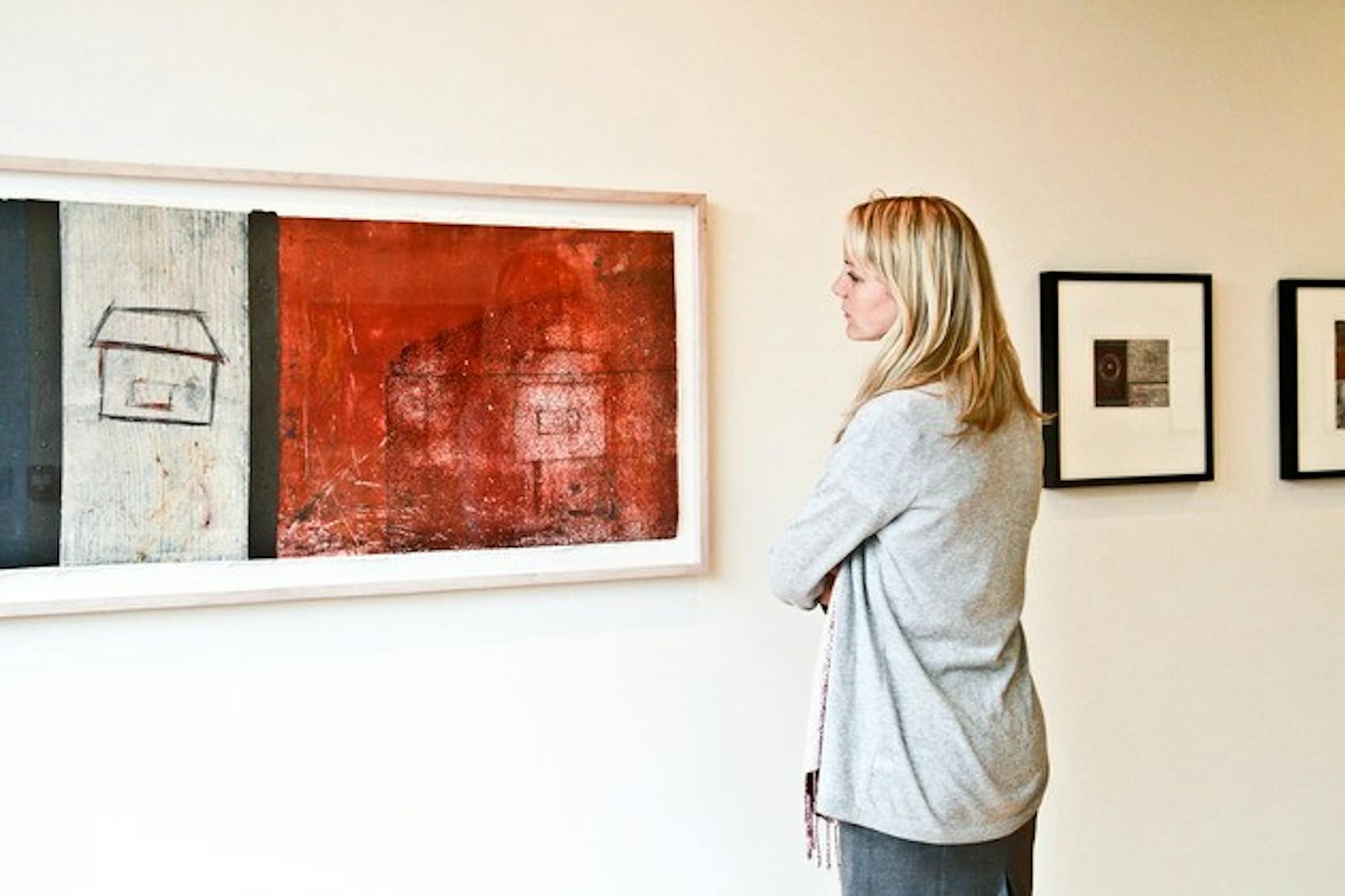
Prints such as "House is well guarded" used mixed media to portray the actual signs that were created by itinerants during the Great Depression. "House is well guarded" depicts a crude drawing of a house atop a wood-like panel, framed on both sides by color blocks of red, black and blue.
Although each print can stand alone, they still relate to each other, Carvajal-Hufschmid said, who added that she treats each print like "a painting."
"I don't want them to look the same because I want them all to have their own personal character," Carvajal-Hufschmid said.
One of the largest pieces of the series is a 22 inches by 60 inches print entitled "It's OK to be here." The piece depicts an "X" created by the illusion of two faded blue boards nailed on top of the side of a whitewashed barn. Seemingly simple from afar, this print incorporates texture and color variation, producing a weathered quality best appreciated when viewing the piece up close.
"[This print] consists of three layers because I wanted to obliterate the paper behind it," Carvajal-Hufschmid said. "I worked board by board and layer by layer because when you see my prints, I want you to imagine yourself building."
Carvajal-Hufschmid's prints may be inspired by the past, but she said the themes of American transience remain relevant to modern life. Carvajal-Hufschmid, who was born in Colombia but now resides in New England, said she seeks to highlight the value of leaving one's mark on a place in her prints and communicating with others who seek change.
Although the exhibit evokes themes from American history, Carvajal-Hufschmid said the series is "very current."
"Hobo Series" expresses Carvajal-Hufschmid's views on American society, past and present, but the artist said her main purpose for the series is to instill a sense of joy in the viewer.
"I just want the viewer to enjoy it and remember it," Carvajal-Hufschmid said. "If my prints put the viewer in a place that they remember, then I know that I've gotten inside the person, and not just touched upon the academic or intellectual part of it."
Carvajal-Hufschmid's exhibition will remain on display through April 26 at the Spheris Gallery. Located at 59 South Main St., the gallery is open Tuesday through Saturday from 11 a.m. to 5:30 p.m. Other pieces from Carvajal-Hufschmid's series are also currently on display at the AVA gallery in Lebanon, N.H.