From Dartmouth Idol competitors to a cappella group members, musical theater veterans to up-and-coming composers, Dartmouth draws scores of talented young musicians to its snowy hills. Blame it on the constraints of the D-Plan or the DJ-dominated basement scene, but for whatever reason, these students rarely join forces to form long-lasting campus bands.
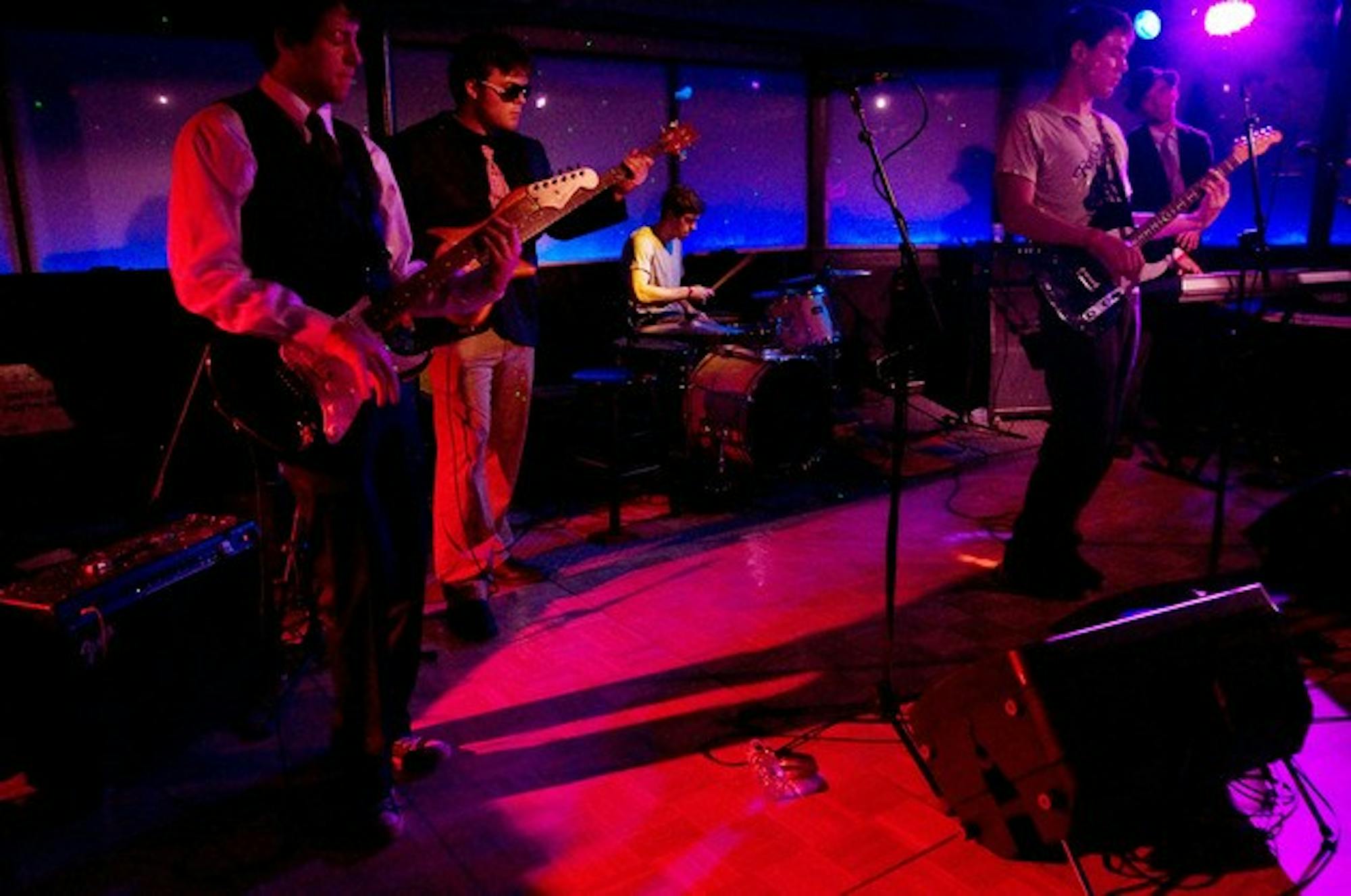
Although the College's band scene is far from lively, a few bands have made a name for themselves on campus in recent years. Drug Money whose members include Alex Palantoni '11, Charlie Grant '11, David Watson '11, David Kinney '11 and Frank Santo '11 has gained a particularly devoted campus following since its founding in the summer of 2009. The band was formed when Palantoni, looking for a quick way to make some cash, lied to one of the organizers of Epsilon Kappa Theta sorority's Thetaroo party and said he was in a band that could play at the event. Palantoni got the gig, but did not actually have a band. He spent the next two days scrambling to find musicians and create a set list.
Drug Money started out playing mostly covers of classic rock songs, but has begun to add more modern songs to its repertoire in order to appeal to a broader audience. The band recently performed Kanye West's "Runaway" at Bones Gate fraternity, Kappa Delta Epsilon sorority and Alpha Delta fraternity.
Most of the band's gigs are at fraternity parties and other Greek venues.
Santo admits that fraternity acoustics are terrible, but said the less-than-ideal setup gives band members room for error in their performance.
"[The acoustics] mask the fact that I can't really play guitar," Santo joked.
Because of Dartmouth's rural location, fraternities and sororities provide the main venues for campus bands to showcase their skills.
Student organizers of Friday Night Rock have tried to add diversity to Dartmouth's music scene, providing a non-Greek arena for student musicians. FNR offers concerts in FUEL on Friday nights, complete with professional lighting and sound equipment.
But FNR cannot revitalize the campus music scene on its own. Student organizers and potential band members agree that the organization deserves more recognition from students.
"There are always a good number of people [at FNR]," Jaymes Sanchez '13, who attended an FNR event last Friday, said. "But it isn't a huge thing on campus."
Sanchez added that the lack of campus bands limits FNR's ability to change Dartmouth's music culture.
"Aside from the bands they bring in, there really are not a lot of campus bands," Sanchez said.
Before FNR can make a significant impact, more students will have to take the initiative to form new groups.
"FNR is cool, but there are not a lot of bands," Santo said. "It's hard for the College to support bands that don't exist."
Max Goldberg '12, a guitarist not currently affiliated with a band, also laments the lack of campus bands.
"There don't seem to be many bands that [play] regularly," Goldberg said. "I think there's a lot of potential I can't imagine there aren't a lot of talented musicians here."
The dearth of campus bands has inspired some musicians to cross over into other genres. Matt Knight '11 has found a musical outlet as an FNR organizer and a campus DJ. Although Knight has achieved success in these areas he opened at the KE$HA concert last fall he said he misses playing in a band.
"I'm a guitar player first, then a songwriter, then a DJ," Knight explained.
Knight said the D-Plan makes it especially hard for bands to stay together at Dartmouth.
"I tried to start a band but it didn't work out," Knight said. "It was too tough to coordinate with other members because of the D-Plan."
Santo also cited the D-Plan as an obstacle for campus bands, explaining that Drug Money was not solidly established until Spring term of his junior year.
"We've all had the same D-Plan since then," says Santo. "If we'd been younger, it would have been harder."
Michael Gillis '12 the only member of the band City of Tomorrow currently on campus has witnessed the D-Plan's ability to tear bands apart firsthand.
"[City of Tomorrow is] a three-person band and two are off campus now," Gillis said. "That's obviously a debilitating factor."
Gillis is the former president of Perform, a short-lived organization meant to serve as a forum for Dartmouth musicians to collaborate.
The group was intended to bring campus musicians together, making it easier for students to form new bands, but it soon disbanded because of a lack of student interest.
"It didn't make sense to continue because the enthusiasm and support were so dismal," Gillis said.
Gillis' experiences trying to find support for new music groups suggests a general apathy from students and administrators alike about diversifying the music options on campus.
"Compared to my friends' experiences at other schools, it feels like creativity is less nurtured here, especially if it's not a structured environment like a cappella," Gillis said.
Kwame Ohene-Adu '14 a member of X.ado who also plays in the Shas, a band formed by three '14s last term also said he would appreciate a more diverse music scene.
"I feel like the school is more focused on a cappella," he said. "It would be so much more exciting if the music scene was more alive."
While most students are aware of the 11 a cappella groups on campus and flock to see them perform in Greek houses and the Hopkins Center alike few have heard about campus bands.
A cappella groups may take attention from campus bands, but Leah Scrivener '11 of The Buddies cited a simpler obstacle faced by her own band: a lack of practice space. Bum Sun Jun '14, lead singer of the Shas, echoed Scrivener's sentiments, explaining that the practice rooms in the Hopkins Center are primarily for music majors.
Whether the problem is rooted in something as simple as practice space or as complex as campus culture, Dartmouth is clearly lacking in campus bands and student musicians agree that they want to see more.
"If there were more bands in frats rather than just music playing over speakers, I think that would add a missing element," Goldberg explained.
For those interested in spearheading Dartmouth's alternative music scene, Gillis said he is looking for potential bandmates.
"If you want to play with me, e-mail me," Gillis said.