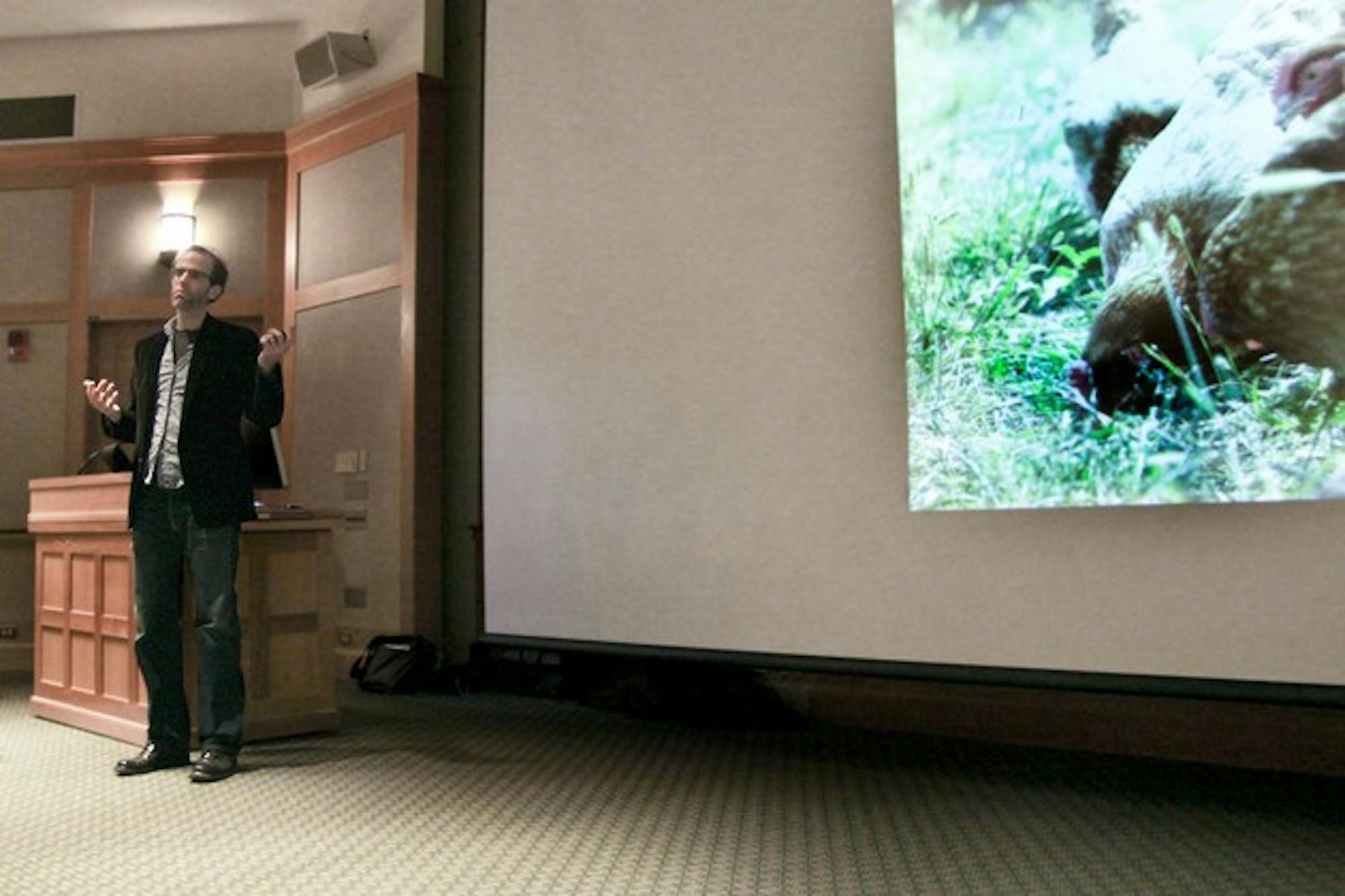
Although he is a chef, Barber who also co-owns the New York-based Blue Hill restaurants emphasized the importance of how food is produced rather than focusing on how it is cooked, citing the health and environmental benefits of food produced through sustainable agricultural systems, as well as improvements in the quality of the ultimate product.
Barber used the example of Stone Barns Center for Food and Agriculture which serves as the source for many of Blue Hill's ingredients as a farm that focuses on data collection, ecologically sustainable methods of production and new farming methods, he said.
Sheep are a prime example of the failings of mass agriculture, according to Barber. Larger businesses feed sheep on a predominately grain-based diet that depletes the health of the animal because they are "not engineered to eat grain," Barber said, resulting in a cut of meat that is inferior to that from a healthy sheep.
"You're eating an animal that's sick, and you're also eating an animal that doesn't have the kind of flavor you want to be eating," Barber said.
Stone Barn's sheep are entirely grass fed, with chickens acting as "sanitation ladies" who spread the sheep's manure across the pasture and fertilize the cycle, Barber said.
"The farmers next door think we're crazy they don't understand us moving sheep three times a day," Barber said.
The effects of such time-intensive policies are obvious when the state of the farm is assessed in the spring, Barber said. Stone Barns' grass is completely green, while that of other nearby farms is so degraded that the farmers choose to chemically treat it, according to Barber.
Barber also discussed Blue Hill's enthusiasm for testing new cooking methods. After experiments with new methods for feeding pigs left the farm with large amounts of lumber, Stone Barns began utilizing biochar pulverized charcoal as a fertilizer, which produced better-tasting, larger and more nutritious vegetables, Barber said. The extensive supply of charcoal also pushed Barber to embrace grilling outside, he said.
Blue Hill has since experimented with grilling with fuels including pig bones beyond the traditional wood charcoal, which Barber said enhances the flavor of the dishes.
"You get a sort of pig times two," he said.
Barber acknowledged that the style of agriculture practiced at Stone Barns cannot be directly replicated as a replacement for current agribusiness.
"It is elitist," he said. "We're on a Rockefeller farm, I charge $40 for an entree, I am an elite."
Stone Barns does encourage change through free education programs and a system of internships, Barber said.
Current food production systems will have to change as oil prices rise, water supplies decrease and weather patterns become less consistent, a combination which has already had devastating effects, sparking "great instability around the world," Barber said.
Barber cited Pilgrim's Pride, which was once the top chicken producer in the United States, as an example of how American companies struggled to adjust to rising oil prices. After two months of oil prices at approximately $148 per barrel and grain prices "skyrocketing," the company went bankrupt, Barber said.
It is our choice whether we enter the period of a changed food system "gracefully" or with difficulty, according to Barber. The impetus to change the modern food system must be made in the forms of both legislation and consumer choices, Barber said.
Barber drew parallels to contemporary protests in the Middle East, saying that while people want to participate in mass movements such as the one currently occurring in Egypt policy makers must play a key role in encouraging the growth of smaller, more sustainable farms.
Barber's lecture was the final installment of the College's three-part Winter 2011 Montgomery Endowment Lecture Series, "Tell Me What You Eat, I'll Tell You Who You Are."
Calvin Trillin, a journalist and author of several books, spoke at the College in a lecture titled "Eating with the Pilgrims" on Feb. 1. Ruth Reichl, a former restaurant owner, restaurant critic for The New York Times and editor-in-chief of Gourmet magazine, presented her speech, "Eating My Words," on Feb. 9.